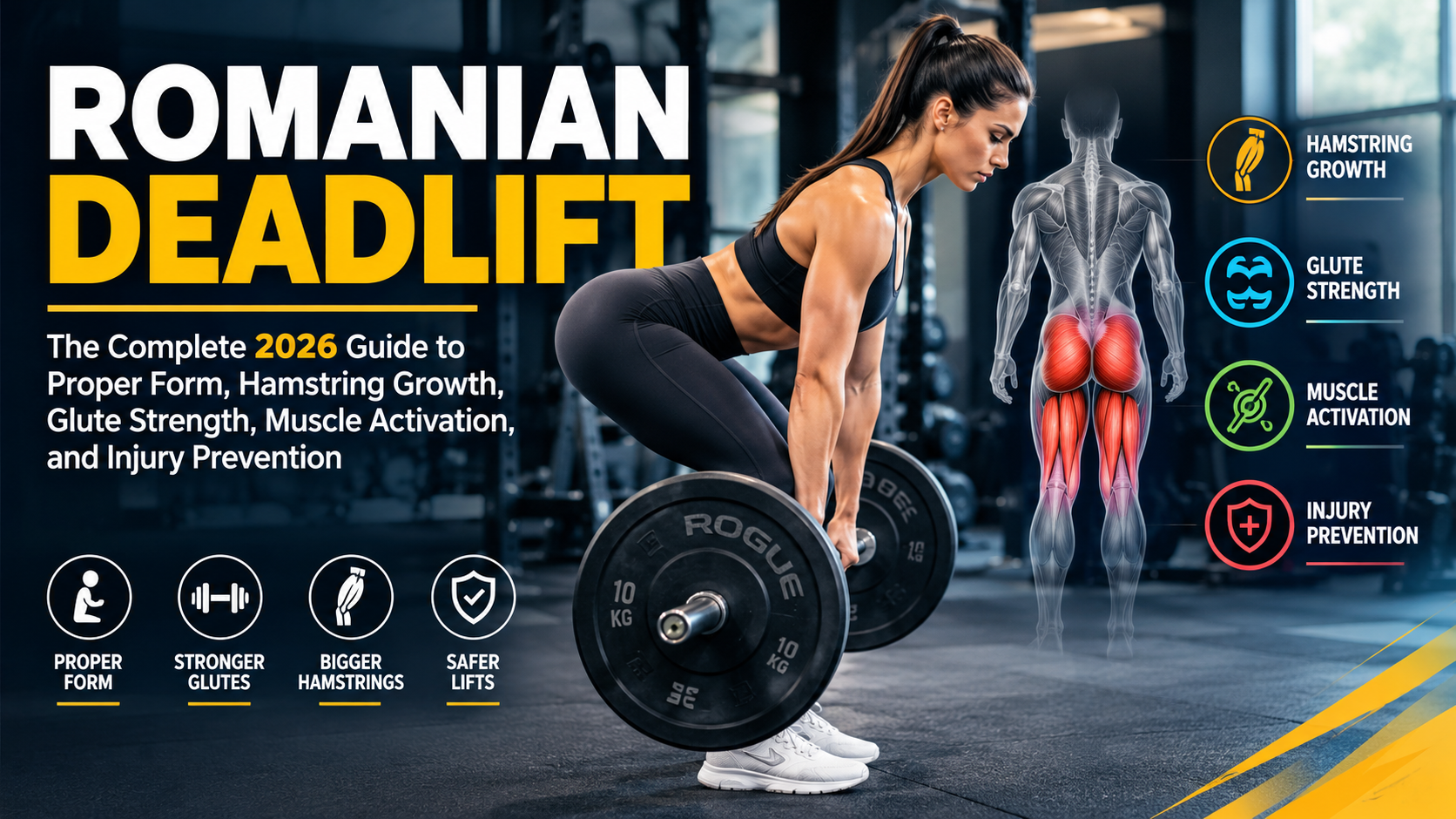
The Romanian deadlift is one of the most effective strength-training exercises for developing the posterior chain, particularly the hamstrings, glutes, and spinal erectors. Unlike conventional deadlifts, which typically begin with the weight on the floor, this movement emphasizes a controlled hip hinge that stretches the hamstrings while building strength throughout the back of the body.
Whether your goal is muscle growth, improved athletic performance, stronger glutes, or better movement mechanics, learning this exercise correctly can transform your lower-body training. It is useful for beginners learning to hinge at the hips and experienced lifters looking to improve strength, muscular development, and control.
However, results depend on more than lifting heavier weights. Proper technique, appropriate range of motion, gradual progression, and recovery all influence how effectively the exercise works. This guide explains the muscles involved, correct execution, common mistakes, variations, programming strategies, and practical ways to train safely.
What Is the Romanian Deadlift?
The Romanian deadlift, often abbreviated as RDL, is a hip-hinge exercise performed by lowering a barbell, dumbbells, or another resistance implement along the front of the legs and returning to a standing position. The hips move backward during the descent, creating tension in the hamstrings and glutes while the spine remains stable.
The defining feature is the movement pattern. Instead of repeatedly bending the knees and lowering the weight toward the floor, you maintain a relatively consistent knee bend and move primarily through the hips. The weight usually stops around mid-shin or wherever your hamstring flexibility and pelvic control allow you to maintain sound technique.
This distinction makes the exercise particularly valuable for developing hip-extension strength. It also teaches a movement pattern used in everyday activities, such as picking up a heavy bag, and in sports involving sprinting, jumping, and rapid changes of direction.
Muscles Worked During the Romanian Deadlift


The exercise primarily targets the hamstrings and gluteus maximus, with the spinal erectors, adductor magnus, and upper-back muscles contributing to stability. The forearms and grip muscles also work to hold the weight throughout each repetition.
The hamstrings cross the hip and knee joints, making them important for both hip extension and knee flexion. During the lowering phase, they lengthen under tension. This combination of muscular loading and lengthening can support strength and hypertrophy when the exercise is performed consistently and progressively.
The gluteus maximus helps extend the hips as you return to standing. Meanwhile, the spinal erectors resist unwanted spinal movement, and the abdominal muscles help maintain trunk stability. Your lats keep the bar close to your body, reducing unnecessary forward loading.
| Muscle group | Primary role | Training benefit |
|---|---|---|
| Hamstrings | Control hip flexion and extend the hips | Strength and muscle growth |
| Gluteus maximus | Drive hip extension | Glute development and power |
| Spinal erectors | Stabilize the spine | Trunk endurance and strength |
| Adductor magnus | Assist hip extension | Lower-body strength |
| Latissimus dorsi | Keep the weight close | Upper-body stability |
| Forearms and grip | Hold the resistance | Grip strength and control |
Although the lower back is involved, this is not primarily a lower-back isolation exercise. If you feel sharp pain or excessive discomfort in your back rather than muscular effort in the intended areas, stop and reassess your technique.
How to Perform the Romanian Deadlift With Proper Form


Start by standing with your feet approximately hip-width apart. Hold a barbell in front of your thighs with an overhand grip, keeping your arms straight but not forcefully locked. Soften your knees, engage your abdominal muscles, and position your shoulders over the bar.
Push your hips backward as though you are reaching toward a wall behind you. Allow your torso to lean forward while keeping the bar close to your legs. Maintain a stable spine and keep your knees slightly bent throughout the descent. Lower the weight slowly until you feel a strong stretch in your hamstrings without losing control of your pelvis or back position.
Pause briefly if you can maintain tension, then drive your hips forward to return to standing. Finish tall with your glutes engaged rather than leaning backward or excessively arching your lower back.
A useful coaching cue is: “Reach your hips back, keep the weight close, and stand by driving your hips forward.” This encourages the correct movement without overcomplicating the technique.
The correct depth varies between individuals. Someone with greater hamstring flexibility may reach mid-shin, while another lifter may need to stop just below the knees. Touching the floor is not a requirement; maintaining muscular tension and controlled movement is more important than achieving maximum depth.
Romanian Deadlift vs. Conventional Deadlift
Although both exercises use a hip hinge, their starting positions, knee movement, and training emphasis differ. The conventional deadlift generally starts with the weight on the floor and involves more knee flexion. The Romanian variation usually starts from standing and emphasizes controlled hip movement with less knee bending.
These differences affect how each exercise fits into a training program. Conventional deadlifts are useful for developing overall pulling strength and lifting heavy loads from the floor. The Romanian variation is often easier to incorporate into hypertrophy-focused sessions because it emphasizes the hamstrings and glutes through a controlled range of motion.
| Feature | Romanian deadlift | Conventional deadlift |
|---|---|---|
| Starting position | Standing with weight in hands | Weight on the floor |
| Knee movement | Relatively limited | Greater knee flexion |
| Main emphasis | Hamstrings and glutes | Overall pulling strength |
| Typical movement | Controlled hip hinge | Hip and knee extension |
| Range of motion | Based on hamstring flexibility | Usually floor to standing |
| Common use | Posterior-chain hypertrophy | Strength and total-body development |
Neither movement is universally superior. A strength athlete may prioritize conventional deadlifts, while a bodybuilder may use the Romanian variation to add targeted hamstring and glute volume.
Best Romanian Deadlift Variations


The barbell version is a practical choice for progressive overload because it allows many lifters to increase resistance gradually. However, different equipment and variations can address individual limitations, training goals, and available facilities.
- Dumbbell variation: Holding dumbbells at your sides or in front of your thighs can feel more comfortable and allows natural arm positioning. It is an excellent starting point for beginners.
- Single-leg variation: Performing the movement on one leg challenges balance, hip stability, and coordination while training the hamstrings and glutes. Start light and use support if needed.
- Smith machine variation: The guided bar path may help some lifters concentrate on the hip hinge, although foot placement and bar positioning still require attention.
- Banded variation: Resistance bands can provide additional tension, depending on how they are anchored. This option is useful for home workouts but may not replace heavier loading for strength development.
- Kickstand variation: Keep one foot slightly behind the other, using it for balance while the front leg performs most of the work. This offers a middle ground between bilateral and single-leg training.
Choose a variation that allows you to maintain balance, control the resistance, and feel the intended muscles working. More complicated variations are not automatically more effective.
Common Mistakes and How to Fix Them
One of the most frequent mistakes is turning the exercise into a squat. Excessive knee bending shifts the movement away from the intended hip-hinge pattern. To correct this, soften your knees at the beginning and maintain a similar angle as your hips travel backward.
Another common problem is rounding the back to lower the weight farther. This usually happens when lifters prioritize depth over control or use more resistance than they can manage. Reduce the load and stop the descent when you can no longer maintain a stable trunk and pelvis.
Letting the bar drift away from the legs also increases the distance between the load and your body, potentially increasing the demand on the lower back. Keep the weight close throughout the repetition, with your lats engaged.
Finally, avoid rushing the lowering phase or bouncing out of the bottom position. A controlled descent helps you maintain tension and recognize when your available range of motion ends. You do not need an exaggeratedly slow tempo; smooth, deliberate repetitions are sufficient.
Sets, Reps, and Weight for Muscle Growth
Your training prescription should reflect your experience, recovery capacity, and overall goals. Beginners generally benefit from mastering the movement with light resistance before attempting challenging working sets. Experienced lifters can use heavier loads, provided they maintain control and consistent technique.
| Training goal | Sets | Repetitions | Rest |
|---|---|---|---|
| Technique practice | 2–3 | 8–10 | 60–90 seconds |
| Muscle growth | 3–4 | 6–12 | 90–180 seconds |
| Strength emphasis | 3–5 | 4–6 | 2–3 minutes |
| Muscular endurance | 2–3 | 12–15 | 60–90 seconds |
These are general starting guidelines, not mandatory prescriptions. The right weight is one you can lift through your intended range of motion without jerking, losing balance, or compromising your spinal position.
For hypertrophy, finish most working sets with approximately one to three repetitions in reserve. This means you could perform another one to three technically sound repetitions if necessary. Training to absolute failure is rarely essential for this exercise, especially when fatigue begins to affect your technique.
How to Progress Safely
Progressive overload means gradually increasing the training stimulus over time. You can achieve this by adding a small amount of weight, performing an additional repetition, improving your range of motion, or executing the same workload with better control.
For example, if you can complete three sets of eight repetitions with consistent technique and still have several repetitions in reserve, you might gradually work toward three sets of ten. Once you reach your target repetitions comfortably, increase the load slightly and repeat the process.
Avoid increasing weight simply because the movement feels easier on one day. Sleep, nutrition, stress, and previous training can influence performance. Keep a training log and judge progress across several sessions rather than relying on a single workout.
If your hamstrings feel tight or your lower back becomes fatigued before your target muscles, reduce the load and reassess your hinge. Video recording from the side can help you identify whether the bar is drifting forward or your knees are bending excessively.
Where to Place It in Your Workout
The Romanian deadlift fits naturally into lower-body, hamstring-focused, glute-focused, and full-body training programs. If heavy strength work is your priority, perform it relatively early in the session, after an appropriate warm-up. If it is an accessory exercise, you can place it after your primary squat or deadlift variation.
A sample lower-body session might include squats, the Romanian variation, a leg curl, split squats, and calf raises. This combination trains the quadriceps, glutes, hamstrings, and calves through different movement patterns.
Allow sufficient recovery between demanding sessions. Many lifters do well training the movement once or twice weekly, depending on the total number of hard sets and other posterior-chain exercises in their program. If soreness consistently affects subsequent workouts, reduce your volume or increase recovery time.
Safety, Flexibility, and Injury Prevention
A proper warm-up should prepare you for the movement without exhausting the muscles beforehand. Begin with several minutes of light activity, followed by unloaded hip hinges and a few progressively heavier warm-up sets. Use these sets to rehearse your technique rather than chase fatigue.
Hamstring flexibility can influence how far you can lower the weight, but flexibility alone does not determine performance. Strength, pelvic control, and the ability to maintain a stable trunk also matter. If your pelvis begins to tuck substantially or your back position changes, shorten the range of motion.
People with existing back injuries, significant pain, or medical restrictions may need individualized guidance from a qualified healthcare professional. Stop if you experience sharp pain, radiating symptoms, numbness, or sudden weakness. Ordinary muscular effort is different from pain that worsens with each repetition.
The goal is not to avoid every sensation of effort. It is to distinguish productive muscular loading from symptoms that indicate the exercise needs to be modified or stopped.
Frequently Asked Questions
Is the Romanian deadlift good for building glutes?
Yes. The movement loads the gluteus maximus as it controls hip flexion and extends the hips during the lifting phase. Combining it with exercises such as squats, hip thrusts, and split squats can support comprehensive glute development.
How low should you go during the Romanian deadlift?
Lower the weight until you feel a strong hamstring stretch while maintaining a stable spine, controlled pelvis, and close bar path. For some people, this means reaching mid-shin; others may need to stop around the knees. Touching the floor is unnecessary.
Should beginners perform this exercise?
Beginners can learn the movement using bodyweight hip hinges, a light resistance band, or dumbbells. Once they can maintain balance, control the descent, and move through a comfortable range of motion, they can gradually introduce heavier resistance.
Is it normal to feel the exercise in your lower back?
Your spinal erectors work to stabilize your torso, so some muscular effort is expected. However, the hamstrings and glutes should be major contributors. Sharp, radiating, or worsening back pain is not something to push through and warrants stopping the exercise.
Can you perform this exercise with dumbbells instead of a barbell?
Yes. Dumbbells provide an effective alternative, especially for beginners and home exercisers. They may offer a more comfortable grip and allow natural arm positioning. The same principles apply: maintain a slight knee bend, move the hips backward, and keep the weights close to your body.
How often should you train the Romanian deadlift?
Once or twice per week is a reasonable starting point for many people. The ideal frequency depends on your training experience, total hamstring and glute volume, recovery, and other exercises in your routine. Reduce frequency or volume if fatigue interferes with technique or progress.
Does the Romanian deadlift help improve athletic performance?
It can support athletic development by strengthening the hamstrings and glutes, which contribute to sprinting, jumping, acceleration, and hip extension. However, improved gym strength does not automatically translate into better sports performance; athletes should also practice sport-specific movements and appropriate speed and power training.
Conclusion
The Romanian deadlift is a versatile exercise for building stronger hamstrings, developing glutes, improving hip-hinge mechanics, and strengthening the posterior chain. Its effectiveness comes from controlled movement, appropriate resistance, and consistent progression rather than lifting the heaviest possible weight or lowering the bar as far as it will go.
Start with a manageable load, maintain a stable trunk, keep the weight close to your legs, and stop the descent when your mobility and control reach their limits. Track your performance, recover adequately, and adjust your technique when necessary.
The most important takeaway is simple: prioritize a strong, controlled hip hinge before chasing heavier weights. With consistent practice and sensible programming, this movement can become a valuable part of a long-term strength and muscle-building routine.