

The hamstrings are essential muscles for walking, running, jumping, lifting, and controlling movement at the knee and hip. Located along the back of your thighs, they help bend your knees, extend your hips, and control your body as you move. Whether you want bigger legs, better sprinting performance, stronger deadlifts, or improved everyday mobility, training these muscles deserves a place in your fitness routine.
Effective hamstring exercises combine movements that work the muscles through hip extension and knee flexion. Deadlift variations, leg curls, bridges, and Nordic hamstring curls challenge the hamstrings in different ways, helping develop strength, muscle size, and functional control. The right routine depends on your experience, equipment, goals, and recovery capacity.
Understanding Hamstring Anatomy and Function

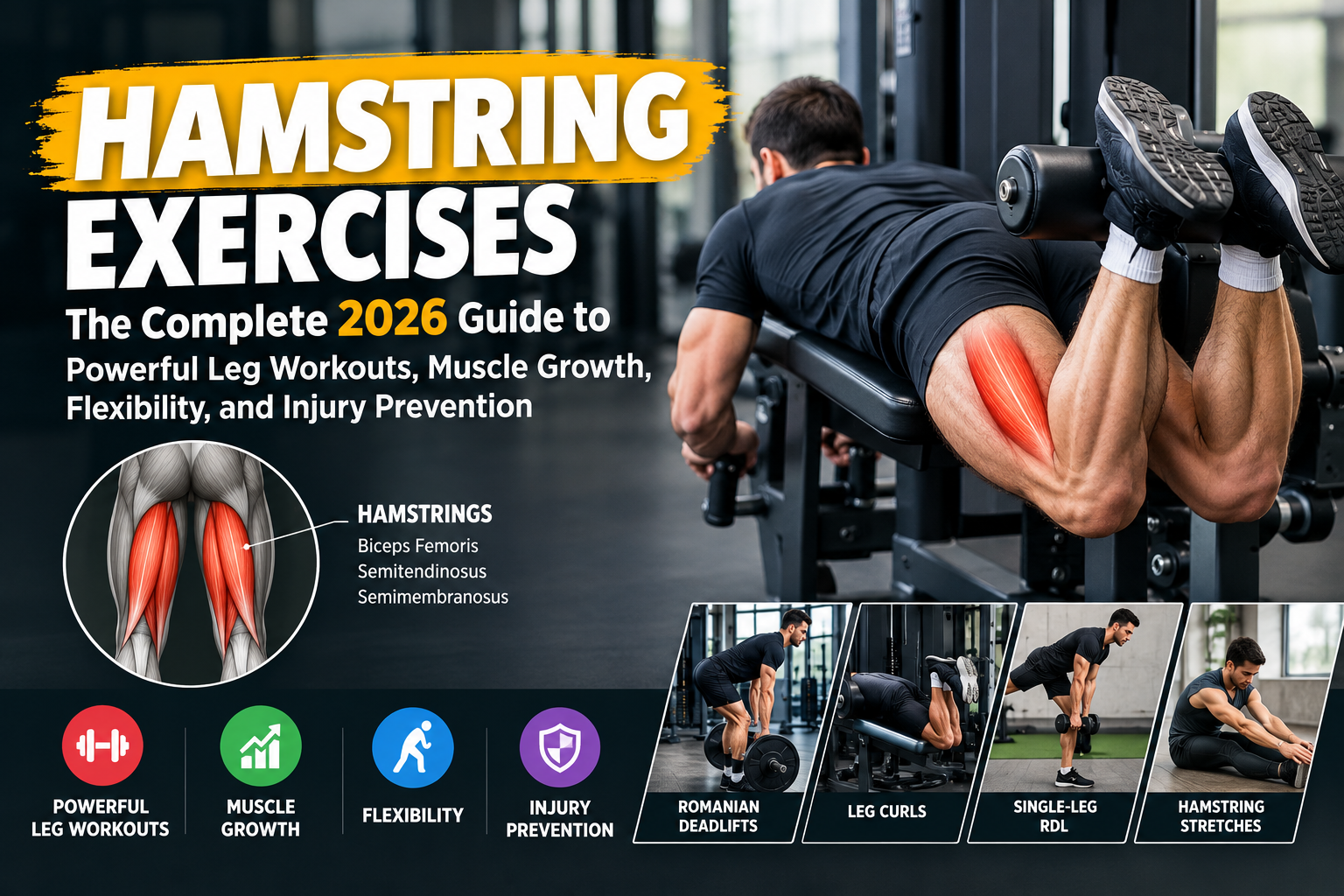
The hamstrings consist of three main muscles: the biceps femoris, semitendinosus, and semimembranosus. The biceps femoris has two heads, long and short, while the other two muscles run along the back of the thigh. Together, these muscles contribute to knee flexion and hip extension, although their individual roles differ slightly.
During a Romanian deadlift, the hamstrings help extend the hips as you return to standing. During a leg curl, they bend the knees against resistance. While sprinting, they help control the lower leg and contribute to powerful hip extension, particularly during the high-speed demands of running.
Because the hamstrings cross the hip, the knee, or both, they respond to different joint positions and movement patterns. Training only one type of exercise may leave gaps in your routine. Combining hip-dominant movements with knee-flexion exercises is a practical way to develop more complete hamstring strength.
Best Hamstring Exercises for Strength and Muscle Growth


The most effective hamstring program includes exercises you can perform with good technique and gradually increasing resistance. Compound lifts allow you to train the hamstrings alongside the glutes and other muscles, while isolation exercises focus more directly on knee flexion. Bodyweight movements can also be challenging when performed with the right control and progression.
You do not need to perform every movement in one session. Choose two to four exercises that match your equipment and experience, and build consistency before adding more volume. A balanced routine should challenge the muscles without leaving you too fatigued to recover or maintain good technique.
Romanian Deadlifts
The Romanian deadlift is a hip-hinge exercise that trains the hamstrings and glutes while developing posterior-chain strength. Stand with your feet about hip-width apart, hold dumbbells or a barbell in front of your thighs, and push your hips backward while keeping your spine in a comfortable neutral position. Lower the weight close to your legs until you feel a strong stretch in the back of your thighs, then drive your hips forward to stand.
The key is to move through the hips rather than turning the exercise into a squat. Your knees should remain slightly bent, and the range of motion should stop when further lowering would require your back to round or your hips to shift out of position. Start with light resistance and focus on controlled repetitions.
Seated or Lying Leg Curls
Leg curls directly train knee flexion and are useful for developing hamstring strength without the technical demands of a deadlift. In the seated version, the hips remain flexed, placing the hamstrings in a lengthened position compared with some lying variations. Both versions can be effective when performed with a suitable load and full, controlled movement.
Adjust the machine to fit your body, align the knee joint with the machine’s pivot, and move smoothly through the available range. Avoid jerking the weight or letting the stack crash between repetitions. If your hips lift from the seat or your lower back starts compensating, reduce the resistance.
Nordic Hamstring Curls
Nordic curls challenge the hamstrings as they control the lowering phase of a knee-dominant movement. Kneel on a padded surface with your ankles secured, keep your hips extended, and slowly lower your torso forward. Use your hands to catch yourself, then push gently off the floor to return to the starting position.
This exercise can be demanding, even for experienced athletes. Begin with a small range of motion or use assistance from a resistance band or your hands. Research on Nordic hamstring training supports its use in hamstring injury-prevention programs, particularly in sports involving sprinting, but it should be introduced progressively rather than performed to exhaustion immediately.
Glute Bridges and Hamstring Bridges
Bridges train the glutes and can also challenge the hamstrings, especially when the heels are positioned to make the movement more demanding for the back of the thighs. Lie on your back with your knees bent, brace your trunk, and lift your hips until your body forms a comfortable line from shoulders to knees.
For a greater hamstring challenge, try a bridge with your heels farther from your hips or progress to a controlled single-leg variation. Keep your pelvis level and avoid arching your lower back to lift higher. Bridges are useful for beginners, home workouts, and training days when you want a simpler movement alongside heavier lifts.
A Practical Hamstring Workout Plan
A well-designed workout should balance hip extension, knee flexion, and recovery. The table below provides a general starting point for healthy adults with no current injury. Adjust the workload to your training level, available equipment, and how well you recover between sessions.
| Exercise | Sets | Repetitions | Main training focus |
|---|---|---|---|
| Romanian deadlift | 3 | 6–10 | Hip hinge and strength |
| Seated leg curl | 3 | 10–15 | Knee flexion and muscle growth |
| Glute bridge | 2–3 | 10–15 | Hip extension and control |
| Nordic curl, assisted if needed | 2 | 4–6 | Eccentric strength |
Rest around two to three minutes after demanding compound sets and approximately one to two minutes after most isolation sets, adjusting as needed to maintain quality. You do not need to reach muscular failure on every set. Leave enough control in reserve to complete the planned repetitions with consistent technique.
Train the hamstrings once or twice weekly to start, depending on your overall lower-body program. If you already perform squats, deadlifts, sprint training, or other demanding leg work, account for that workload rather than adding exercises without considering recovery. Progress by adding repetitions or small amounts of resistance when your current workload feels manageable.
How to Improve Hamstring Flexibility and Mobility
Hamstring flexibility can help you move comfortably through activities that require hip flexion and knee extension. However, feeling tightness in the back of your thighs does not always mean the muscles are physically short. It may also reflect fatigue, sensitivity to stretching, limited movement tolerance, or other factors.
A simple mobility routine can include a gentle supine hamstring stretch using a towel or strap, a standing hip hinge with no weight, and controlled leg movements within a comfortable range. Hold static stretches for about 20–30 seconds and repeat as appropriate without forcing the joint or bouncing aggressively. Stretching should create mild tension, not sharp pain, numbness, or tingling.
For strength training, flexibility and control should develop together. Romanian deadlifts train the hamstrings while they lengthen under load, whereas curls strengthen them through knee movement. You can combine both approaches rather than relying on stretching alone to improve performance.
Common Hamstring Training Mistakes and How to Fix Them
One common mistake is rounding the back during deadlifts to reach a lower position. This often happens when the load is too heavy or the lifter tries to force extra range of motion. Reduce the weight, push the hips backward, and stop when you can no longer maintain a comfortable, controlled torso position. Your range should match your mobility, not someone else’s.
Another mistake is training the hamstrings only with deadlifts. Hip-hinge exercises are valuable, but they do not replace knee-curl movements, which train the hamstrings through a different action. Including both patterns gives your program more complete coverage. Similarly, rushing through repetitions or relying on momentum can reduce control and make it harder to progress consistently.
Finally, increasing training volume too quickly can leave the muscles excessively sore, particularly after Nordic curls or unfamiliar eccentric work. Introduce challenging exercises gradually and leave enough recovery time between sessions. Sudden sharp pain, bruising, marked weakness, or difficulty walking after an exercise may indicate an injury and should be assessed by a qualified healthcare professional.
Nutrition and Recovery for Stronger Hamstrings
Muscle growth depends on training stimulus, sufficient nutrition, and recovery. Include protein-rich foods such as eggs, fish, poultry, yogurt, tofu, beans, and lentils in your daily diet. Carbohydrate sources such as rice, potatoes, oats, fruit, and whole grains help provide energy for demanding workouts and support recovery between sessions.
For many healthy adults who train regularly, a daily protein intake of approximately 1.4–2.0 grams per kilogram of body weight is a commonly used range for supporting muscle development. Individual needs vary with body size, training demands, age, and health status. Total calorie intake also matters: consistently eating too little can make it harder to build muscle and recover from training.
Sleep and rest are just as important as exercise selection. Most adults should aim for at least seven hours of sleep per night. If performance drops, soreness persists, or your legs feel unusually fatigued, reduce the workload and reassess your schedule. Recovery is not wasted training time; it is part of adapting to the work you have done.
Frequently Asked Questions About Hamstring Exercises
What is the best exercise for hamstrings?
The Romanian deadlift is an excellent option for training the hamstrings through hip extension, while seated and lying leg curls directly challenge knee flexion. Nordic curls can develop eccentric strength. Rather than relying on one movement, combine a hip-hinge exercise with a knee-curl variation for a more balanced program.
How often should I train my hamstrings?
Many people can begin with one or two focused sessions per week. Your ideal frequency depends on training experience, exercise selection, total leg-training volume, and recovery. If you also sprint, play sports, or perform heavy deadlifts, account for those activities before adding more work.
Can I train my hamstrings at home without equipment?
Yes. Glute bridges, single-leg bridges, bodyweight hip hinges, and sliding leg curls using towels on a smooth floor can train the hamstrings at home. Nordic curls are another option if you have a secure way to anchor your ankles. Start with manageable variations and progress gradually.
Do hamstring exercises help prevent injuries?
Progressive hamstring strengthening can improve muscle capacity and may reduce the risk of certain injuries, especially in sports that involve high-speed running. Nordic curls have evidence supporting their use in injury-prevention programs. However, no single exercise eliminates injury risk; training load, sprint exposure, recovery, and proper progression also matter.
Why do my hamstrings feel tight after exercise?
Tightness can occur because of muscle fatigue, unfamiliar exercise, delayed-onset muscle soreness, or sensitivity to stretching. Gentle movement and adequate recovery may help if symptoms are mild. Sharp pain, tingling, bruising, or persistent symptoms should not be treated as ordinary tightness.
Should I stretch before or after hamstring training?
Before training, use a brief warm-up with light activity and dynamic movements to prepare for the session. Static stretching can be included afterward or in a separate mobility routine if it suits your needs. Avoid forcing intense stretches into painful ranges, and remember that strength training through a controlled range can also help develop movement capacity.
Conclusion: Build Stronger Legs With Smart Hamstring Training
Effective hamstring exercises improve more than the appearance of the back of your thighs. They help develop hip-extension power, knee-flexion strength, movement control, and the physical capacity needed for running, lifting, and everyday activities.
Build your routine around complementary movements such as Romanian deadlifts, leg curls, bridges, and appropriately scaled Nordic curls. Use good technique, increase resistance gradually, support your training with adequate nutrition and sleep, and pay attention to signs that your body needs more recovery.
The most important takeaway is consistency. A balanced program performed regularly will generally deliver better results than an aggressive routine you cannot sustain. Train with purpose, progress patiently, and develop hamstring strength that supports both your fitness goals and the way you move every day.