
Strong, well-developed arms are useful for more than appearance. They help you lift, carry, push, pull, and perform everyday tasks with greater control. Whether your goal is building bigger biceps, developing defined triceps, improving grip strength, or creating a balanced physique, an effective training plan combines the right exercises, consistent effort, good technique, and adequate recovery.
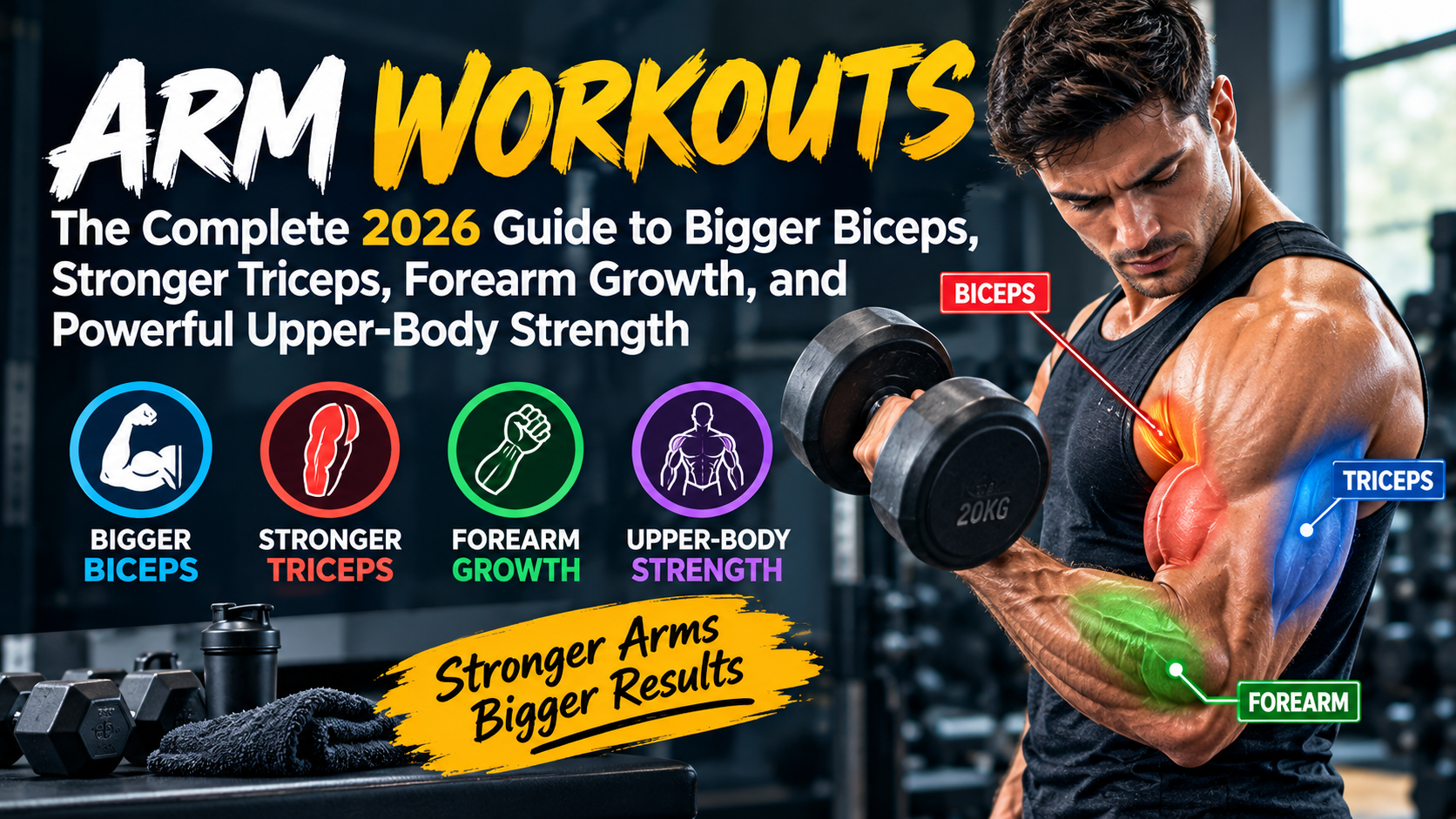
Your arms contain several muscles that work together during gym exercises and daily movement. The biceps help bend the elbow, the triceps straighten it, and the forearm muscles contribute to grip and wrist control. Training these areas with a combination of compound movements and targeted exercises can improve strength and muscle development without requiring complicated routines or hours in the gym.
This guide explains arm anatomy, the best exercises, a practical training plan, common mistakes, and nutrition strategies to help you build stronger arms safely and consistently.
Understanding Arm Muscles and How They Work

Effective arm training begins with understanding the major muscle groups. The biceps brachii sits at the front of the upper arm and helps bend the elbow and rotate the forearm so the palm faces upward. Beneath it, the brachialis also contributes to elbow flexion and can add thickness to the upper arm. The brachioradialis, located in the forearm, assists with elbow flexion, particularly during neutral-grip movements.
The triceps brachii occupies the back of the upper arm and has three heads: long, lateral, and medial. Its primary function is elbow extension, which is essential for pushing movements such as push-ups, bench presses, and overhead presses. Because the triceps make up a substantial portion of upper-arm muscle mass, developing them is important for overall arm size.
The forearms contain muscles responsible for gripping, wrist movement, and controlling the fingers. They work during exercises such as deadlifts, rows, curls, and farmer’s carries. Balanced development therefore involves more than repeatedly curling dumbbells; it requires training the muscles responsible for both pulling and pushing actions.
Best Arm Workouts for Muscle Growth


The most effective arm training combines movements that challenge the biceps, triceps, and supporting forearm muscles through a comfortable range of motion. Choose weights you can control without swinging your torso or forcing your joints into uncomfortable positions. Good technique makes it easier to apply resistance to the intended muscles rather than relying on momentum.
You do not need every exercise in one session. A few well-chosen movements performed consistently can be more productive than a long routine filled with unnecessary repetitions. Start with a manageable workload and gradually increase resistance or repetitions as your technique and strength improve.
Dumbbell Biceps Curls
Dumbbell curls are a foundational exercise for developing the biceps. Stand with your feet stable, keep your elbows close to your sides, and curl the weights without rocking your torso. Lower them under control instead of allowing gravity to pull them down.
You can perform curls with both arms together or alternate sides. If your shoulders move forward or your back arches to lift the weights, reduce the load. A controlled repetition with a moderate dumbbell is generally more useful than a heavier repetition powered by momentum.
Hammer Curls
Hammer curls use a neutral grip, with the palms facing each other. This position trains the biceps alongside the brachialis and brachioradialis, making it a useful option for upper-arm thickness and forearm development. Keep your wrists straight and avoid swinging the dumbbells.
They work well alongside standard curls because the grip changes how the elbow flexors contribute to the movement. You can perform them standing or seated, depending on which position helps you maintain better control.
Triceps Pushdowns
Cable pushdowns directly train the triceps. Set the cable around upper-chest height, keep your elbows close to your body, and extend your arms smoothly. Return the handle slowly until your elbows bend comfortably, maintaining control throughout the repetition.
Avoid leaning heavily over the cable or moving your shoulders excessively. If you feel the exercise mainly in your shoulders or experience elbow discomfort, lower the resistance and review your technique.
Overhead Triceps Extensions
Overhead extensions train the triceps with the arms raised, placing the long head in a more lengthened position. You can perform the movement with a dumbbell or cable, keeping your upper arms steady while bending and straightening the elbows.
Use a weight that allows a comfortable range of motion without arching your lower back. If shoulder mobility or elbow pain limits the movement, choose a more comfortable triceps exercise rather than forcing the position.
Push-Ups and Close-Grip Presses
Push-ups and close-grip pressing variations train the triceps alongside the chest and shoulders. Push-ups are especially useful for beginners because the difficulty can be adjusted by using a wall, an elevated surface, or the floor. Keep your torso aligned and lower yourself under control.
Close-grip bench presses allow you to add external resistance, but your hands do not need to be extremely close together. Choose a grip that feels comfortable for your wrists and elbows while keeping your forearms reasonably aligned during the movement.
Best Exercises for Forearm Strength and Grip

Forearm training supports grip strength, wrist control, and performance in exercises such as deadlifts, pull-ups, and rows. Although many pulling exercises already challenge the forearms, direct work can be useful if grip endurance or forearm development is a particular goal.
Wrist curls target the muscles that flex the wrist, while reverse wrist curls train the wrist extensors. Farmer’s carries challenge grip and trunk stability by asking you to walk while holding heavy weights. Begin with manageable loads and avoid excessive wrist bending, bouncing, or training through sharp pain.
A balanced approach is more effective than endlessly adding grip exercises. Your forearms need recovery just like other muscle groups, and intense grip training immediately before heavy pulling sessions can reduce your performance.
A Practical Weekly Arm Training Plan
A good routine balances direct arm work with compound exercises that already involve the biceps and triceps. Pull-ups and rows train elbow flexors, while presses and push-ups challenge elbow extensors. If you already train your back and chest, account for that work before adding a large amount of extra arm volume.
For many beginners, one or two focused arm sessions per week can be enough to make progress. The following plan is a starting point, not a rule that everyone must follow. Adjust the workload according to experience, recovery, available equipment, and your wider training program.
| Exercise | Target muscles | Sets | Repetitions |
|---|---|---|---|
| Dumbbell curls | Biceps | 3 | 8–12 |
| Hammer curls | Brachialis and forearms | 2–3 | 10–12 |
| Cable triceps pushdowns | Triceps | 3 | 10–15 |
| Overhead triceps extensions | Triceps, especially long head | 2–3 | 10–15 |
| Wrist curls | Forearm flexors | 2 | 12–15 |
| Farmer’s carries | Grip and forearms | 2–3 | 20–40 seconds |
Rest long enough between sets to maintain good technique. Many people find around 60–120 seconds useful for smaller isolation exercises, while demanding compound movements may require longer. If performance drops sharply between sets, allow more recovery rather than rushing through the session.
Progressive overload means gradually increasing the training challenge. You might add a repetition, improve control, or increase the weight slightly once you can complete all prescribed repetitions with sound form. You do not need to train to complete failure on every set to build muscle.
Common Training Mistakes and How to Fix Them
One common mistake is lifting weights that are too heavy. Excessive swinging during curls, shortened repetitions, and uncontrolled lowering can shift work away from the intended muscles and make it harder to assess progress. Reduce the load and aim for smooth repetitions with a consistent range of motion.
Another mistake is training arms hard every day in the belief that more work always produces faster growth. Muscles adapt during recovery, and repeatedly stressing already-fatigued elbows or wrists can undermine performance. Give demanding sessions adequate recovery time and consider how much indirect arm work you already perform during back and chest training.
Neglecting progressive overload is also a problem. Repeating the same weight and repetitions indefinitely may eventually limit improvement. Keep a simple training log, record your sets and repetitions, and increase the challenge gradually. If an exercise causes persistent joint pain, change the movement and seek advice from a qualified healthcare professional when needed.
Nutrition and Recovery for Bigger Arms

Building muscle requires sufficient energy, protein, and recovery. Protein-rich foods such as eggs, fish, chicken, lean meat, dairy products, tofu, and legumes can help supply the amino acids needed for muscle repair. For many healthy adults who strength train, approximately 1.4–2.0 grams of protein per kilogram of body weight per day is a commonly used range, although individual requirements vary.
Carbohydrates from foods such as rice, oats, potatoes, fruit, and whole grains help support training performance. Dietary fats also contribute to a balanced diet. You do not need expensive supplements to make progress if you can meet your nutritional needs through regular food, although some people find convenient protein products useful.
Sleep and consistency matter just as much as exercise selection. Most adults should aim for at least seven hours of sleep each night, and some may need more. Rather than judging progress by how your arms feel immediately after a workout, track strength, repetitions, measurements if desired, and how well you recover over several weeks.
How to Make Arm Training Safer and More Effective
Warm up with a few minutes of easy movement and lighter practice sets before demanding exercises. Check that your equipment is secure, use a stable stance, and avoid forcing your elbows or wrists into uncomfortable positions. Beginners should prioritize learning the movement before attempting very heavy weights.
Sharp pain, sudden weakness, significant swelling, or persistent joint discomfort should not be treated as a normal part of training. Stop the aggravating exercise and seek medical advice when symptoms are concerning. People returning after an injury or managing a medical condition may need a modified program developed with a qualified professional.
As a useful coaching cue, think: “Control the weight, keep the movement smooth, and finish each repetition with good form.” That approach makes it easier to train consistently and identify when you are ready to progress.
Frequently Asked Questions About Arm Workouts
How often should I train my arms?
Many people can make progress by training their arms directly once or twice per week, depending on their experience and overall routine. Remember that pulling exercises also train the biceps, while pressing movements involve the triceps. Allow enough recovery between challenging sessions and adjust your workload if strength or technique begins to decline.
How long does it take to build bigger arms?
Visible changes depend on training experience, genetics, nutrition, consistency, and starting muscle mass. Beginners may notice improvements in strength within a few weeks, while noticeable changes in muscle size generally require sustained training over several months. Track your progress over time rather than expecting dramatic changes after a handful of sessions.
Are dumbbells enough to build arm muscle?
Yes. Dumbbells can effectively train the biceps, triceps, and forearms through exercises such as curls, hammer curls, overhead extensions, and wrist curls. Resistance bands and bodyweight exercises can also help. The important factors are sufficient resistance, controlled technique, appropriate training volume, and gradual progression.
Should I train biceps or triceps first?
Either can come first, depending on your priorities. If you want to emphasize biceps development, start with curls while your muscles are fresh. If triceps strength or size is your main goal, begin with a suitable triceps movement. You can also alternate which muscle group comes first across sessions.
Can I build stronger arms at home without a gym?
Yes. You can use dumbbells, resistance bands, or bodyweight exercises such as push-ups and appropriately scaled close-grip push-ups. Choose movements that challenge your muscles safely, maintain consistent technique, and gradually increase resistance or repetitions as your strength improves.
Do I need supplements to grow my arms?
No. Supplements are not essential if you already consume enough calories, protein, and other nutrients. A balanced diet, progressive resistance training, and sufficient sleep provide the foundation for muscle growth. If you consider using a supplement, review its ingredients and suitability, particularly if you have a medical condition or take medication.
Conclusion: Build Stronger Arms With Consistent Training
Effective arm workouts combine biceps curls, hammer curls, triceps extensions, pressing movements, and suitable forearm exercises. Training these muscles through controlled repetitions and a comfortable range of motion can improve strength, muscle size, grip, and everyday function.
The best routine is one you can perform consistently and recover from. Choose a manageable number of exercises, record your progress, eat enough protein and energy, and increase the challenge gradually. Avoid chasing heavier weights when your technique begins to break down, and take persistent pain seriously.
Ultimately, stronger arms come from months of smart training rather than one exhausting session. Focus on good technique, balanced muscle development, and steady progress, and your results will be more sustainable.