
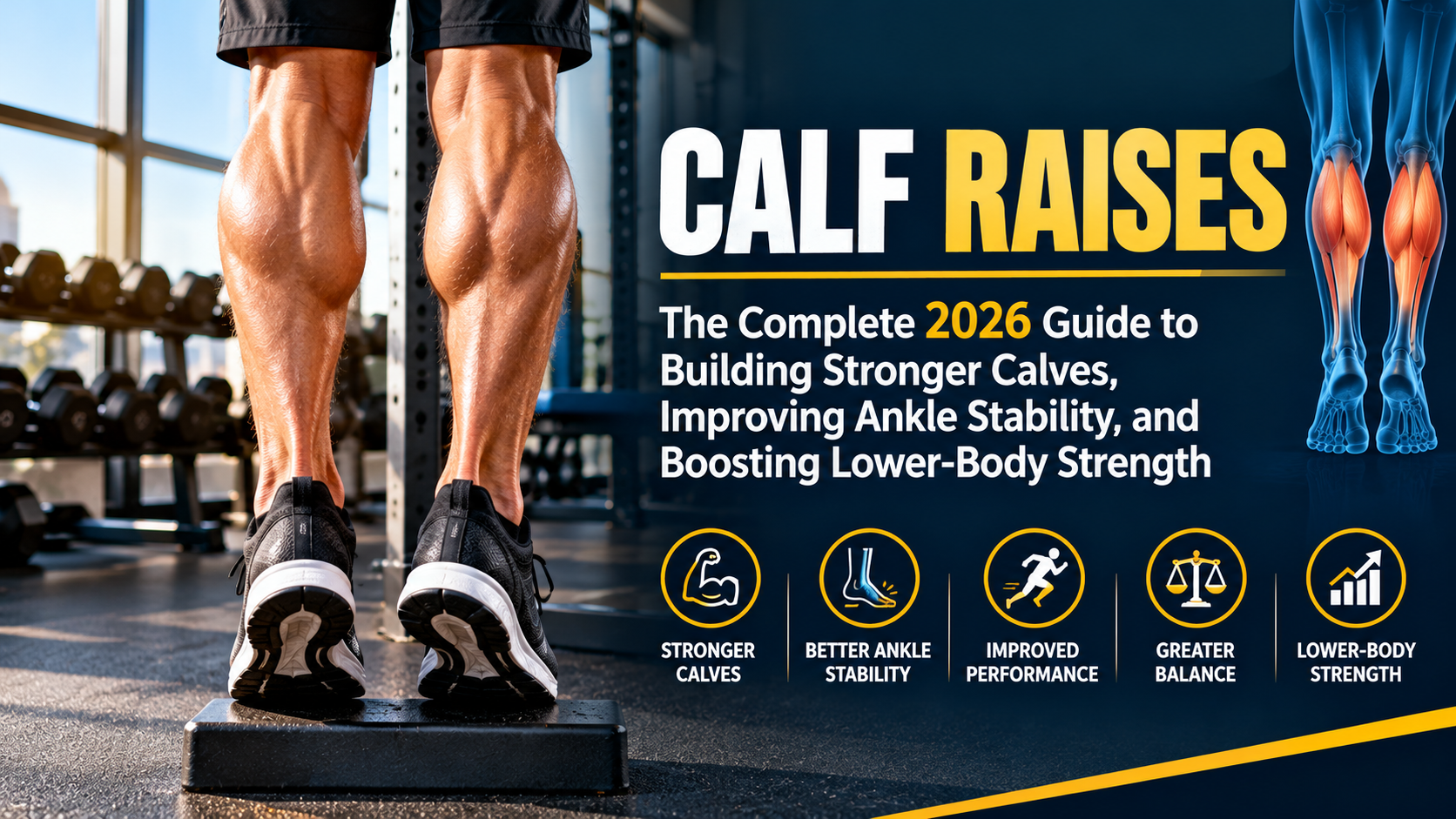
Strong calves do more than improve the appearance of your lower legs. They help you walk, run, jump, climb stairs, and maintain balance during everyday activities. Training the calf muscles can also improve ankle control and contribute to lower-body strength when combined with a well-rounded fitness routine.
Calf raises are among the simplest and most effective exercises for developing these muscles. They require little equipment, can be performed at home or in a gym, and are easy to adapt for beginners and experienced lifters. The key is using controlled movement, an appropriate range of motion, and progressive resistance rather than bouncing through repetitions.


What Are Calf Raises?
Calf raises are a lower-body exercise in which you lift your heels off the floor, rise onto the balls of your feet, and then lower your heels under control. The movement primarily trains the calf muscles responsible for pointing the foot downward, a motion known as plantar flexion.
The two main muscles involved are the gastrocnemius and soleus. The gastrocnemius forms much of the visible shape of the upper calf and crosses both the knee and ankle joints. The soleus lies underneath it and plays an important role in maintaining posture and supporting walking and running.
Because these muscles work throughout the day, they are accustomed to repeated activity. Building strength and muscle size often requires training that gradually challenges them beyond their normal workload. Consistent exercise, sufficient recovery, and suitable resistance can help you make progress over time.
Benefits of Training Your Calf Muscles

One major benefit of calf training is improved muscular strength and endurance. Your calves help propel your body forward during walking and running, contribute to jumping movements, and assist when pushing off the ground. Stronger calves can support these activities, particularly when training includes other exercises such as squats, lunges, and plyometric drills appropriate to your ability.
Another advantage is better ankle function. The calf muscles and Achilles tendon work together to control ankle movement and transfer force through the lower leg. Strengthening this system may support everyday mobility and athletic performance, although no single exercise guarantees injury prevention or eliminates ankle pain.
Regular training can also increase calf muscle size. Results depend on genetics, training history, exercise selection, resistance, nutrition, and recovery. Some people naturally have fuller calves, while others may need more time and carefully planned training to see visible changes.
The Best Types of Calf Raises
Different variations change the resistance, balance demands, and emphasis placed on the calf muscles. Using a combination can make your program more complete without requiring complicated equipment.


Standing Calf Raises
Standing calf raises are a practical choice for training the gastrocnemius because the knee remains relatively straight. You can perform them using body weight, dumbbells, a Smith machine, or a dedicated standing calf machine.
To perform the movement, stand with your feet about hip-width apart, rise onto your toes, pause briefly at the top, and lower your heels slowly. If using a step, let your heels descend only as far as you can comfortably control without pain or excessive stretching.
Seated Calf Raises
Seated variations place the knees in a bent position, which shortens the gastrocnemius and allows the soleus to contribute more to the movement. This makes the exercise a useful complement to standing work.
Sit with the balls of your feet on the platform and the resistance resting securely above your lower thighs. Lift your heels, pause, and lower them gradually. Avoid using momentum to move a heavy load, particularly when your ankles begin to fatigue.
Single-Leg Calf Raises
Single-leg versions train one side at a time, making it easier to identify differences in strength, balance, or movement control. They are useful for runners, recreational athletes, and people who want to progress beyond standard body-weight repetitions.
Stand near a wall or sturdy support if needed. Rise through the working foot while keeping your body upright, then lower slowly. Start with body weight before adding a dumbbell, and avoid forcing extra range of motion simply to make the exercise harder.
Donkey Calf Raises
Donkey calf raises use a forward-leaning position with the hips bent and the knees slightly flexed. They can be performed with a suitable machine or a carefully arranged setup that allows the heels to move freely.
The forward lean changes body position, but it does not isolate a completely separate calf muscle. The most important factors remain controlled ankle movement, sufficient resistance, and a comfortable range of motion.
How to Perform Calf Raises With Proper Form
Good technique makes the exercise more effective and helps you avoid unnecessary stress on the feet and ankles. Begin on a flat surface until you can perform the movement without losing balance or relying on momentum.
Follow these form cues:
- Stand tall with your feet positioned comfortably and your weight distributed across the balls of your feet.
- Keep your knees straight but not forcefully locked during standing variations.
- Lift your heels as high as you can comfortably manage without rolling your ankles outward.
- Pause briefly at the top and squeeze your calf muscles.
- Lower your heels slowly, maintaining control throughout the descent.
- Breathe naturally rather than holding your breath during every repetition.
A common mistake is bouncing at the bottom to complete more repetitions. This reduces control and can increase the demands placed on the Achilles tendon. Another mistake is using excessive weight, which often shortens the movement and encourages poor technique.
Think of each repetition as a controlled lift rather than a spring-loaded bounce. If your range of motion becomes smaller or your ankles begin wobbling, reduce the resistance or stop the set.
How Many Reps and Sets Should You Do?
The right training volume depends on your experience, goals, and recovery capacity. Beginners can start with a modest number of sets and build gradually, while experienced lifters may tolerate more weekly work when it fits their overall training plan.
| Training goal | Sets per session | Repetitions | Rest between sets |
|---|---|---|---|
| Beginner strength and technique | 2–3 | 10–15 | 60–90 seconds |
| Muscle growth | 3–4 | 8–15 | 60–120 seconds |
| Muscular endurance | 2–4 | 15–25 | 45–90 seconds |
| Single-leg control | 2–3 per side | 8–12 | 60–90 seconds |
These are starting guidelines, not strict rules. Choose a resistance that allows you to complete the repetitions with good technique while making the final few challenging. You do not need to train to complete failure every set to make progress.
For example, if you can complete three sets of 15 repetitions comfortably, increase the resistance slightly or use a more challenging variation. If your form breaks down before you reach the target, reduce the load or repetitions.
Common Problems and How to Fix Them
A frequent issue is not feeling the calves working despite completing many repetitions. This can happen when you rush, use too little range of motion, or rely on bouncing. Slow the movement, pause at the top, and lower your heels under control. Improving technique is often more useful than immediately adding weight.
Another problem is discomfort around the Achilles tendon or ankle. Mild muscle fatigue is normal, but sharp pain, persistent tenderness, swelling, or worsening discomfort should not be ignored. Stop the painful movement and seek advice from a qualified healthcare professional if symptoms persist or affect walking.
Limited ankle mobility can also make the exercise uncomfortable. Start on level ground and work within a pain-free range instead of forcing a deep stretch from a step. People recovering from Achilles tendon injuries, ankle surgery, or other lower-leg conditions should follow an individual rehabilitation plan rather than assuming ordinary gym guidance is appropriate.
How to Add Calf Training to Your Workout Routine
For most healthy adults, training the calves two or three times per week is a reasonable starting point. You can place calf work after leg exercises or add it to an upper-body session if that better suits your schedule. Leave enough recovery time between demanding sessions, particularly when you also run, jump, or play sports.
A balanced approach includes both straight-knee and bent-knee movements. For instance, you might perform standing calf raises after squats on one day and seated calf raises after another workout later in the week. This trains the calf complex from different knee positions without making the routine unnecessarily complicated.
Progress should be measured through more than muscle soreness. Track your resistance, repetitions, movement quality, and ability to maintain control. Soreness is not a reliable measure of workout effectiveness, and constantly increasing volume is not necessary if you are already making steady progress.
Nutrition and Recovery for Calf Growth
Muscle development depends on training as well as adequate nutrition and recovery. Protein provides the amino acids needed to repair and build muscle tissue, while carbohydrates help support training energy and replenish glycogen. A varied diet containing protein-rich foods, whole grains, fruits, vegetables, and healthy fats supports general fitness.
For many healthy adults who exercise regularly, a daily protein intake around 1.4–2.0 grams per kilogram of body weight can support muscle-building goals, although individual needs vary. Foods such as eggs, dairy products, fish, chicken, beans, lentils, tofu, and other protein sources can help meet those needs.
Sleep matters, too. Insufficient rest can affect exercise performance and recovery, making it harder to maintain consistent training. Aim for adequate sleep, allow tired muscles to recover, and increase workload gradually. Supplements are not a substitute for a sensible program, sufficient food, and consistent effort.
Frequently Asked Questions
Are calf raises enough to build bigger calves?
They can be a central part of a calf-building program, especially when you progressively increase resistance and train consistently. However, muscle growth also depends on nutrition, recovery, genetics, and total training volume. Combining standing and seated variations can provide a useful starting point.
Should beginners do calf raises every day?
Daily training is usually unnecessary for beginners. Starting with two sessions per week allows time to learn technique and assess recovery. You can adjust frequency as your strength, training experience, and tolerance improve.
Are standing or seated calf raises better?
Neither is universally better. Standing versions train the gastrocnemius more effectively because the knee is straighter, while seated versions place relatively greater emphasis on the soleus. Including both can help develop the calf muscles more comprehensively.
Can calf raises improve jumping and running?
Stronger calf muscles can contribute to push-off power and lower-leg endurance, both of which matter for running and jumping. However, performance also depends on technique, coordination, hip and knee strength, and sport-specific practice.
Should your heels go below the level of a step?
Only when you can control the movement comfortably and without pain. A step can increase the available range of motion, but it is not essential. Beginners and people with ankle or Achilles discomfort may be better off using a flat surface.
Why do my calves cramp during exercise?
Cramps can be associated with muscle fatigue, training intensity, prolonged exertion, or other individual factors. Reduce the workload if cramping occurs, rest, and gradually build your training capacity. Frequent or severe cramps, especially with other symptoms, warrant medical evaluation.
How long does it take to see calf muscle growth?
Noticeable changes often take several weeks to months, depending on your starting point, training consistency, nutrition, and genetics. Keep a record of performance and measurements under consistent conditions rather than judging progress from day-to-day appearance.
Conclusion
Calf raises offer a simple, adaptable way to strengthen the lower legs, support ankle function, and develop more muscular calves. Their effectiveness comes from consistent practice, controlled repetitions, appropriate resistance, and a balanced approach that includes both straight-knee and bent-knee variations.
Start with a manageable workload, focus on full and comfortable movement, and increase the challenge as your technique improves. Pair your training with adequate protein, sufficient sleep, and sensible recovery. The most important takeaway is that stronger calves are built through progressive, repeatable training—not by rushing through endless repetitions or lifting more weight than you can control.