
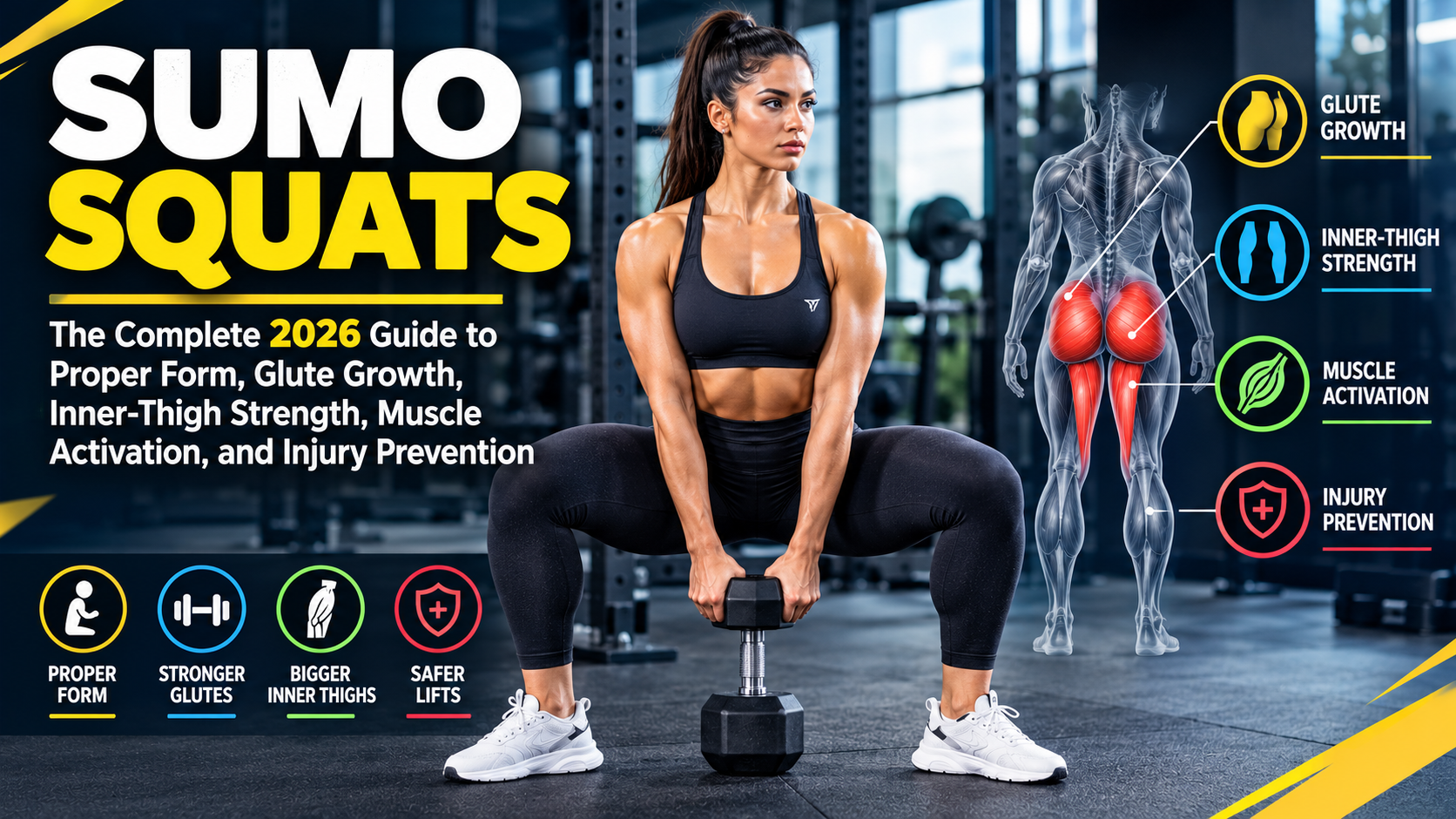
Sumo squats are a popular lower-body exercise that uses a wider-than-shoulder-width stance and outward-pointing toes to challenge the glutes, quadriceps, inner thighs, and other muscles involved in hip and knee movement. Whether you train at home or in a commercial gym, this squat variation can help build lower-body strength, improve movement control, and add variety to your workout routine.
Unlike a conventional squat, the sumo stance changes your hip position and the way your legs move during each repetition. This makes the exercise particularly useful for people who want to emphasize their glutes and adductors while still training the quadriceps. You can perform it with bodyweight, a dumbbell, a kettlebell, or a barbell, depending on your experience and equipment.
However, a wider stance does not automatically produce better results. Foot placement, mobility, balance, resistance, and depth all influence how effectively you perform the movement. Understanding these details will help you choose the right variation, avoid common mistakes, and build a sustainable lower-body training program.
What Are Sumo Squats?
Sumo squats are a squat variation performed with the feet positioned wider than shoulder width and the toes turned outward at a comfortable angle. You bend your knees and hips to lower your body, then push through your feet to return to standing. The exercise is named after the wide stance associated with sumo wrestling.
The movement trains several muscle groups simultaneously. Your quadriceps help straighten your knees, your gluteus maximus contributes to hip extension, and your hip adductors help control your legs and assist hip movement. Your abdominal and back muscles work to stabilize your torso, particularly when you hold external resistance.
One advantage of this exercise is its flexibility. Beginners can learn the movement without weights, while experienced lifters can increase the challenge using dumbbells, kettlebells, or barbells. The best version is one that allows you to maintain balance, control your knees, and move through a comfortable range of motion.
Muscles Worked During Sumo Squats


The primary muscles involved are the gluteus maximus, quadriceps, and hip adductors. Their relative contribution depends on your stance, squat depth, torso position, anatomy, and the amount of resistance you use. A wider stance often increases the demand on the hip adductors, although it does not isolate the inner thighs completely.
The gluteus maximus works to extend the hips as you rise from the bottom position. The quadriceps straighten the knees, while the adductor magnus and other adductor muscles contribute to hip control and can assist hip extension, particularly at deeper joint angles. The hamstrings and calves contribute to movement control and stability, but they are not the primary targets.
Your core muscles also play an important role. They help keep your torso stable so you can transfer force through your legs without unnecessary movement. When you hold a dumbbell or kettlebell, your upper back, forearms, and grip muscles help maintain the position of the weight.
| Muscle group | Main function | Training benefit |
|---|---|---|
| Gluteus maximus | Extends the hips | Glute strength and development |
| Quadriceps | Straightens the knees | Thigh strength |
| Hip adductors | Control and move the thighs | Inner-thigh strength and hip stability |
| Core muscles | Stabilize the torso | Better movement control |
| Calves | Assist ankle stability | Balance and lower-leg control |
| Hamstrings | Assist hip movement and knee control | Supporting lower-body function |
How to Perform Sumo Squats With Proper Form


Start by standing with your feet wider than shoulder width. Turn your toes outward at a comfortable angle, usually somewhere around 20 to 45 degrees, depending on your hip structure and mobility. Keep your weight distributed across your feet, with your heels firmly planted and your chest in a natural position.
Brace your abdominal muscles and bend your knees and hips together to lower your body. Allow your knees to travel in the same general direction as your toes rather than collapsing inward. Descend only as far as you can maintain balance, foot contact, and a controlled torso position.
Once you reach your comfortable depth, push through your feet and extend your knees and hips to return to standing. Keep the movement smooth instead of bouncing out of the bottom position. Finish upright without forcefully locking your knees or leaning backward.
A helpful coaching cue is: “Sit between your hips, keep your knees aligned with your toes, and drive the floor away as you stand.” This encourages a controlled squat without forcing you into an excessively wide stance.
Your ideal stance may differ from someone else’s. If your hips feel pinched or your heels lift, narrow your feet slightly or adjust your toe angle. Good technique should fit your natural movement rather than forcing your body into a predetermined position.
Benefits of Sumo Squats for Strength and Muscle Growth
One major benefit is the ability to train the glutes, quadriceps, and inner thighs in a single movement. This makes the exercise useful for people who want an efficient lower-body workout without needing several pieces of equipment. With progressive resistance and sufficient recovery, it can contribute to stronger muscles and improved lower-body performance.
The wider stance can also challenge hip mobility and control. Regular practice through a comfortable range of motion may help you become more confident with different squat positions. However, the exercise is not a guaranteed solution for limited mobility, and it should not cause sharp pain or persistent joint discomfort.
Another advantage is accessibility. Bodyweight repetitions can help beginners develop coordination before adding resistance, while weighted versions allow experienced lifters to progressively challenge their muscles. This flexibility makes the movement suitable for home training, gym sessions, and many general fitness programs.
It is important to maintain realistic expectations. No squat variation selectively removes fat from the inner thighs or creates fat loss in a specific body region. Visible muscle definition depends on muscle development, overall body composition, nutrition, and individual genetics.
Sumo Squats vs. Regular Squats
The biggest difference between the two exercises is stance width. A conventional squat generally uses a shoulder-width or slightly wider position, whereas the sumo variation uses a wider stance with more outward toe rotation. These differences change the movement demands at the hips and knees.
Neither variation is universally superior. Conventional squats may feel more natural for people who prefer a narrower stance or want to develop general squat strength. The wider version may feel better for others, particularly when their hip anatomy and mobility accommodate the position comfortably.
| Feature | Sumo squat | Conventional squat |
|---|---|---|
| Stance | Wide | Shoulder-width or individually comfortable |
| Toe angle | More outward | Usually forward or slightly outward |
| Muscle emphasis | Glutes, quadriceps, adductors | Glutes and quadriceps |
| Mobility demands | Greater comfort with hip abduction and external rotation | Depends on stance and squat style |
| Common equipment | Bodyweight, dumbbell, kettlebell, barbell | Bodyweight, dumbbell, kettlebell, barbell |
| Best choice | A comfortable wide-stance squat pattern | A comfortable general squat pattern |
Both movements can build muscle and strength. Choose based on your goals, comfort, technique, and ability to progressively increase the training challenge.
Best Sumo Squat Variations for Different Fitness Levels


Bodyweight sumo squats are an excellent starting point for beginners. They allow you to learn foot placement, knee alignment, and squat depth without worrying about holding a heavy weight. If balance is difficult, lightly hold a stable support while practicing the movement.
The goblet variation involves holding a dumbbell or kettlebell in front of your chest or between your legs. This adds resistance and encourages a controlled torso position. It is a practical option for home workouts because one dumbbell or kettlebell can provide enough challenge for many training levels.
More experienced lifters can use a barbell for heavier loading, provided they have the necessary technique and equipment setup. Other options include tempo squats, in which you lower yourself slowly, and paused squats, in which you briefly hold the bottom position. These methods increase the difficulty without requiring a large increase in weight.
Select the variation that matches your current ability. A well-controlled bodyweight squat is more useful than a heavily loaded repetition performed with poor balance or uncomfortable joint positions.
Common Mistakes and How to Fix Them
One frequent mistake is adopting an excessively wide stance. Some lifters assume that placing their feet farther apart will automatically target the inner thighs more effectively. In practice, an overly wide position can restrict comfortable movement, cause hip discomfort, or make it difficult to maintain balance. Start with a moderate stance and adjust gradually.
Another problem is allowing the knees to collapse inward during the ascent. This can happen when the resistance is too heavy, fatigue is high, or the lifter struggles to control the movement. Reduce the load, slow down your repetitions, and guide your knees in the same general direction as your toes.
Lifting the heels is another sign that your current setup or depth may not suit your mobility. Keep your feet planted and reduce the depth if necessary. If you repeatedly struggle, practice supported squats and work on ankle mobility separately.
Finally, avoid rushing through repetitions or bouncing at the bottom. Controlled movement helps you maintain balance and recognize discomfort before it becomes more serious. The goal is to challenge your muscles while retaining control of every repetition.
Sets, Reps, and Workout Programming
Your training volume should match your experience, recovery, and overall lower-body program. Beginners can start with two or three sets of bodyweight repetitions, focusing on consistency rather than fatigue. Once the movement feels comfortable, gradually introduce resistance.
For muscle growth, many people can begin with three or four sets of eight to twelve repetitions using a challenging but manageable weight. Leave approximately one to three good repetitions in reserve on most sets. This provides a useful training stimulus without requiring you to push every set to complete failure.
| Training goal | Sets | Repetitions | Rest |
|---|---|---|---|
| Beginner technique | 2–3 | 8–12 | 60–90 seconds |
| Muscle growth | 3–4 | 8–12 | 90–150 seconds |
| Strength development | 3–5 | 5–8 | 2–3 minutes |
| Muscular endurance | 2–3 | 12–20 | 45–90 seconds |
These are general guidelines rather than strict rules. Increase the weight when you can complete your target repetitions with good technique and adequate control. You can also progress by adding repetitions, improving depth within a comfortable range, or using a controlled lowering tempo.
For a balanced lower-body session, combine the movement with exercises that train different functions, such as Romanian deadlifts, leg curls, calf raises, and split squats. This provides a broader stimulus than relying on a single squat variation.
Safety, Mobility, and Injury Prevention
Before training, spend a few minutes warming up with light activity and controlled bodyweight squats. Practice your stance and perform several easy repetitions before adding resistance. Your warm-up should prepare your muscles and joints without leaving you tired before the working sets begin.
Mobility requirements vary between individuals. If your hips feel restricted, adjust your stance width and toe angle rather than forcing yourself deeper. If your knees or hips hurt during the movement, reduce the range of motion or resistance and reassess your technique.
People with existing injuries or persistent joint symptoms may benefit from advice from a qualified physiotherapist or healthcare professional. Stop exercising if you experience sharp pain, sudden weakness, or symptoms that worsen with each repetition. Normal muscular effort is not the same as joint pain.
Consistency matters, but so does recovery. Allow time between challenging lower-body sessions, get adequate sleep, and eat enough to support your training goals. Gradually increasing workload is generally more sustainable than suddenly adding heavy weights or excessive repetitions.
Frequently Asked Questions
Are sumo squats better for glutes than regular squats?
Not necessarily. Both variations can develop the glutes when performed with sufficient effort, appropriate resistance, and progressive overload. The wider stance changes hip positioning and may increase the contribution of the hip adductors, but the best option depends on your anatomy, comfort, and training goals.
Do sumo squats target the inner thighs?
Yes, the hip adductor muscles contribute to controlling the thighs during the movement and can assist hip extension. However, the exercise also trains the glutes and quadriceps. Dedicated adductor exercises may be useful if inner-thigh strength is a particular priority.
How many sumo squats should beginners do?
A reasonable starting point is two or three sets of eight to twelve controlled bodyweight repetitions, performed two or three times per week as part of a balanced program if recovery allows. Beginners should focus on stable foot placement and comfortable depth before increasing resistance.
Can sumo squats help with weight loss?
They can contribute to a weight-loss program by building muscle and increasing energy expenditure during exercise. However, fat loss depends primarily on maintaining an appropriate calorie deficit over time. No squat variation specifically burns fat from the inner thighs or hips.
Should your toes point outward during sumo squats?
Yes, the toes generally point outward to accommodate the wider stance, but the exact angle varies between individuals. Start with a comfortable angle and keep your knees tracking in the same general direction. Avoid forcing your feet into an extreme position that causes discomfort.
Are weighted sumo squats effective for muscle growth?
Yes. Dumbbells, kettlebells, and barbells can increase resistance and make the exercise more challenging. Muscle growth depends on progressive overload, sufficient training volume, good technique, nutrition, and recovery rather than the equipment itself.
Can you perform sumo squats every day?
You can practice light bodyweight repetitions frequently if they do not cause discomfort or interfere with recovery, but demanding weighted sessions generally require more recovery time. Most people benefit from spacing challenging lower-body workouts across the week according to their total training volume and experience.
Conclusion
Sumo squats are a practical lower-body exercise for developing the glutes, quadriceps, and inner thighs while improving squat control and building strength. Their wide stance offers a useful alternative to conventional squats, but effectiveness depends on selecting a comfortable position, maintaining knee alignment, controlling your depth, and using resistance appropriate to your ability.
Begin with bodyweight repetitions, learn the movement, and gradually progress to dumbbells, kettlebells, or barbells as your technique improves. Combine the exercise with other lower-body movements, consistent nutrition, and adequate recovery for more balanced results.
The final takeaway: the most effective squat is not the one with the widest stance or the heaviest weight, but the one you can perform safely, progressively, and consistently.