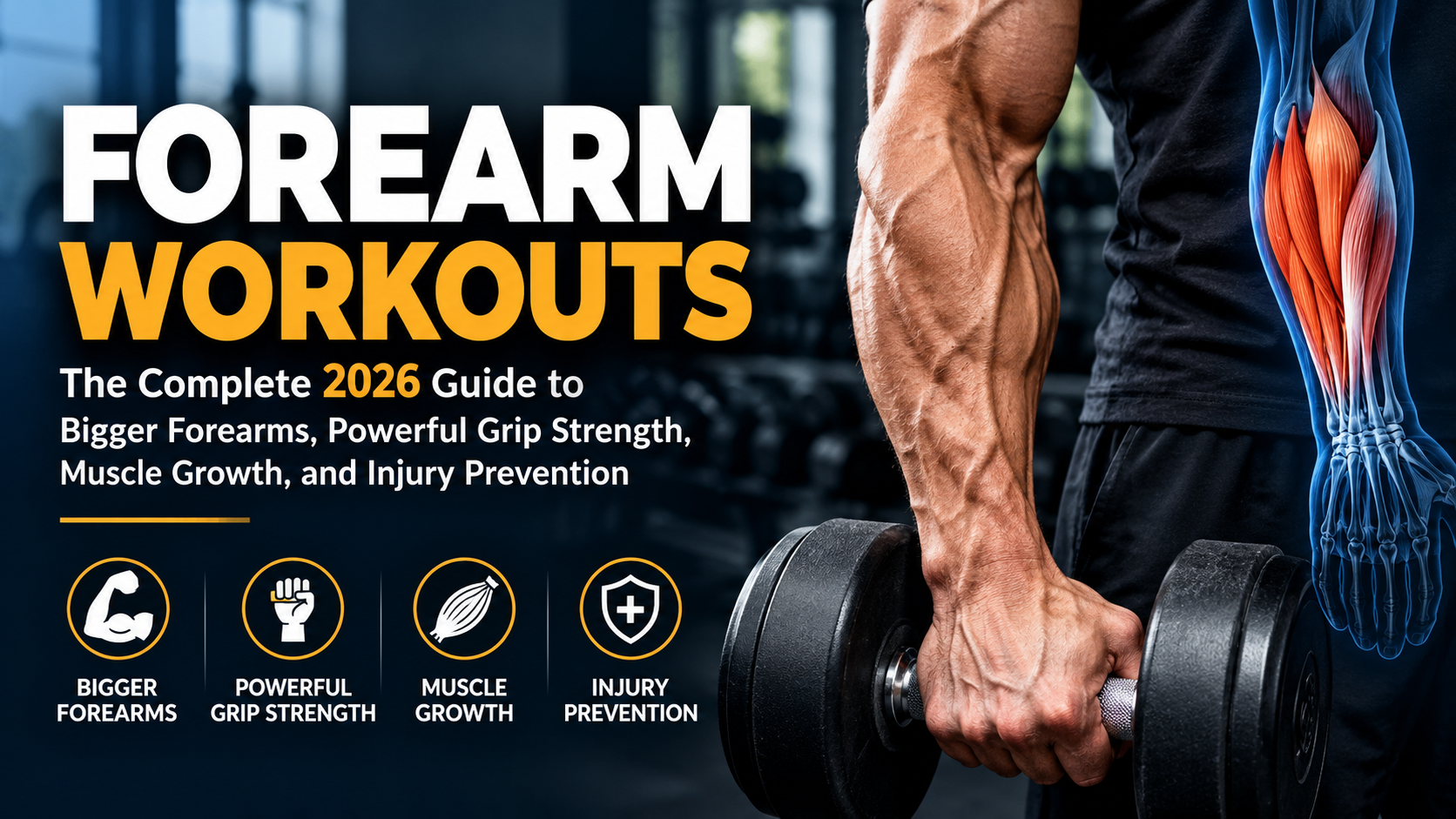
Strong forearms do more than improve the appearance of your arms. They help you grip heavy dumbbells, hold a barbell during deadlifts, carry groceries, climb, and perform everyday tasks that require hand and wrist control. Developing these muscles can also improve performance in bodybuilding, powerlifting, rock climbing, and other strength-based activities.
Effective forearm workouts combine wrist flexion, wrist extension, grip training, and forearm rotation to develop the muscles responsible for controlling your hands and wrists. You do not need an elaborate gym setup to train them. Dumbbells, resistance bands, a barbell, or even a towel can provide useful resistance when used consistently.
The key is to train the forearms through controlled movements, progressively increase the challenge, and allow adequate recovery. This guide explains the relevant anatomy, the best exercises, practical programming, common mistakes, and strategies for building stronger, more muscular forearms.
Understanding Forearm Muscles and Their Functions


The forearm extends from the elbow to the wrist and contains several muscles responsible for moving the wrist, fingers, and thumb. These muscles are commonly grouped into flexors and extensors, although additional muscles control forearm rotation and contribute to elbow movement.
The wrist flexors, located primarily along the palm side, help bend the wrist and contribute to gripping objects. The wrist extensors on the opposite side help straighten the wrist and stabilize it during lifting. The brachioradialis, a prominent muscle near the outer forearm, assists elbow flexion, particularly when your hand is in a neutral position, as during a hammer curl.
The pronator and supinator muscles rotate the forearm so your palm faces downward or upward. Together, these structures support precise hand movements and help transfer force between your fingers, wrists, and elbows.
Balanced development matters because repeatedly training only your gripping muscles may neglect wrist extension and rotation. A well-rounded program targets multiple functions instead of relying exclusively on squeezing exercises.
Benefits of Forearm Training
One of the most practical benefits is improved grip strength. A stronger grip can help you hold dumbbells for longer, maintain control during pulling exercises, and carry heavier objects without your hands giving out first. This is especially useful during deadlifts, rows, farmer’s carries, and pull-ups.
Forearm training can also contribute to muscle growth and better arm proportions. The forearms are visible in many everyday situations, and developing their musculature can create a more balanced appearance alongside the biceps and triceps. However, visible definition also depends on genetics, body composition, and overall muscle development.
Another benefit is improved muscular endurance around the wrist and hand. This may help with activities such as climbing, racquet sports, and certain manual tasks. Strength training can improve physical capacity, but it does not guarantee protection from repetitive-strain injuries or eliminate the need for proper technique and recovery.
Best Forearm Exercises for Strength and Muscle Growth


The most effective forearm routine includes exercises that train wrist movement, gripping endurance, and the muscles that assist elbow flexion. Choose movements you can perform with controlled technique, and increase resistance gradually as your strength improves.
Dumbbell wrist curls: Sit with your forearms supported on your thighs or a bench and your palms facing upward. Allow your wrists to extend slightly, then curl the weight upward without lifting your forearms. Lower slowly to train the wrist flexors through a comfortable range of motion.
Reverse wrist curls: Use the same setup with your palms facing downward. Lift the backs of your hands while keeping your forearms supported. The wrist extensors are relatively smaller than the flexors, so begin with a light weight and avoid swinging the dumbbells.
Hammer curls: Hold dumbbells with your palms facing inward and bend your elbows without rotating your wrists. This movement trains the brachioradialis alongside the biceps and brachialis, helping develop the upper forearm near the elbow.
Farmer’s carries: Hold challenging dumbbells or kettlebells at your sides and walk with an upright posture. Maintain a secure grip without shrugging excessively or leaning from side to side. This exercise combines grip strength, trunk stability, and whole-body coordination.
Dead hangs: Hang from a secure pull-up bar with your shoulders controlled and your grip firm. Start with short holds and stop before your grip fails unexpectedly. People with shoulder problems should seek appropriate guidance before attempting this movement.
Best Forearm Exercises at Home Without a Gym


You can build stronger forearms at home with a pair of dumbbells, a resistance band, or simple grip-training equipment. Wrist curls and reverse wrist curls are particularly convenient because they require little space and allow you to adjust resistance to your ability.
Resistance-band wrist exercises provide another accessible option. Anchor the band securely, maintain a comfortable wrist position, and perform controlled flexion, extension, or rotation. Bands are useful for lighter resistance, but their tension increases as they stretch, so avoid allowing them to snap back uncontrollably.
Hand grippers can improve grip strength when used with appropriate resistance and consistent practice. Start with a gripper you can close through its full range without straining your fingers or wrist. Repeatedly squeezing a device that is too difficult can encourage poor technique and excessive fatigue.
A towel hold is another simple alternative. Hold a folded towel securely or use it as a grip surface for an appropriate pulling exercise. The thicker grip can increase the challenge, but make sure the equipment and setup are stable before adding body weight or heavy resistance.
Forearm Workouts for Different Fitness Goals
Your routine should reflect whether you want bigger muscles, a stronger grip, or better muscular endurance. Muscle growth generally benefits from sufficient weekly training volume, challenging sets, and gradual progression. Grip-focused training places greater emphasis on carries, hangs, and sustained holds.
For beginners, two or three exercises performed once or twice weekly can provide a useful starting point. Experienced lifters may benefit from additional work, especially if their regular training does not sufficiently challenge the wrist flexors, extensors, and grip muscles.
| Goal | Exercises | Sets and repetitions |
|---|---|---|
| Forearm muscle growth | Wrist curls, reverse wrist curls | 3 sets of 10–15 each |
| Grip strength | Farmer’s carries, heavy holds | 3 sets of 20–40 seconds |
| Grip endurance | Dead hangs, lighter carries | 2–3 controlled holds |
| Upper forearm development | Hammer curls, reverse curls | 3 sets of 8–12 |
| Balanced wrist strength | Wrist flexion and extension | 2–3 sets of 12–15 each |
These are general starting guidelines rather than rigid rules. Adjust the workload according to your experience, recovery, and other exercises in your program. You do not need to perform every exercise in the table during one session.
How Often Should You Train Your Forearms?
For many people, training the forearms directly once or twice per week is sufficient to begin making progress. Your forearms already work during pulling exercises, deadlifts, rows, curls, and loaded carries, so this indirect training should be included when estimating your overall workload.
For example, someone who performs heavy deadlifts, pull-ups, and dumbbell rows several times a week may need less direct grip training than someone whose routine contains mostly machine-based exercises. Start conservatively and increase the workload only when your hands, wrists, and elbows recover well between sessions.
Avoid training every set to complete failure, particularly with demanding grip exercises. Excessive fatigue may interfere with your ability to hold weights safely during subsequent workouts. If your grip is consistently limiting your main lifts, place additional grip work after those lifts rather than before them.
Consistency matters more than daily training. A manageable routine performed over several months is generally more useful than an intense schedule that produces persistent soreness and forces you to stop.
Common Mistakes That Limit Forearm Growth
One frequent mistake is using excessive weight during wrist curls. When the resistance is too heavy, lifters often move their elbows and forearms instead of controlling the wrist. Reduce the weight, stabilize your forearms, and use a smooth range of motion.
Another problem is neglecting the wrist extensors. Many people perform wrist curls or gripping exercises but never train the opposite side of the forearm. Including reverse wrist curls and other controlled extension exercises can help create a more balanced program.
Training too frequently can also interfere with progress. Grip muscles and tendons need time to recover from repeated loading, particularly when you combine direct forearm exercises with heavy pulling sessions. Persistent tenderness around the wrist or elbow is a reason to reduce the workload and reassess your technique.
Finally, avoid expecting rapid changes in size. Muscle development takes time, and forearm appearance varies with genetics, muscle insertions, body fat, and training history. Track improvements in repetitions, resistance, and hold duration rather than judging progress solely by appearance.
Nutrition and Recovery for Bigger Forearms
Muscle growth requires appropriate training, sufficient calories, and adequate protein. Include protein-rich foods such as eggs, fish, lean meat, dairy products, tofu, and legumes as part of a balanced diet. For many healthy adults who strength-train regularly, approximately 1.4–2.0 grams of protein per kilogram of body weight per day is a useful evidence-informed range, although individual needs vary.
Sleep also supports recovery and training performance. Aim for a consistent sleep schedule and allow fatigued muscles time to recover before repeating demanding sessions. If your performance declines over several workouts, reassess your training volume, nutrition, and sleep rather than simply adding more exercises.
Progressive overload should be gradual. You might increase a dumbbell’s weight slightly, perform a few more controlled repetitions, or extend a farmer’s carry by several seconds. Avoid increasing every training variable at once, since this makes it harder to determine what is helping and what is causing excessive fatigue.
Frequently Asked Questions
How long does it take to build bigger forearms?
Noticeable improvements in strength may occur within several weeks, while visible muscle growth often takes several months of consistent training. Your results depend on genetics, nutrition, training experience, resistance progression, and recovery. Comparing performance over time is more reliable than expecting a specific amount of growth by a fixed date.
Can forearm exercises improve grip strength?
Yes. Farmer’s carries, dead hangs, heavy holds, and suitable gripper exercises can improve grip strength when performed consistently. Wrist curls and reverse wrist curls also strengthen the muscles involved in wrist movement, supporting a more comprehensive training program.
Should you train forearms on arm day or back day?
Either can work. Training them after back exercises is convenient because your grip is already involved, while arm day may provide more time for direct wrist exercises. The main consideration is avoiding excessive fatigue before exercises that require a secure grip.
Are forearm workouts necessary if you lift weights?
Not always. Rows, pull-ups, deadlifts, and dumbbell exercises already train your grip and some forearm muscles. Direct training is useful when grip strength is a limiting factor, when you want additional forearm development, or when your current program provides insufficient work for particular wrist movements.
Can you train forearms every day?
Daily light movement may be tolerated by some people, but demanding resistance training every day is generally unnecessary. Start with one or two direct sessions per week and adjust according to recovery. Persistent pain, declining performance, or unusual weakness suggests that your training load may need to be reduced.
What is the best exercise for forearm growth?
There is no single best exercise for everyone. Wrist curls train the wrist flexors, reverse wrist curls target the extensors, and hammer curls develop the brachioradialis. Combining these movements with appropriate grip training offers broader muscular development than relying on one exercise alone.
Conclusion
Effective forearm workouts develop more than arm size. They strengthen the muscles responsible for gripping, wrist control, and forearm rotation, supporting better performance in the gym and everyday activities. The best results come from combining targeted wrist exercises with grip-focused movements, sensible progression, balanced nutrition, and adequate recovery.
Start with a few manageable exercises, use controlled repetitions, and train both wrist flexion and extension. As your strength improves, gradually increase resistance or training volume without sacrificing technique.
The final takeaway: stronger, more muscular forearms are built through consistent, balanced training rather than endless squeezing or daily workouts. Focus on measurable progress, respect recovery, and give your muscles time to adapt.