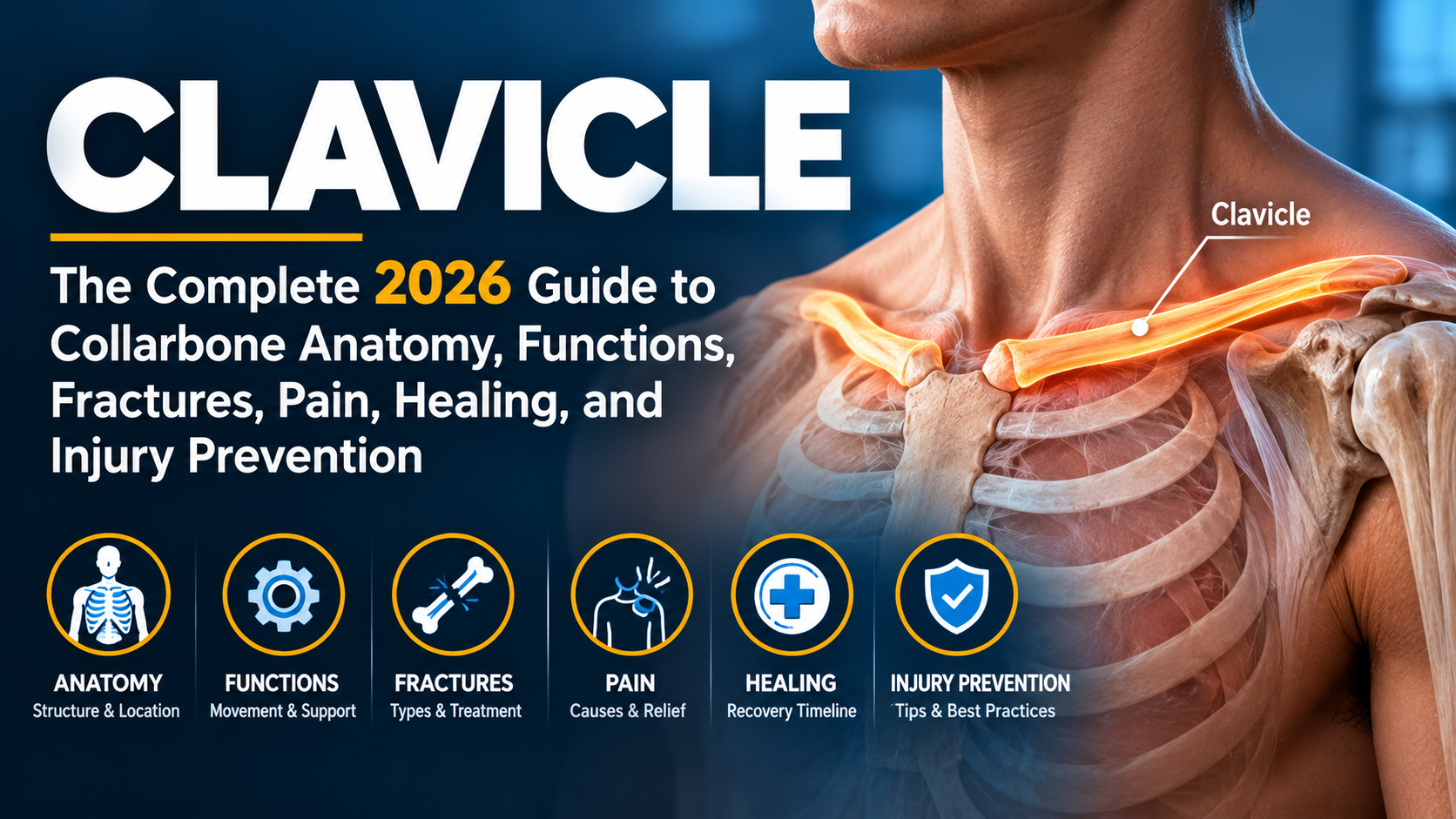
The clavicle, commonly known as the collarbone, is a small but essential bone that connects the upper limb to the central skeleton. It plays a crucial role in shoulder stability, arm movement, posture, and protection of important nerves and blood vessels. Despite its relatively slender shape, this bone withstands considerable forces during everyday activities, exercise, and sports.
Understanding its anatomy can help you recognize potential injuries, distinguish ordinary soreness from warning signs, and make informed decisions about recovery. Whether you are studying human anatomy, experiencing shoulder discomfort, or learning about sports injuries, knowing how the collarbone works provides a useful foundation for understanding shoulder health.
What Is the Clavicle?
The clavicle is an elongated, S-shaped bone positioned horizontally at the top of the chest. It extends from the sternum, or breastbone, to the acromion, a bony projection of the scapula, also called the shoulder blade. Together, these structures help form the shoulder girdle, which supports the arm and allows a wide range of movement.
Unlike many long bones, the collarbone lies close to the skin, making it easy to see or feel in many people. Its position also makes it vulnerable to direct impacts and falls. A fall onto an outstretched hand, a collision during contact sports, or a bicycle accident can transmit force through the shoulder and cause a fracture.
The bone develops early during fetal development, and its growth continues through adolescence. Its medial end, near the sternum, is among the last skeletal regions to finish fusing, often completing this process in the early to mid-twenties.
Clavicle Anatomy and Major Structures

The collarbone has two ends and a central shaft. Each region has a distinct shape and connects with surrounding structures to provide stability while permitting movement.
The medial, or sternal, end is thicker and articulates with the manubrium of the sternum at the sternoclavicular joint. This joint connects the upper limb to the axial skeleton and helps the shoulder move upward, downward, forward, and backward.
The lateral, or acromial, end is flatter and meets the acromion of the scapula at the acromioclavicular joint. Ligaments around this joint help maintain alignment between the collarbone and shoulder blade.
The central shaft has a gentle S-shaped curve. Its shape helps distribute mechanical forces, while its underside contains attachment areas for important ligaments and muscles.
| Anatomical structure | Location | Main role |
|---|---|---|
| Sternal end | Near the breastbone | Forms the sternoclavicular joint |
| Acromial end | Near the shoulder | Forms the acromioclavicular joint |
| Shaft | Middle section | Transfers forces and supports shoulder positioning |
| Conoid tubercle | Underside near the lateral end | Attachment for the conoid ligament |
| Subclavian groove | Underside of the shaft | Related to the subclavius muscle attachment |
Several important structures pass beneath or near the collarbone, including the subclavian blood vessels and parts of the brachial plexus, a network of nerves supplying the arm. This close anatomical relationship explains why significant injuries sometimes require urgent medical assessment.
What Does the Collarbone Do?
The collarbone acts as a structural strut between the sternum and shoulder blade. By holding the shoulder away from the chest, it allows the arm to move more freely instead of being restricted against the torso. This is particularly important when reaching overhead, lifting objects, throwing a ball, or performing pressing exercises.
It also helps transmit forces from the arm to the central skeleton. When you push a heavy door or catch yourself during a fall, mechanical forces travel through the upper limb and shoulder girdle. The collarbone helps distribute those forces while maintaining the shoulder’s position.
Muscles and ligaments surrounding the bone contribute to its function. The deltoid and trapezius muscles attach near its lateral region, while the pectoralis major and sternocleidomastoid connect with the medial region. The subclavius muscle runs beneath it and helps stabilize the area.
A useful way to understand its purpose is to imagine a tent pole holding fabric away from a central support. If that pole becomes unstable, the surrounding structure loses some of its shape and support. Similarly, a collarbone injury can affect shoulder alignment and make normal arm movements uncomfortable.
Common Collarbone Injuries and Their Causes

Fractures are among the most common collarbone injuries, particularly in children, adolescents, cyclists, and athletes involved in contact sports. A fracture occurs when a force exceeds the bone’s ability to withstand it. The middle third is a frequent fracture location because of its shape and mechanical loading.
Symptoms can include sudden pain, swelling, bruising, tenderness, and difficulty raising the affected arm. Some people notice a visible bump or change in shoulder position. A displaced fracture occurs when the broken ends move out of their normal alignment, while a nondisplaced fracture retains relatively good alignment.
Other injuries affect the joints rather than the bone itself. An acromioclavicular joint separation, often called a shoulder separation, involves injury to the ligaments connecting the collarbone and shoulder blade. A sternoclavicular joint injury affects the connection near the breastbone. These conditions differ from a fracture and may require different treatment.
Overuse can also cause discomfort around the collarbone, particularly in people who repeatedly perform overhead movements, heavy lifting, or demanding upper-body training. However, pain in this region may also originate from muscles, tendons, joints, or other nearby structures. Persistent or unexplained pain should not automatically be attributed to a bone problem.
Symptoms That Need Medical Attention
A suspected fracture deserves prompt medical evaluation, especially after a fall, collision, or direct blow. Common warning signs include sharp pain, swelling, bruising, a grinding sensation during movement, or an inability to use the arm normally. A clinician can assess the injury and determine whether imaging is necessary.
Certain symptoms require emergency attention. These include a bone fragment pushing against or breaking through the skin, rapidly increasing swelling, severe deformity, numbness or weakness in the arm, a hand that becomes unusually pale or cold, or significant bleeding. Difficulty breathing or swallowing after an injury near the sternum is also concerning.
Pain near the collarbone is not always musculoskeletal. Chest pressure, shortness of breath, sweating, or pain spreading into the jaw or arm may indicate a medical emergency unrelated to a simple bone injury. Seek emergency care rather than assuming these symptoms result from exercise or a minor strain.
Diagnosis and Treatment Options

Diagnosis typically begins with a medical history and physical examination. A healthcare professional asks how the injury occurred, checks tenderness and shoulder movement, and assesses circulation, sensation, and strength in the arm. These checks help identify possible damage to nearby nerves or blood vessels.
X-rays are commonly used to confirm a suspected fracture and determine its location and alignment. Depending on the injury, additional imaging, such as a CT scan, may be appropriate, particularly for complex fractures or injuries involving the sternoclavicular joint.
Treatment depends on the severity and pattern of the injury.
| Injury or condition | Common treatment approach | Important consideration |
|---|---|---|
| Nondisplaced fracture | Sling, pain management, and follow-up | Alignment and healing need monitoring |
| Displaced fracture | Specialist assessment; surgery in selected cases | Bone position, skin condition, and function influence decisions |
| AC joint separation | Activity modification, pain relief, and rehabilitation | Severe ligament injuries may need surgery |
| Sternoclavicular injury | Prompt specialist evaluation | Some dislocations can affect nearby vital structures |
| Persistent unexplained pain | Clinical assessment and targeted testing | The cause must be established before treatment |
Most uncomplicated fractures heal without surgery. A sling can support the arm while discomfort settles, and clinicians may recommend appropriate pain relief based on individual circumstances. Surgery may be considered when fractures are significantly displaced, the skin is threatened, there is associated neurovascular injury, or other clinical factors make operative treatment preferable.
There is no single treatment plan that suits every patient. The decision should consider the injury pattern, overall health, activity demands, risks, and expected functional outcome.
Recovery, Rehabilitation, and Healing Time

Healing time varies according to age, fracture severity, displacement, general health, and treatment method. Many uncomplicated fractures in children heal in approximately four to six weeks, while adults often require around six to twelve weeks for substantial bone healing. Complex injuries can take longer, and the return to full strength may extend beyond the initial healing period.
Pain often improves before the bone has regained its full strength. This distinction matters because returning too early to heavy lifting, contact sports, or activities with a high fall risk can increase the chance of complications. Follow-up appointments help clinicians assess healing and advise when activity can safely increase.
Rehabilitation usually progresses in stages. Early care focuses on comfort and protecting the injury. Once appropriate, gentle movement helps limit shoulder stiffness. Later exercises restore range of motion, strength, coordination, and endurance.
For example, a recreational weightlifter may begin with gentle shoulder movements and gradually return to resistance training only after receiving appropriate clearance. Heavy bench presses, overhead presses, and contact activities should not resume simply because everyday pain has decreased.
Adequate nutrition, sufficient protein, calcium, and vitamin D support normal bone health. Avoiding smoking is also important because smoking can impair bone healing. Supplements are not a substitute for a balanced diet or medical guidance when a deficiency is suspected.
How to Protect Your Collarbone and Shoulder Health
Preventing every fracture is impossible, but sensible precautions can reduce risk. Cyclists should use a properly fitted helmet and follow safe riding practices. Athletes can benefit from appropriate protective equipment, sport-specific technique, and gradual increases in training intensity.
In the gym, controlled technique matters more than lifting the heaviest possible load. Increase resistance progressively, maintain good movement control, and avoid forcing painful overhead positions. If shoulder discomfort develops repeatedly during bench presses, push-ups, or overhead exercises, review your technique and reduce the provoking workload until the cause is clearer.
Fall prevention is equally valuable. Good lighting, clear walkways, suitable footwear, and balance training can reduce the likelihood of accidents. For older adults and people with osteoporosis risk factors, discussing bone health with a healthcare professional may help identify opportunities to protect skeletal strength.
The key principle is simple: persistent pain is a signal to investigate, not something to push through indefinitely. Early assessment can help distinguish a minor soft-tissue problem from an injury that requires specific treatment.
Frequently Asked Questions
What is the main function of the clavicle?
Its primary function is to connect the upper limb to the central skeleton while keeping the shoulder positioned away from the chest. It also helps transfer forces, supports shoulder movement, and contributes to the stability of the shoulder girdle.
How do you know if your collarbone is fractured?
Typical symptoms include pain after an injury, swelling, bruising, tenderness, difficulty moving the arm, and sometimes a visible deformity. These signs cannot confirm a fracture by themselves, so medical examination and usually an X-ray are needed.
How long does a collarbone fracture take to heal?
Many uncomplicated fractures heal substantially within six to twelve weeks in adults, although some take longer. Children often heal faster. Pain reduction does not necessarily mean the bone is ready for heavy lifting or contact sports, so follow your clinician’s return-to-activity guidance.
Can a collarbone fracture heal without surgery?
Yes. Many fractures heal successfully with a sling, appropriate pain management, activity modification, and follow-up care. Surgery is considered for selected injuries based on displacement, skin involvement, associated damage, and the patient’s individual circumstances.
Can you exercise with a collarbone injury?
Gentle activity may be appropriate in some cases, but exercises that stress the injured shoulder should be avoided until a healthcare professional confirms what is safe. Heavy lifting, overhead movements, and contact sports can worsen an injury or delay recovery if resumed too soon.
Why does my collarbone hurt without an injury?
Discomfort may result from muscle strain, joint irritation, repetitive activity, or problems involving nearby structures. Persistent, worsening, or unexplained pain warrants medical evaluation. Seek emergency care if it occurs with chest pressure, breathing difficulty, faintness, or other serious symptoms.
Is a visible collarbone normal?
Yes. The bone commonly forms a visible line beneath the skin, especially in people with a leaner build. However, a new bump, sudden asymmetry, swelling, or deformity following an injury should be assessed by a healthcare professional.
Conclusion
The clavicle is much more than a visible bone across the upper chest. It provides a vital connection between the arm and central skeleton, supports shoulder mechanics, distributes forces, and works alongside muscles, joints, ligaments, nerves, and blood vessels.
Understanding its anatomy and function makes it easier to recognize possible injuries, appreciate the importance of appropriate treatment, and avoid rushing recovery. Most uncomplicated collarbone fractures heal with conservative care, but severe pain, deformity, changes in arm circulation or sensation, and breathing difficulties require prompt medical attention.
The final takeaway: Protecting shoulder health starts with understanding how the collarbone works, responding sensibly to pain, and allowing injuries adequate time to heal. When symptoms are severe or recovery does not progress as expected, professional assessment is the safest route toward restoring comfortable, confident movement.