
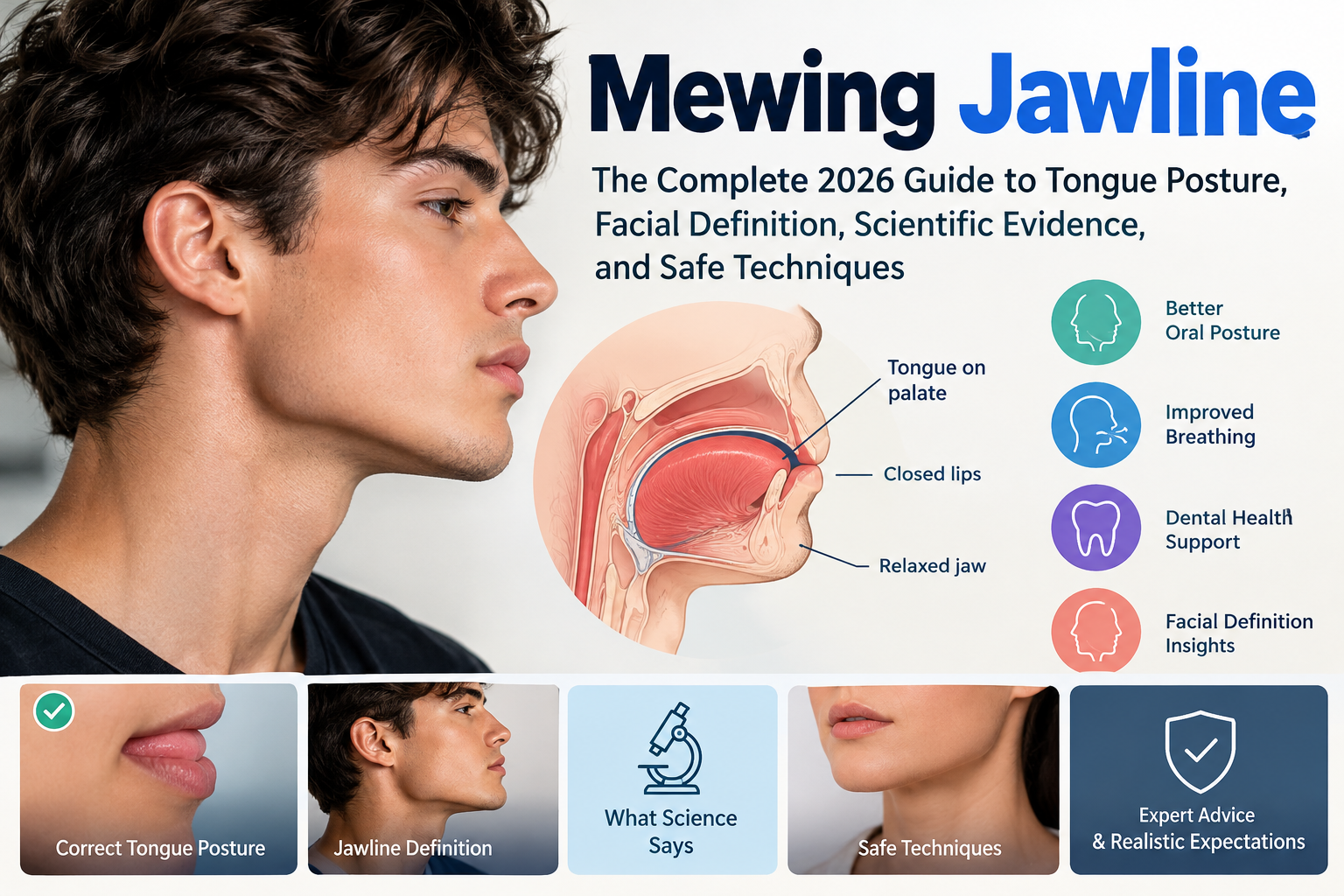
The mewing jawline trend has become popular on social media, where videos promise a sharper jaw, a more defined chin, and improved facial appearance through changes in tongue posture. The technique involves placing the tongue against the roof of the mouth while keeping the lips closed and breathing through the nose when comfortable.
Although proper oral posture plays a role in breathing, swallowing, and dental function, claims that mewing can dramatically reshape an adult’s facial bones are not supported by strong scientific evidence. Understanding the difference between healthy tongue posture and exaggerated appearance claims can help you make informed decisions without risking your dental health.
This guide explains how the technique is performed, what research can and cannot establish, which factors influence jawline definition, and when professional dental or medical advice is appropriate.
What Is Mewing and How Does It Relate to the Jawline?
Mewing is an informal term for a tongue-posture technique associated with British orthodontist John Mew and his son Mike Mew. It generally involves resting the tongue against the palate, keeping the lips together comfortably, and maintaining a relaxed jaw. Online communities often present it as a natural way to improve facial structure.
The idea behind mewing is that oral posture and muscle function may influence facial development, particularly during childhood and adolescence. However, this concept is frequently extended online into claims that consciously positioning the tongue will substantially change the jawbone, cheekbones, or chin in adults. Those claims go beyond what current evidence reliably demonstrates.
A key distinction is that healthy oral posture is not the same as a proven facial reshaping treatment. The tongue naturally changes position during speech, eating, and swallowing. Maintaining a comfortable resting position may support normal oral function, but it should not involve forceful pressure or constant muscular tension.
How to Practice Proper Tongue Posture Safely


If you want to understand the technique, focus on relaxed positioning rather than trying to force your face into a new shape. The following cues describe general oral posture, not a guaranteed method for changing your jawline.
- Rest the tongue gently: Allow the tongue to rest against the roof of the mouth where comfortable. Avoid pressing forcefully into the palate.
- Keep the lips relaxed: Your lips may rest together naturally without squeezing them tightly.
- Let the teeth remain relaxed: Avoid clenching or deliberately pushing the upper and lower teeth together.
- Breathe comfortably: Nasal breathing is generally preferable when your nasal passages are clear. Do not force it if you have congestion or breathing difficulties.
- Keep the jaw relaxed: Avoid jutting the lower jaw forward or tensing the muscles around the chin.
The goal is a comfortable resting posture, not an exhausting exercise. If your tongue cannot rest comfortably against the palate, or you experience pain, clicking, difficulty swallowing, or breathing problems, do not force the position. A dentist, orthodontist, or appropriately qualified healthcare professional can assess whether an underlying issue needs attention.
Does Mewing Actually Create a Sharper Jawline?
The most important question is whether the technique produces lasting structural changes. According to the American Association of Orthodontists and Cleveland Clinic, there is no strong scientific evidence that mewing reliably reshapes the jawline or corrects teeth alignment.
That does not mean tongue posture is irrelevant to oral function; it means the specific promise of a dramatically sharper face from voluntary tongue positioning has not been established.
Facial appearance is influenced by several factors, including inherited bone structure, age, dental alignment, soft-tissue distribution, and the shape of the chin and lower jaw. Lighting, camera angles, head position, facial expressions, and changes in body weight can also affect how defined the jaw appears in photographs. Before-and-after images shared online rarely control for these variables, so they cannot establish that tongue posture caused the difference.
A useful way to understand the limitation is to compare posture with orthodontic treatment. Braces and clear aligners use carefully planned forces to move teeth over time, while certain jaw discrepancies may require specialist treatment or surgery. Simply holding the tongue in a particular position is not an equivalent, validated treatment method.
Mewing for Adults Versus Teenagers
Age matters when discussing facial growth. During childhood and adolescence, the jaws and other facial structures are still developing. Tongue posture, oral habits, dental relationships, and breathing patterns may be relevant when a clinician assesses a child’s development, but this does not establish that self-directed mewing can predictably improve facial appearance.
In adults, the facial skeleton is largely mature, so a tongue-positioning habit should not be expected to produce major changes in jawbone shape. Adults who notice an overbite, underbite, crowded teeth, or a recessed chin are better served by an assessment from a dentist or orthodontist. A professional can distinguish between dental alignment issues, jaw relationships, and normal differences in facial anatomy.
| Factor | What it can influence | What to understand |
|---|---|---|
| Age and growth | Development of facial bones and jaws | Children and adults need different assessments |
| Genetics | Chin projection, jaw width, and facial proportions | Natural variation is normal |
| Dental alignment | Bite, tooth position, and smile appearance | Orthodontic evaluation can identify treatment needs |
| Soft tissue | How clearly the jawline is visible | Appearance varies between individuals |
| Head and neck posture | The jaw and neck’s appearance in photos | Temporary visual changes are not bone remodeling |
| Tongue posture | Oral resting habits and function | It is not a proven adult jaw-sculpting treatment |
The distinction is important for families, too. If a child habitually breathes through the mouth, snores, has difficulty swallowing, or has a noticeable bite problem, the appropriate response is professional evaluation rather than relying on social-media advice.
Risks of Forceful Mewing and Common Mistakes
Trying to make the technique more effective by applying greater pressure can be counterproductive. Forceful tongue placement, pushing against the teeth, clenching the jaw, or holding an unnatural position for long periods may contribute to discomfort and unwanted changes in dental alignment. The American Association of Orthodontists also warns about possible bite problems and speech difficulties associated with misguided oral-health trends.
Common mistakes include expecting fast results, pressing the tongue hard against the palate, pushing the lower jaw forward, and ignoring symptoms because they are assumed to be part of the process. If you develop jaw-joint pain, tooth sensitivity, changes in how your teeth meet, difficulty speaking, or discomfort when swallowing, stop the forced posture and consult a dental professional. Do not attempt to correct a suspected bite problem by applying more pressure.
The safest principle is straightforward: oral posture should feel natural and comfortable, not like a strenuous workout. Healthy habits should not require jaw clenching, persistent muscle tension, or pain. If you cannot breathe comfortably through your nose, do not force nasal breathing; nasal congestion and other breathing difficulties may need medical assessment.
Evidence-Based Ways to Improve Jawline Appearance
If your goal is a more defined jawline, start by understanding what affects its appearance. Genetics influence the shape of the mandible, chin projection, and facial proportions. Soft tissue, skin elasticity, age, and head position also affect how clearly the jaw separates visually from the neck. These factors explain why two people with similar body sizes can have very different jawlines.
Rather than relying on unproven facial exercises, focus on approaches that support overall health and address specific concerns. Maintain a comfortable, neutral head position, follow a balanced diet, and engage in regular physical activity. If weight management is appropriate for your health, pursue gradual, sustainable habits rather than extreme dieting. Losing weight does not guarantee a particular facial shape, and a naturally rounded jawline is not a health problem.
If your concern involves tooth alignment, a recessed chin, an overbite, or an underbite, consult a qualified dentist or orthodontist. Depending on the cause, professional options may include braces, clear aligners, or specialist assessment for a jaw discrepancy. Orthodontic treatment can correct certain dental and bite problems, but the right treatment depends on an individual examination.
Mewing, Myofunctional Therapy, and Professional Treatment
Mewing is often confused with orofacial myofunctional therapy, a structured approach that may involve exercises for tongue movement, lip posture, swallowing, and other oral functions. The important difference is that therapy is tailored to an identified functional concern and delivered or guided by an appropriately trained professional. It is not simply an appearance-focused routine performed in front of a mirror.
Research on myofunctional therapy is still developing, and findings vary according to the condition being treated and the quality of the studies. A 2025 scoping review found that evidence for several applications remained limited or inconclusive. This means that therapy may be useful in selected clinical situations, but it should not be promoted as a guaranteed way to reshape the face.
For example, someone with an unusual swallowing pattern may benefit from a professional assessment involving a dentist or speech-language pathologist with relevant training. Someone who snores heavily or struggles to breathe through the nose may need medical evaluation instead. The treatment should address the underlying problem rather than assuming that a single tongue position can resolve every concern.
Frequently Asked Questions
How long does mewing take to change your jawline?
There is no scientifically established timeline because strong evidence does not show that mewing reliably changes an adult jawline. Online claims about visible changes within weeks or months are not a dependable guide. Differences in photographs may reflect lighting, head position, facial expression, or natural changes rather than a structural effect of tongue posture.
Does mewing work for adults?
Current evidence does not establish that mewing can significantly reshape an adult’s facial bones or reliably correct dental alignment. Adults can still benefit from addressing oral-function concerns with appropriate professional guidance, but this is different from expecting a cosmetic transformation through tongue positioning alone.
Can mewing fix an overbite or underbite?
No reliable evidence shows that self-directed mewing can correct an overbite or underbite. These conditions involve the relationship between the teeth and, in some cases, the jaws themselves. An orthodontist can assess the type and severity of the bite problem and explain whether orthodontic appliances or other treatment may be appropriate.
Is hard mewing more effective than normal mewing?
There is no credible evidence that forcefully pressing the tongue against the palate produces better jawline results. Excessive pressure, tooth pushing, and jaw clenching may cause discomfort or contribute to unwanted dental changes. Keep the tongue and jaw relaxed rather than treating oral posture as a strength-training exercise.
Can mewing make your chin more prominent?
There is no strong evidence that mewing can permanently move an adult’s chin forward or change the underlying jawbone shape. Chin projection is influenced largely by facial anatomy and the relationship between the jaws. If chin position or facial balance concerns you, a qualified clinician can explain realistic options based on your individual structure.
Does tongue posture matter for oral health?
Yes, tongue posture can be relevant to oral function, including swallowing and the development of oral habits. However, its significance depends on the individual, and not everyone needs posture training. If you have difficulty swallowing, persistent mouth breathing, speech concerns, or dental problems, seek an appropriate professional assessment rather than trying to force a new resting position.
Can mewing cause jaw pain?
Forceful positioning or repeated clenching may contribute to jaw muscle discomfort or aggravate existing symptoms in some people. Stop any posture that causes pain, clicking with discomfort, restricted movement, or changes in your bite. A dentist or healthcare professional can help determine whether the symptoms relate to the temporomandibular joint, muscles, teeth, or another cause.
Conclusion: Focus on Healthy Oral Posture, Not Unproven Promises
The popularity of the mewing jawline trend reflects a desire for simple ways to improve facial appearance, but its most dramatic promises are not backed by strong scientific evidence. Resting the tongue comfortably, keeping the jaw relaxed, and breathing through the nose when possible can be part of normal oral habits. These practices should not be confused with a proven method for reshaping adult facial bones.
A defined jawline depends on many factors, including inherited anatomy, chin projection, soft tissue, age, and posture. When a concern involves bite alignment, breathing, swallowing, or jaw discomfort, professional assessment is more reliable than experimenting with forceful techniques.
The final takeaway: Prioritize comfortable oral function and evidence-based care over promises of rapid facial transformation. Healthy habits can support your well-being, while a dentist or orthodontist can help you understand which changes are realistic and safe for your individual needs.