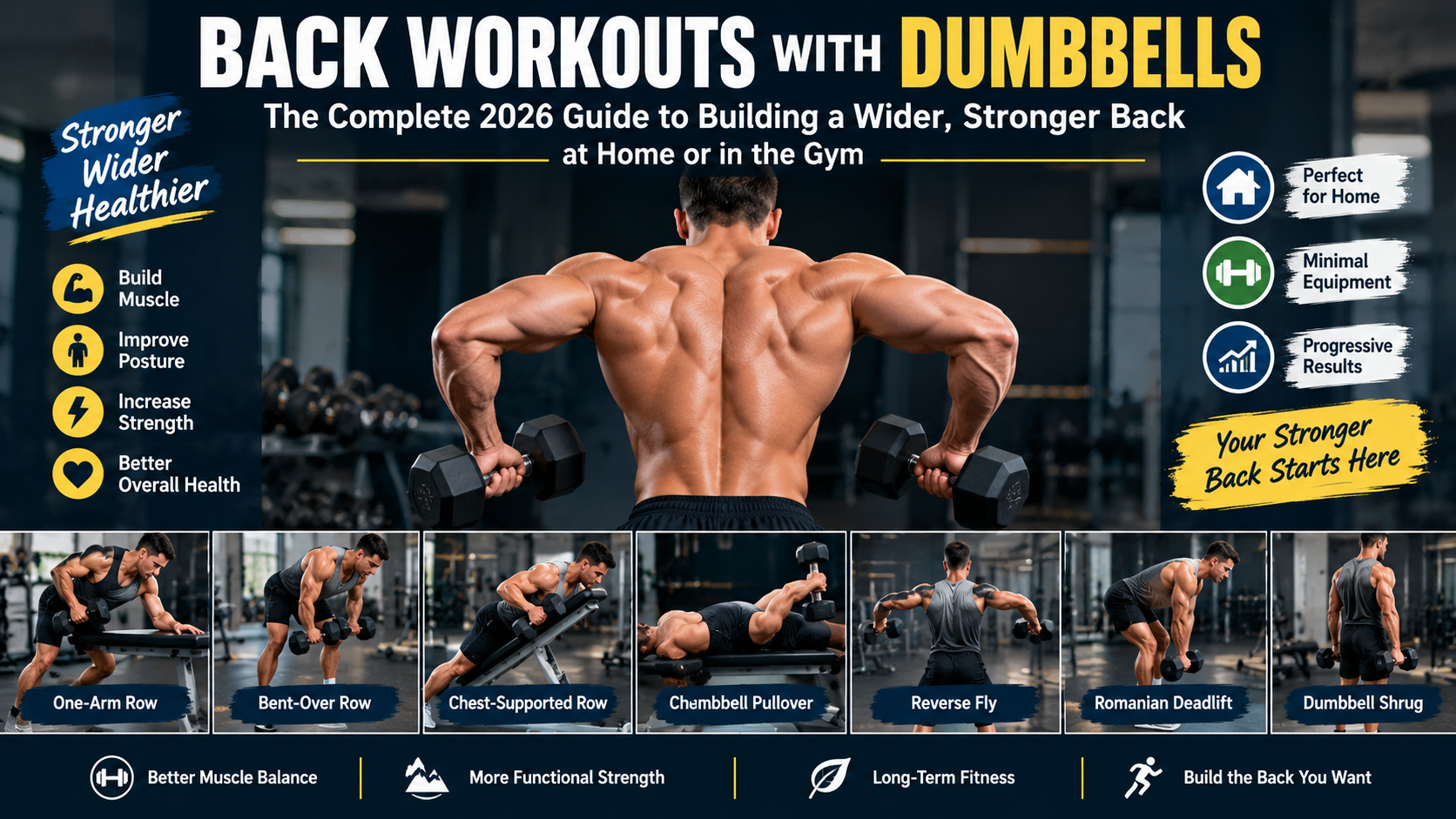
If you want a stronger, wider back without relying on a complicated gym setup, back workouts with dumbbells are an excellent place to start. A pair of dumbbells can train the lats, rhomboids, trapezius, rear deltoids, spinal erectors and other muscles that contribute to a powerful upper body.
The real advantage of dumbbells is flexibility. You can train one side at a time, change your grip, adjust your range of motion and work through movements that are difficult to reproduce with a barbell. They also make it possible to train effectively at home with relatively little equipment.
A good back session is not simply about pulling heavy weights. The goal is to create controlled tension through the target muscles, maintain a stable torso and gradually increase the challenge over time. As a practical training rule, “Move the weight with your back, not your ego.” That means prioritizing technique over load.
Why Back Workouts With Dumbbells Work So Well
The back is a large collection of muscles rather than one single muscle. The latissimus dorsi contributes to back width, the trapezius and rhomboids help create upper-back thickness, while the erector spinae supports the spine and helps maintain posture. A well-designed dumbbell workout can address several of these areas in one session.
Dumbbells also allow more freedom than a fixed bar. Your hands can move independently, which can help reveal strength differences between the left and right sides. If your dominant arm tends to do most of the work during rows, unilateral exercises can help you identify and gradually address that imbalance.
Another benefit is accessibility. A beginner can start with light dumbbells and learn the movement pattern, while an experienced lifter can use heavier weights, slower repetitions, pauses and more challenging variations. The same basic equipment can therefore remain useful for years.
The Back Muscles You Need to Train
Understanding the anatomy makes exercise selection much easier. The latissimus dorsi, commonly called the lats, are large muscles that extend from the mid-to-lower back toward the upper arm. They are heavily involved in pulling the arm downward and backward and contribute strongly to the appearance of a wider back.
The rhomboids and middle trapezius sit around the shoulder blades and play an important role in pulling the shoulder blades toward each other. The upper trapezius contributes to shoulder elevation, while the lower trapezius helps with scapular control. The rear deltoids also contribute during many rowing movements.
The spinal erectors run along the spine and help stabilize and extend the trunk. They are involved in exercises such as dumbbell Romanian deadlifts and bent-over rows, although the exact muscle emphasis depends on technique. This is why a balanced program should include both rowing movements and exercises that challenge the posterior chain.
Best Dumbbell Exercises for a Complete Back
Effective back workouts with dumbbells don’t require dozens of exercises. A handful of well-chosen movements can cover most of the major functions of the back.
| Exercise | Primary emphasis | Useful training benefit |
|---|---|---|
| One-arm dumbbell row | Lats, rhomboids, traps | Excellent unilateral pulling movement |
| Bent-over dumbbell row | Upper back and lats | Builds overall pulling strength |
| Chest-supported dumbbell row | Upper back and lats | Reduces lower-back involvement |
| Dumbbell pullover | Lats and upper body | Trains shoulder extension through a long range |
| Dumbbell reverse fly | Rear delts, rhomboids | Develops upper-back detail and shoulder control |
| Dumbbell Romanian deadlift | Hamstrings, glutes, erectors | Strengthens the posterior chain |
| Dumbbell shrug | Upper trapezius | Builds upper-trap strength and size |
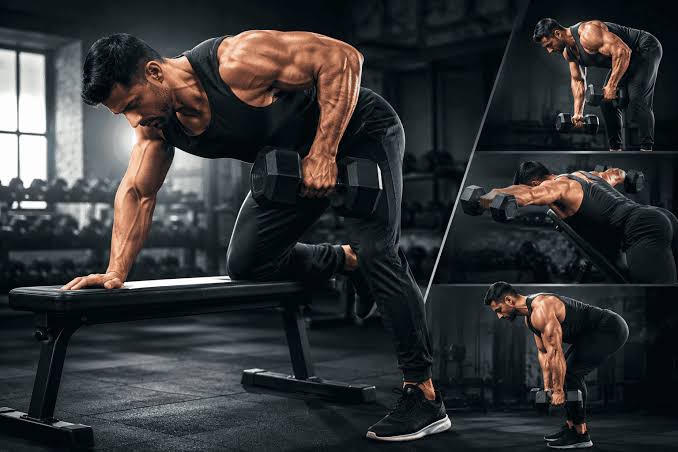
The one-arm dumbbell row is particularly useful because you can support yourself with a bench or another stable surface. This reduces the demand on your lower back and allows you to concentrate on pulling the elbow toward your hip.
Chest-supported rows are another valuable option when available. By placing your chest against an incline bench, you remove much of the need to stabilize the torso. This can be useful when your lower back becomes the limiting factor during conventional rows.
Building Back Width With Dumbbells
If your goal is a wider-looking back, your training should give plenty of attention to the lats. Although dumbbells cannot perfectly reproduce every cable or pull-up variation, they can still provide meaningful resistance through shoulder-extension and rowing patterns.
One-arm rows are particularly useful here. Instead of thinking about pulling the dumbbell toward your hand, imagine driving your elbow backward and slightly toward your hip. That subtle change can help you feel the lat working rather than simply turning the movement into an arm exercise.
Dumbbell pullovers can also complement rowing exercises by challenging the lats through a different movement pattern. Use a controlled range of motion rather than forcing the dumbbell excessively far behind your head. The objective is muscular tension, not seeing how far you can stretch.
Building Upper-Back Thickness
A thick upper back comes from developing several muscles around the shoulder blades. Rows are the foundation because they allow you to load horizontal pulling patterns progressively.
During a row, avoid turning the exercise into a full-body movement. Keep your torso controlled and allow the shoulder blade to move naturally before pulling the elbow backward. At the top, a brief pause can make a moderate dumbbell feel much more challenging without requiring a dramatic increase in weight.
Reverse flyes can then add targeted work for the rear shoulders and upper-back muscles. Because the muscles involved are relatively small, heavy weights are usually unnecessary. Lighter dumbbells and controlled repetitions are often much more productive than swinging large weights through a short range.
A Simple Dumbbell Back Workout
A practical session can be built around one major row, one secondary row, one lat-focused movement and one upper-back isolation exercise. For example, you could perform one-arm dumbbell rows, chest-supported rows, dumbbell pullovers and reverse flyes.
For many recreational lifters, around three working sets per exercise provides a reasonable starting point. Moderate repetition ranges can work well for compound rows, while higher repetitions can be useful for reverse flyes. Beginners should focus first on learning consistent technique rather than immediately chasing maximum weight.
Rest long enough to perform the next set with good form. If your repetitions become dramatically slower because you are exhausted, the limiting factor may have shifted from the back muscles to general fatigue. A slightly longer rest period can often improve the quality of the next set.
Form and Technique Matter More Than Heavy Weights
One of the most common mistakes in back workouts with dumbbells is using too much weight. When the dumbbell becomes excessively heavy, people often jerk the torso, rotate the shoulders or shorten the movement.
A better approach is to establish a stable starting position and control both directions of the repetition. The lowering phase matters just as much as the lifting phase because the muscles remain under tension while the weight returns to its starting position.
For rows, think about keeping the chest stable while moving the elbow. For reverse flyes, keep the movement relatively controlled and avoid turning the exercise into a momentum-driven swing. For Romanian deadlifts, maintain a neutral spine and move through the hips rather than repeatedly rounding the lower back.
A useful coaching principle is simple: if you cannot control the weight, the weight is controlling you.
Training at Home With Limited Equipment
One reason back workouts with dumbbells are so popular is that they work surprisingly well in a home environment. You do not necessarily need a complete home gym. A pair of adjustable dumbbells and a stable bench can provide enough variety for a productive back session.
Without a bench, you can still perform standing bent-over rows, Romanian deadlifts and other movements. However, make sure the surface you use for support is stable and appropriate for exercise. Avoid improvising with unstable furniture.
Adjustable dumbbells are especially useful because progression becomes easier. Instead of purchasing a separate pair for every weight, you can increase resistance gradually as your strength improves. This can make home training both practical and economical.
How to Progress Without Losing Good Form
Progressive overload is one of the foundations of resistance training. It does not always mean adding more weight. You can increase repetitions, improve range of motion, slow the eccentric phase, add a pause or perform more high-quality sets.
For example, if you can comfortably perform a movement for eight controlled repetitions, you might gradually work toward ten or twelve before increasing the dumbbell weight. Once you increase the load, return to a lower repetition target and build upward again.
This approach works particularly well for back workouts with dumbbells because the back contains both large and relatively small muscles. A weight that is appropriate for rows may be far too heavy for reverse flyes. Progress should therefore be exercise-specific rather than based on one universal number.
Common Mistakes and Their Solutions
A frequent problem is letting the biceps dominate every row. This often happens when the lifter thinks primarily about moving the hand instead of driving the elbow. Concentrating on elbow movement and maintaining a controlled tempo can improve the mind-muscle connection.
Another common mistake is excessive torso rotation during one-arm rows. A small amount of natural movement can occur, but deliberately twisting the body to lift a heavier dumbbell reduces the quality of the exercise. Lowering the weight usually solves the problem immediately.
Training the back too aggressively can also become counterproductive. More exercises and more sets do not automatically produce faster results. Muscles need adequate recovery, and performance can suffer when every session becomes a test of exhaustion.
Finally, don’t neglect the lower body and core. Romanian deadlifts and bent-over movements require trunk stability, and a balanced strength program should develop the entire posterior chain rather than treating the back in isolation.
How Often to Train Your Back
For many people, training the back two times per week can work well because it allows volume to be distributed instead of crammed into one exhausting session. The exact frequency should depend on training experience, recovery, total weekly workload and the rest of the program.
Someone new to resistance training may make excellent progress with a single focused session while learning technique. More experienced lifters may divide pulling movements across two workouts, using different exercises or repetition ranges.
Recovery matters just as much as training frequency. Adequate sleep, sufficient nutrition and sensible progression all contribute to performance. If soreness remains severe or strength consistently declines, reducing training volume or allowing more recovery may be appropriate.
Frequently Asked Questions
Are back workouts with dumbbells effective for building muscle?
Yes. Dumbbells can provide sufficient resistance and progressive overload to build the major muscles of the back. Rows, pullovers, reverse flyes and posterior-chain exercises can collectively provide substantial training stimulus when performed with appropriate technique, resistance and consistency.
Can dumbbells build a wider back?
They can contribute significantly to back width by training the latissimus dorsi through rowing and shoulder-extension movements. Building a visibly wider back also depends on genetics, overall muscle development, nutrition and progressive resistance training.
How many exercises should a dumbbell back workout include?
A complete session does not need a huge exercise list. Around three to five well-selected movements can cover major areas of the back, particularly when the workout includes a row, a lat-focused movement and an upper-back exercise.
How heavy should dumbbells be for back training?
The appropriate weight is one that allows you to complete the intended repetitions with controlled technique while still making the final repetitions challenging. If you have to swing, twist or shorten the range of motion to complete the set, the dumbbells are probably too heavy.
Can beginners do back workouts with dumbbells?
Absolutely. Dumbbells are particularly useful for beginners because they allow gradual progression and relatively simple movement patterns. New lifters should prioritize learning proper posture, controlled repetitions and safe loading before attempting very heavy weights.
How long should a dumbbell back workout take?
A focused session can often be completed in roughly 30 to 50 minutes, depending on the number of exercises, sets, rest periods and training pace. Longer workouts are not automatically better; quality sets and consistent progression are more important.
Can dumbbells help improve posture?
Strengthening the upper back can support better shoulder and trunk control, particularly when combined with mobility work and good everyday movement habits. However, posture is influenced by many factors, so back exercises should be viewed as one component of a broader approach rather than a guaranteed correction.
Conclusion
The best back workouts with dumbbells are not necessarily the longest or most complicated. A strong program combines effective rowing movements, lat-focused exercises, upper-back work and posterior-chain training while giving you enough recovery to improve.
Focus on controlled repetitions, stable body positioning and gradual progression. Start with a manageable weight, learn the movement, and increase the challenge as your technique becomes more consistent. Over time, those small improvements can translate into greater back strength, more muscle and a noticeably stronger upper-body shape.
The biggest takeaway is simple: train the back with intention, not just weight. A pair of dumbbells can provide everything from beginner-friendly movements to challenging strength work, provided you use them consistently and progress intelligently.