

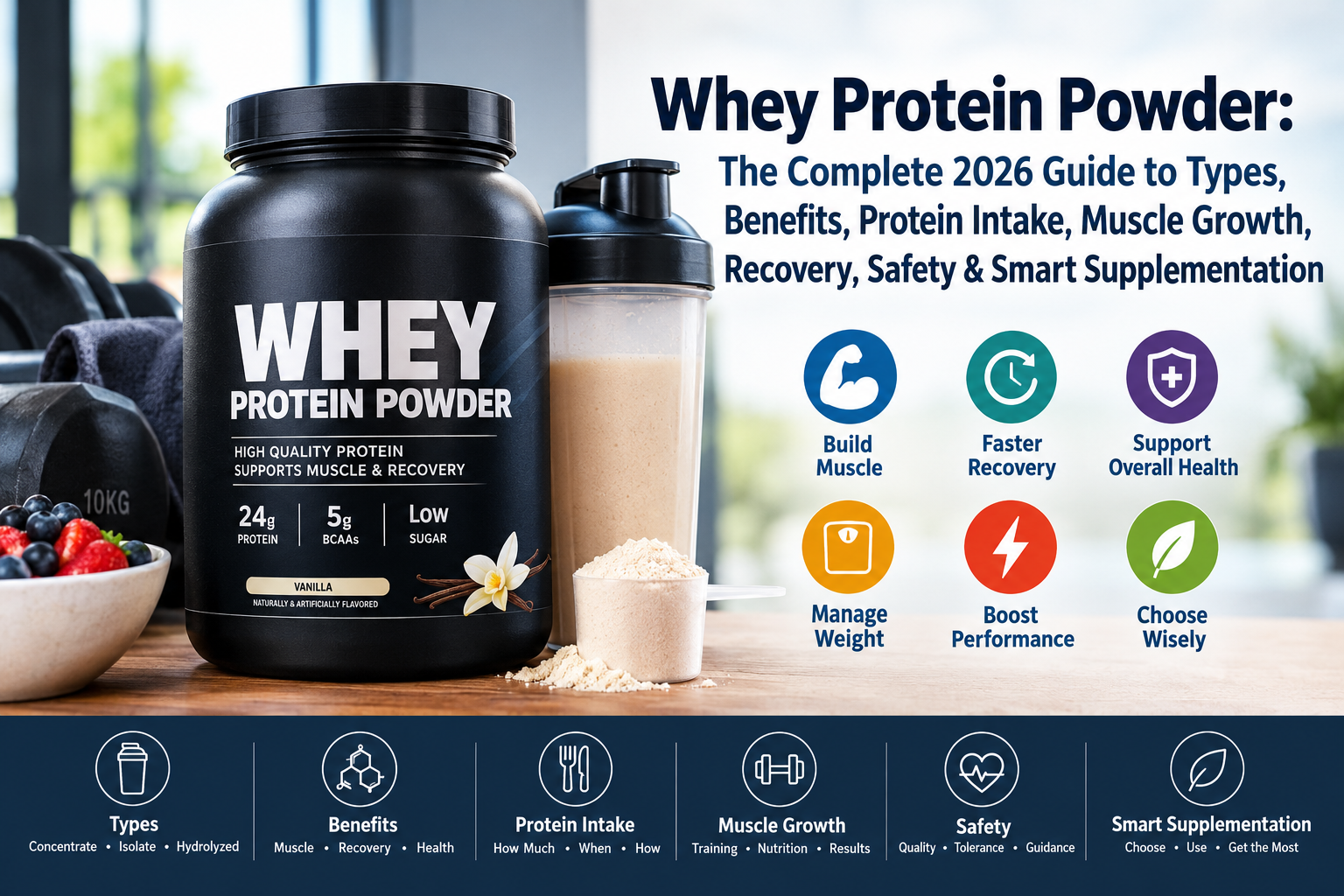
Whey protein powder has become one of the most widely used sports nutrition supplements because it offers a convenient way to increase daily protein intake without preparing another full meal. Made from milk, whey is a complete protein containing all nine essential amino acids, including the branched-chain amino acids (BCAAs) leucine, isoleucine, and valine. Its relatively rapid digestion and high-quality amino acid profile make it particularly useful around resistance training and during periods when meeting protein needs through food alone is difficult.
The important point, however, is that whey is a supplement rather than a shortcut to muscle growth. Muscle development depends on progressive resistance training, adequate total protein and calories, recovery, sleep, and consistent nutrition. Research involving resistance-trained adults suggests that protein supplementation can provide additional gains in lean mass and strength, but the effect is generally modest and becomes less meaningful when total daily protein intake is already sufficient.
What Is Whey Protein Powder?
Whey is the liquid portion separated from milk during cheesemaking. It contains proteins that can be processed, concentrated, filtered, dried, and turned into a convenient powder. The resulting product can vary considerably depending on processing, protein concentration, flavorings, sweeteners, carbohydrates, fats, and other added ingredients.
The most important nutritional feature is protein quality. Whey supplies all essential amino acids and is particularly rich in leucine, an amino acid involved in stimulating muscle protein synthesis. This makes it especially relevant for people performing resistance exercise. A useful way to think about it is as a concentrated building-material delivery system: it provides amino acids, but your training program supplies the stimulus that tells your body where and when those materials are needed.
How Whey Protein Powder Supports Muscle Growth
Muscle growth occurs through a continual balance between muscle protein breakdown and muscle protein synthesis. Resistance training creates a stimulus that increases the body’s need to repair and adapt muscle tissue. Consuming adequate protein supplies amino acids that can support this process.
Research supports the combination of protein intake and resistance training rather than treating protein as an independent muscle-building solution. Evidence from large research reviews suggests that protein supplementation during prolonged resistance training can improve strength, fat-free mass, and muscle size, with benefits becoming less apparent when total protein intake is already high.
That distinction matters in real life. Someone eating enough protein from chicken, fish, eggs, dairy, legumes, tofu, and other foods may gain little additional benefit from simply adding multiple shakes. Conversely, someone struggling to reach an appropriate protein target because of a busy schedule may find a shake extremely practical.
“The supplement works best when it solves a nutritional problem rather than creating another one.”
For example, a person who finishes work at 6 p.m., trains at 7 p.m., and cannot prepare dinner until later may use a shake as a convenient protein source. It is not the shake itself that creates the adaptation; it simply makes adequate protein intake easier to achieve consistently.
Whey Concentrate, Isolate and Hydrolyzed Whey Explained
The three major forms are whey concentrate, whey isolate, and hydrolyzed whey. They are produced through different processing methods and therefore differ in protein concentration, lactose content, fat, carbohydrates, texture, digestion characteristics, and price.
| Type | Typical characteristics | Best suited for |
|---|---|---|
| Whey concentrate | Contains protein plus varying amounts of lactose, fat and carbohydrates | Everyday use and general fitness |
| Whey isolate | More extensively filtered and generally higher in protein by weight with less lactose | People wanting a leaner protein source or those sensitive to lactose |
| Hydrolyzed whey | Protein is partially broken down into smaller peptides | Specialized sports-nutrition applications and people prioritizing rapid digestion |
Whey concentrate is often the simplest choice for everyday users because it provides high-quality protein without requiring the additional processing used to produce isolate. Whey isolate can be useful when someone wants to minimize lactose or reduce the amount of carbohydrate and fat accompanying each serving. Hydrolyzed products may digest differently, but their higher price does not automatically translate into better muscle growth for everyone.
The label matters more than the marketing language. Check the actual protein content per serving, serving size, carbohydrate and fat amounts, ingredient list, sweeteners, allergens, and any added compounds. A product advertised as “advanced” or “ultra” is not necessarily nutritionally superior to a straightforward formula.

How Much Protein Do You Need Each Day?
Protein requirements vary according to body size, age, training status, goals, energy intake, and other individual factors. The general adult RDA is 0.8 grams per kilogram of body weight per day, while sports-nutrition guidance commonly places the needs of athletes around 1.2–2.0 grams per kilogram per day.
For someone who weighs 75 kg, a sports-oriented range of 1.2–2.0 grams per kilogram would correspond to approximately 90–150 grams of protein per day. That does not mean all of it should come from whey. Food should remain the foundation of the diet, with supplementation used to close practical gaps.
| Body weight | 1.2 g/kg | 1.6 g/kg | 2.0 g/kg |
|---|---|---|---|
| 60 kg | 72 g | 96 g | 120 g |
| 70 kg | 84 g | 112 g | 140 g |
| 80 kg | 96 g | 128 g | 160 g |
| 90 kg | 108 g | 144 g | 180 g |
| 100 kg | 120 g | 160 g | 200 g |
These figures are planning examples rather than universal prescriptions. Research suggests that increasing total protein can help resistance-training adaptations, but more is not automatically better. Individual requirements can differ based on training volume, age, body composition, energy intake, and other factors.
When Should You Take Whey Protein?
The idea of a narrow “anabolic window” has been exaggerated. Protein timing around exercise can matter, but total daily protein intake is generally more important than obsessing over a precise minute on the clock.
A practical approach is to use a shake when it fits naturally into the day’s nutrition. For example, it can work after a morning workout when breakfast is delayed, between meals when protein intake is low, or after an evening training session when a full meal is inconvenient.
“Consistency beats perfect timing when the bigger nutritional picture is already in place.”
For many people, the best timing is simply the time that helps them maintain a consistent protein intake. Someone who already eats a protein-rich meal shortly after training may have little reason to rush home for a shake.
Whey Protein for Muscle Recovery and Exercise Performance
Training creates physical stress that requires recovery. Protein contributes amino acids for tissue repair and remodeling, making adequate intake particularly important when exercise volume is high. Whey is convenient because a serving can provide substantial protein without the preparation required for a complete meal.
However, protein should not be confused with an all-purpose performance enhancer. Its established role is supporting protein requirements, muscle repair, and adaptations to training rather than directly turning into immediate speed, endurance, or strength.
For a strength athlete, the practical distinction is simple: protein helps provide the raw materials for adaptation, while progressive overload creates the training stimulus. For an endurance athlete, carbohydrates, hydration, electrolytes, total energy intake, and sport-specific fueling can be equally or more important depending on the activity.
Whey Protein for Weight Loss and Fat Management
Whey can fit into a fat-loss diet because protein tends to be filling and can help people preserve lean tissue while reducing calories. A shake can also be easier to control portion-wise than a high-calorie snack or dessert. But whey does not independently “burn fat.”
The problem is often one of substitution. If someone adds a 150-calorie shake to an already adequate diet without changing anything else, total energy intake rises. If that same shake replaces a higher-calorie snack while maintaining sufficient overall nutrition, it can be useful.
This makes whey most useful as a food-management tool rather than a fat-burning ingredient. The question is not whether the powder has magical weight-loss properties; it is whether the protein source helps the person maintain an appropriate calorie intake while meeting protein needs.
Whey Protein and Lactose Sensitivity
Because whey comes from milk, lactose can be relevant. Whey concentrate generally contains more lactose than whey isolate, while the exact amount varies between products. Someone with lactose intolerance may therefore find an isolate easier to tolerate, although individual responses differ.
It is also important to distinguish lactose intolerance from a milk allergy. Lactose intolerance involves difficulty digesting lactose, whereas a milk allergy involves an immune response to milk proteins. A person with a confirmed milk allergy should not assume that switching between whey varieties makes the product appropriate.
If a protein shake consistently causes bloating, gas, abdominal discomfort, diarrhea, or other symptoms, the sensible response is to examine the ingredient list and overall diet rather than simply increasing the serving size. Other ingredients, sugar alcohols, thickeners, or large serving sizes can also contribute to digestive problems.
How to Choose a Quality Protein Powder
Choosing a quality product starts with the nutrition label rather than the front of the package. Look for a meaningful amount of protein per serving, transparent ingredient information, reasonable calories for your goal, and a formulation you can digest comfortably.
Because dietary supplements are not approved for safety and effectiveness before reaching consumers in the same way as medicines, product quality and responsible labeling deserve attention. Look for transparent manufacturers, clear ingredient information, appropriate serving sizes, and credible third-party testing where available.
Third-party testing can provide an additional layer of confidence, particularly for competitive athletes concerned about prohibited substances or contamination. Be cautious with products making unusually dramatic claims about muscle growth, hormone effects, rapid fat loss, or performance.
Common Problems With Whey Protein and Their Solutions
One common problem is digestive discomfort. The solution may be choosing a lower-lactose product, reducing the serving size, checking for sugar alcohols and other additives, or simply using another protein source. Another issue is unnecessary calorie accumulation from flavored powders, milk, nut butters, oats, and other shake ingredients that can turn a simple protein drink into a large meal.
A second problem is relying on shakes so heavily that whole foods disappear from the diet. Whole foods provide more than protein: they can contribute fiber, vitamins, minerals, essential fats, carbohydrates, and a broader range of nutrients. A useful rule is that a supplement should support a good diet rather than replace dietary variety.
People with kidney disease, certain metabolic conditions, significant food allergies, or other medical concerns should discuss high-protein diets and supplements with an appropriately qualified healthcare professional. Individual medical circumstances can change what is appropriate.
Whey Protein Powder vs Whole-Food Protein
Whole foods remain the nutritional foundation because they provide protein alongside other nutrients. Chicken, eggs, Greek yogurt, milk, fish, lean meat, beans, lentils, soy foods, and other protein-rich foods can all contribute to daily intake.
Whey’s main advantage is convenience. Imagine trying to obtain an additional 25 grams of protein during a busy workday. Preparing a complete meal may take time, while mixing powder with water or milk takes seconds. That convenience can improve consistency, which is often more valuable than choosing the theoretically perfect protein source but failing to consume enough of it.
The best approach is therefore complementary: use food for dietary variety and use supplements when they make your nutrition easier to execute.
Is Whey Protein Safe?
For healthy adults, whey is generally considered a practical protein source when consumed as part of an appropriate diet. Safety also depends on the product and the individual.
If a product causes persistent gastrointestinal symptoms, allergic reactions, or other concerning effects, discontinuing it and seeking appropriate medical advice is more sensible than assuming every reaction is normal. Product quality, serving size, total protein intake, allergies, and existing medical conditions all matter.
Frequently Asked Questions
Is whey protein powder good for building muscle?
Whey can support muscle growth when it helps a person meet adequate daily protein needs alongside resistance training. Protein supplementation can contribute to improvements in lean mass and strength during prolonged resistance training, but the benefits depend heavily on total protein intake, training quality, calories, and recovery.
How much whey protein should you take per day?
There is no universal number of scoops that everyone needs. The more useful approach is to calculate total daily protein from food and supplements and then use whey to fill the remaining gap. For many exercising adults, approximately 1.2–2.0 grams of total protein per kilogram of body weight per day is a commonly cited sports-nutrition range.
Is whey protein better than protein from food?
Not inherently. Whey is highly convenient and provides complete protein with a strong essential amino acid profile, but whole foods offer additional nutrients and dietary variety. Whey is best viewed as a convenient supplement rather than a replacement for a balanced diet.
Should you take whey protein before or after a workout?
Either can work depending on your daily eating pattern. The most important consideration is meeting total protein needs rather than trying to consume a shake within an extremely narrow post-workout window. A shake can be particularly useful when a normal protein-rich meal is not convenient after training.
Can whey protein help with weight loss?
It can support a weight-management strategy when it helps increase protein intake, improve satiety, or replace a higher-calorie food. It does not automatically cause fat loss. Weight reduction still depends primarily on maintaining an appropriate energy balance over time while preserving adequate nutrition and, ideally, lean mass through resistance exercise.
Is whey protein safe every day?
For most healthy adults, regular use can fit safely into a balanced diet when the overall protein intake and calories are appropriate. The quality of the product, individual tolerance, allergies, existing medical conditions, and total dietary intake all matter. People with medical conditions affecting protein or kidney metabolism should obtain individualized professional guidance.
Conclusion
Whey protein powder is best understood as a convenient, high-quality source of complete protein rather than a miracle supplement. Its strongest practical value is helping people consistently reach their protein needs, particularly when busy schedules, appetite, meal timing, or training demands make whole-food protein inconvenient.
The evidence supports protein supplementation as part of resistance training for improving lean mass and strength, but it also shows an important limit: simply consuming more protein does not replace progressive exercise, adequate calories, recovery, or a well-structured diet.
The final takeaway is straightforward: choose a transparent product that fits your nutritional needs, use it to complement whole foods, and focus on total daily protein rather than marketing promises or perfect timing. For most people, consistency—not the fanciest tub on the shelf—is what makes a protein strategy genuinely useful.