
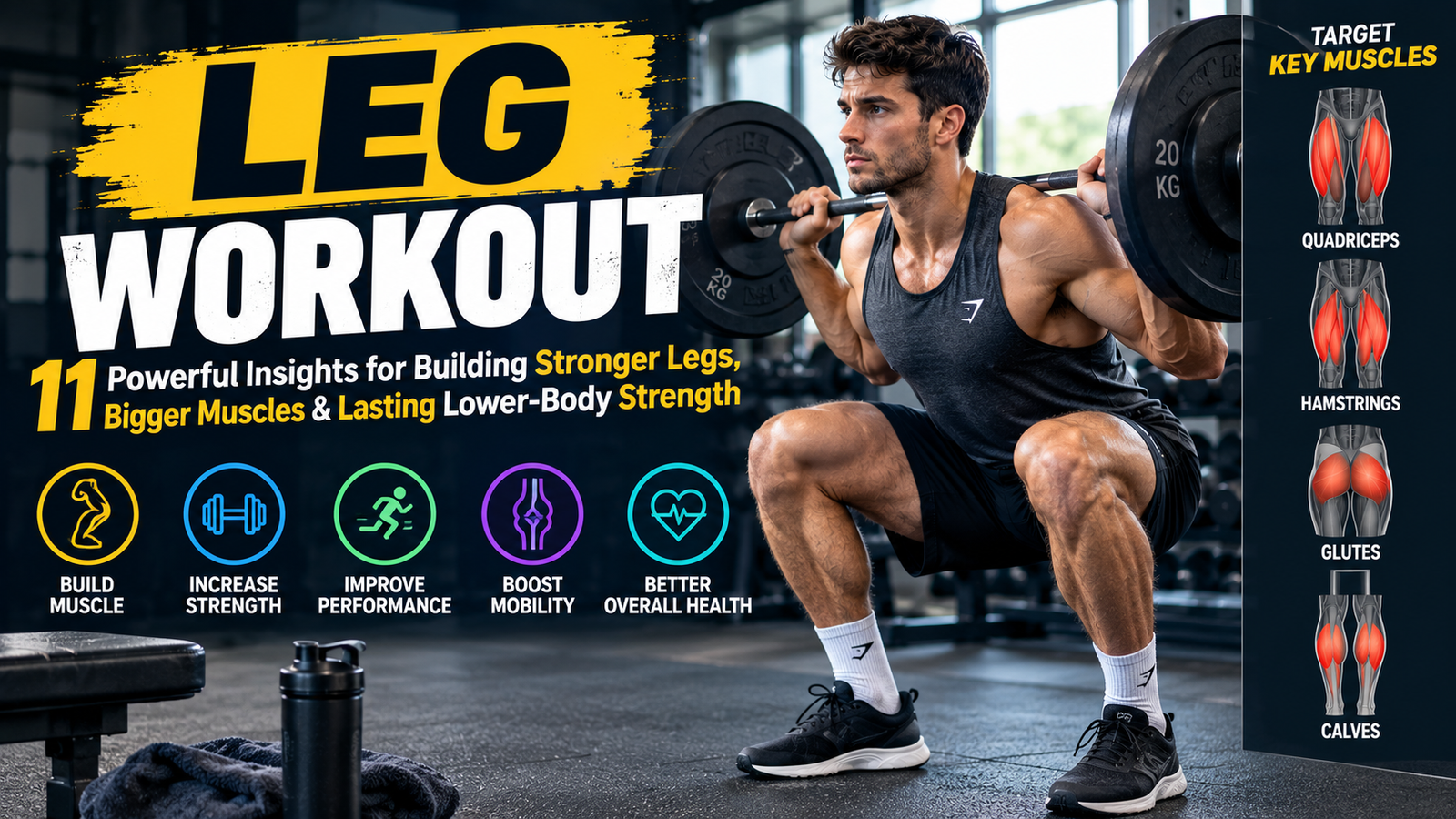
A well-designed leg workout is one of the most effective ways to build lower-body strength, develop muscular legs, improve athletic performance, and support everyday movement. Whether your goal is bigger quadriceps, stronger hamstrings, more developed glutes, or better overall fitness, training your lower body consistently can deliver benefits that extend far beyond appearance.
Your legs contain some of the body’s largest muscle groups, including the quadriceps, hamstrings, gluteal muscles, and calves. These muscles work together during squats, lunges, running, jumping, climbing stairs, and countless everyday activities. Training them effectively requires a combination of compound exercises, targeted isolation movements, appropriate resistance, and sufficient recovery.
The most effective approach is not necessarily the longest or most exhausting session. A productive routine prioritizes proper technique, progressive overload, balanced muscle development, and a training volume you can recover from. With the right structure, beginners and experienced lifters alike can develop stronger, more capable lower bodies.
Why Leg Training Matters for Strength and Muscle Growth
A consistent leg workout helps develop muscular strength, endurance, and size throughout the lower body. Exercises such as squats, Romanian deadlifts, leg presses, and lunges challenge multiple muscles simultaneously, making them valuable for building strength efficiently.
Strong legs also contribute to practical activities. Walking uphill, carrying heavy objects, getting up from a chair, and maintaining balance all rely on lower-body strength. For athletes, stronger legs can support acceleration, jumping, deceleration, and changes of direction, although sport-specific practice is still necessary to develop those skills.
Lower-body training also supports bone health by exposing the body to appropriate mechanical loading. Resistance exercise can contribute to maintaining bone density and muscle function as people age. These benefits make leg training valuable for general health, not just bodybuilding.
The Best Exercises for a Complete Leg Workout
An effective leg workout combines compound movements that train several muscle groups with isolation exercises that target specific areas. Compound lifts provide an efficient foundation, while accessory movements help address muscles that may receive less direct attention.
Essential lower-body exercises

Squats
Squats train the quadriceps and glutes while challenging the core and upper back. Choose a depth that allows you to maintain control and a comfortable, stable position.

Romanian deadlifts
This hip-hinge movement emphasizes the hamstrings and glutes. Keep the weights close to your legs and move your hips backward while maintaining a controlled torso position.

Leg presses
The leg press trains the quadriceps and glutes with external support for the torso. Use a comfortable range of motion without allowing your lower back to round excessively.

Lunges
Lunges develop unilateral strength, balance, and coordination. They also help reveal differences between the left and right legs.

Leg curls
Leg curls directly train the hamstrings through knee flexion. They complement hip-hinge exercises and help provide more complete hamstring training.

Calf raises
Calf raises strengthen the gastrocnemius and soleus. Use a controlled movement, a comfortable stretch, and a deliberate pause near the top.
Exercise selection should reflect your experience, mobility, available equipment, and training goals. You do not need every exercise in a single session. A few well-chosen movements performed consistently can produce excellent results.
A Practical Leg Workout Routine for Muscle Growth
The following routine combines compound lifts and isolation exercises to train the major lower-body muscle groups. It is designed for a generally healthy beginner-to-intermediate gym trainee who already understands basic exercise technique.
| Exercise | Sets | Repetitions | Main Muscles |
|---|---|---|---|
| Barbell or goblet squat | 3 | 6–10 | Quadriceps, glutes |
| Romanian deadlift | 3 | 8–12 | Hamstrings, glutes |
| Leg press | 3 | 10–12 | Quadriceps, glutes |
| Seated leg curl | 3 | 10–15 | Hamstrings |
| Standing calf raise | 3 | 12–20 | Calves |
| Reverse lunges | 2 | 8–12 per leg | Quadriceps, glutes |
Rest approximately two to three minutes between demanding compound sets and around 60–120 seconds for most isolation exercises. Take longer when needed to maintain good technique and performance.
Before beginning, spend five to ten minutes warming up with easy cycling or walking, followed by dynamic movements and lighter sets of your first exercise. Warm-up sets should prepare you for the working weight without creating unnecessary fatigue.
How to Train Each Leg Muscle Effectively
The quadriceps are located at the front of the thighs and help extend the knees. Squats, leg presses, split squats, and leg extensions are useful options for developing them. Exercises that allow a comfortable, controlled range of knee movement can provide a strong training stimulus.
The hamstrings work at both the hip and knee, making it useful to include different movement patterns. Romanian deadlifts train hip extension, while seated and lying leg curls train knee flexion. The glutes contribute to hip extension and stabilization, benefiting from squats, lunges, and hip-hinge exercises.
Calf training deserves its own attention. The gastrocnemius crosses both the knee and ankle, while the soleus crosses the ankle. Straight-knee calf raises emphasize the gastrocnemius, whereas bent-knee variations place greater emphasis on the soleus. Both can contribute to balanced lower-leg development.
Proper Form and Common Training Mistakes
Good technique makes a leg workout more productive and helps you apply resistance consistently. During squats, keep your feet stable, control the descent, and use a depth that suits your mobility and anatomy. Your knees can naturally travel forward over your toes when the movement is comfortable and controlled.
A common mistake is increasing weight before mastering the movement. Excessive loading can shorten your range of motion, encourage bouncing, or cause you to lose a stable position. Another problem is rushing repetitions. Controlled lowering and deliberate lifting make it easier to maintain consistent technique and recognize when fatigue is affecting performance.
Avoid treating every set as a maximum-effort test. Most working sets can finish with approximately one to three good repetitions still possible. Training to failure may occasionally be appropriate, particularly on safer machine exercises, but it is not necessary for every movement.
Sets, Repetitions, and Progressive Overload
Muscle growth depends on challenging training, sufficient weekly volume, and progressive overload. For many people, moderate repetition ranges provide a practical balance between resistance, technique, and fatigue. However, muscles can grow across a broad range of repetitions when sets are sufficiently challenging.
Start with a manageable amount of work and increase it gradually when recovery and performance support the change. If you consistently complete all prescribed repetitions with good form, add a small amount of weight. If technique deteriorates or you cannot reach the lower end of your repetition range, reduce the load.
A training log helps make progression measurable. Record your exercises, weights, repetitions, and sets. Over several weeks, these records can reveal whether your strength is improving and whether your routine needs adjustment.
Recovery, Nutrition, and Training Frequency
A demanding leg workout can create considerable muscular fatigue, particularly when it includes squats, lunges, and hip hinges. Allow sufficient recovery before repeating a similarly challenging session. Many recreational lifters train their legs once or twice per week, depending on total training volume, experience, and how well they recover.
Protein supports muscle repair and growth, while carbohydrates help provide energy for demanding training. For healthy adults who regularly perform resistance exercise, approximately 1.4–2.0 grams of protein per kilogram of body weight per day is a commonly used evidence-based range. Individual requirements can vary according to body composition goals, total calorie intake, age, and health circumstances.
Sleep matters just as much as the workout itself. Consistently getting adequate sleep, staying hydrated, and managing overall training stress can help maintain performance. If your legs remain unusually sore or your strength declines across several sessions, consider reducing training volume or taking additional recovery time.
Adapting Leg Training to Your Fitness Level
Beginners should focus on learning movement patterns before chasing heavy weights. Goblet squats, bodyweight split squats, light Romanian deadlifts, and machine exercises can help develop coordination and confidence. Starting with fewer sets also makes it easier to assess soreness and recovery.
Intermediate and advanced lifters may benefit from more specific programming. Someone prioritizing quadriceps growth could emphasize squats, leg presses, and leg extensions, while a lifter focused on hamstrings might allocate more work to Romanian deadlifts and leg curls. Exercise variations should support a clear goal rather than add complexity for its own sake.
Home training can be effective too. Dumbbells, resistance bands, adjustable weights, and bodyweight movements provide useful ways to train the lower body without a commercial gym. Split squats, step-ups, glute bridges, and single-leg calf raises can make lighter equipment more challenging.
FAQs About Leg Workout
How many times per week should I train legs?
Most people can make progress by training their legs once or twice per week. The ideal frequency depends on your training experience, weekly volume, exercise intensity, and recovery. Splitting your work across two sessions can help maintain exercise quality when a single session becomes too demanding.
How long should a leg workout last?
A typical session may take around 45–75 minutes, including warm-up sets, working sets, and rest periods. The exact duration depends on your exercise selection and training pace. A shorter session with focused, high-quality work can be more productive than a longer session filled with unnecessary exercises.
Can I build leg muscle without a barbell?
Yes. Dumbbells, resistance machines, resistance bands, and bodyweight exercises can all help develop leg strength and muscle. The key is choosing movements that challenge the target muscles and gradually increasing resistance, repetitions, or difficulty as your strength improves.
Should I do cardio before or after leg training?
If building strength or muscle is your main goal, perform demanding resistance exercises before longer or more intense cardio. A short, easy warm-up beforehand is beneficial. You can perform additional cardio afterward or on another day, depending on your recovery and overall fitness goals.
Why are my legs sore after training?
Muscle soreness can occur after unfamiliar exercises, increased training volume, or challenging eccentric movements. It often develops over the following day and may peak within 24–72 hours. Gentle movement can improve comfort, but sharp pain, substantial swelling, or worsening symptoms should not be treated as ordinary soreness.
Is training legs necessary for overall fitness?
Leg training is not the only way to improve fitness, but it is an important component of a balanced resistance-training program. Strong lower-body muscles support everyday movement, physical independence, balance, and many athletic activities. Combining leg exercises with upper-body training and cardiovascular activity provides broader fitness benefits.
Conclusion: Build Stronger Legs With Consistency
A well-planned leg workout develops more than muscular thighs and calves. It builds lower-body strength, supports athletic performance, improves functional movement, and contributes to a balanced physique. The foundation is straightforward: choose effective exercises, maintain proper technique, apply progressive overload, and give your body enough time and nutrition to recover.
You do not need an endless list of movements or exhausting sessions to make progress. Focus on consistent training, measurable improvements, and exercises that suit your current ability. Adjust the workload when recovery becomes difficult, and remember that muscle development takes time.
The final takeaway: Strong legs are built through quality repetitions repeated over months, not through one punishing workout. Train with purpose, progress patiently, and make recovery part of the plan.