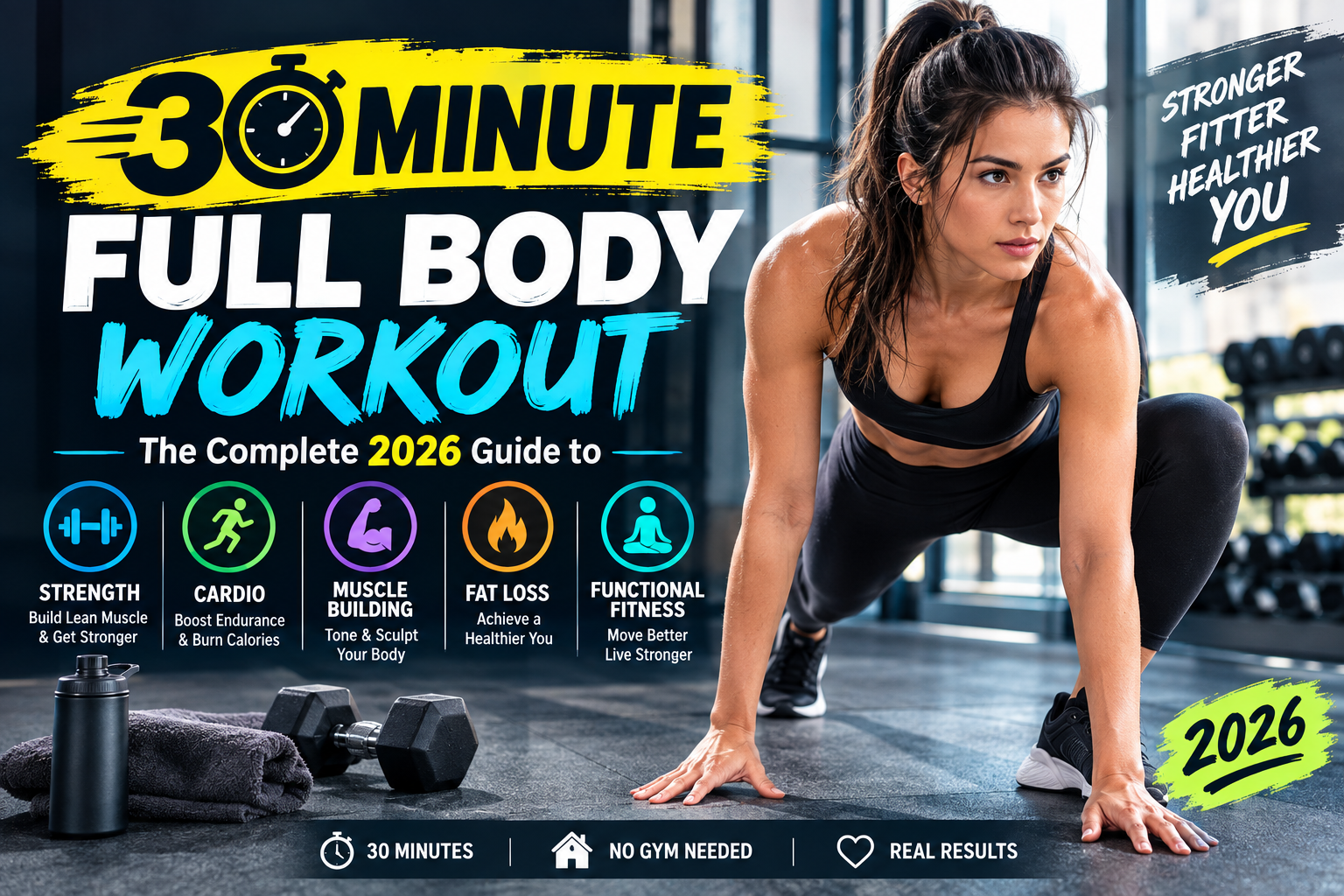
A 30 minute full body workout can be remarkably effective when it is structured around compound movements, appropriate resistance, controlled technique, and efficient rest periods. You do not need to spend an hour in the gym to train your major muscle groups effectively. The goal is to make each minute purposeful rather than simply making the workout longer.
A well-designed session can combine strength training, cardiovascular conditioning, core stability, mobility, and functional movement in one compact routine. Whether you train at home or in a gym, the right exercise selection can provide a challenging stimulus for your legs, chest, back, shoulders, arms, and core while keeping the session manageable enough to repeat consistently.
Why a 30 Minute Full Body Workout Works
The biggest advantage of a 30 minute full body workout is efficiency. Compound exercises such as squats, push-ups, rows, lunges, deadlifts, and overhead presses train multiple joints and muscle groups simultaneously. Instead of spending several minutes isolating individual muscles, you can create a balanced training stimulus through movements that require the body to work as a coordinated unit.
Exercise duration also needs to be viewed in context. A focused half-hour session performed with good technique can be more productive than a longer workout filled with unnecessary rest or poorly planned exercises. Consistency matters even more. A person who completes three efficient sessions every week is likely to make better long-term progress than someone who occasionally performs exhausting workouts but struggles to maintain a routine.
How to Structure a 30 Minute Full Body Workout
A practical 30 minute full body workout can be divided into a short warm-up, a focused strength circuit, a conditioning segment, and a brief cooldown. This structure allows you to prepare the joints and muscles before gradually increasing training intensity. It also gives the session a clear beginning, middle, and end.
| Workout Phase | Approximate Time | Main Purpose |
|---|---|---|
| Dynamic warm-up | 4–5 minutes | Raise temperature and prepare joints |
| Strength circuit | 15–17 minutes | Train major muscle groups |
| Conditioning | 5–6 minutes | Improve cardiovascular fitness |
| Cooldown | 2–3 minutes | Gradually reduce intensity |
The exact timing can change according to fitness level and training goals. Beginners may need longer recovery periods, while experienced exercisers can increase resistance or reduce rest. The principle remains the same: prioritize quality repetitions over rushing through exercises simply to beat the clock.

Best Exercises for a Full Body Session
The foundation of a 30 minute full body workout should be compound movements that provide a strong return on training time. Squats target the quadriceps, glutes, and supporting muscles, while hip-hinge movements such as Romanian deadlifts emphasize the posterior chain. Push-ups and presses train the chest, shoulders, and triceps, while rows develop the upper back and biceps.
A balanced session should also include unilateral movement and core stability. Reverse lunges, split squats, carries, planks, and dead bugs can challenge balance and coordination while addressing muscles that may receive less attention during basic bilateral exercises. A useful rule is to think in movement patterns rather than individual body parts: squat, hinge, push, pull, lunge, carry, and brace.
A Practical 30 Minute Full Body Workout Routine
A simple 30 minute full body workout can begin with bodyweight squats, arm circles, hip hinges, walking lunges, and light marching to raise body temperature. After the warm-up, move into a circuit containing squats or goblet squats, push-ups, dumbbell rows, Romanian deadlifts, reverse lunges, and a plank variation.
Perform each movement with controlled repetitions rather than trying to move as quickly as possible. Rest briefly between exercises and take a longer recovery period between rounds when necessary. For example, someone using dumbbells might choose a weight that makes the final few repetitions challenging while still allowing clean technique and a stable range of motion.
How to Make the Workout Harder
Progressive overload is what turns a 30 minute full body workout from a temporary calorie-burning session into a sustainable strength program. Progress does not always mean adding heavier weights. You can increase repetitions, improve range of motion, add resistance, reduce excessive rest, or perform the same movement with better control.
Suppose you can comfortably complete three rounds of goblet squats with a particular dumbbell. Rather than immediately doubling the weight, gradually increase repetitions or move to a slightly heavier load when your technique remains strong. This approach gives the muscles a reason to adapt without turning every session into a test of maximum effort.
Full Body Training for Muscle and Strength
A properly programmed 30 minute full body workout can support muscle development because resistance training creates a stimulus that encourages muscular adaptation. The most important variables are progressive resistance, sufficient training volume, recovery, nutrition, and consistency.
For strength development, prioritize controlled compound movements and gradually increase resistance. For hypertrophy, moderate repetitions combined with challenging sets can be effective. The American College of Sports Medicine emphasizes progressive resistance training and appropriate exercise selection as fundamental components of effective strength programming. Training does not need to be excessively long to be productive.
Full Body Workouts for Fat Loss and Cardio
A 30 minute full body workout can contribute to calorie expenditure and cardiovascular fitness, but fat loss ultimately depends on overall energy balance. Strength training helps preserve and build lean tissue, while conditioning work can increase cardiovascular demand and energy expenditure. Combining both approaches creates a more complete fitness strategy than relying exclusively on cardio.
For example, alternating strength exercises with short periods of brisk movement can keep the heart rate elevated without sacrificing resistance training. However, higher intensity is not automatically better. Someone who finishes every session completely exhausted may struggle to recover and maintain consistency. Sustainable training should challenge the body without constantly overwhelming it.
Home and Gym Variations
One of the strengths of a 30 minute full body workout is that it can be adapted to almost any environment. At home, bodyweight squats, push-ups, lunges, glute bridges, planks, and resistance-band rows can create a demanding session. A pair of adjustable dumbbells can expand the exercise selection considerably.
In a gym, barbells, cable machines, kettlebells, dumbbells, and resistance machines provide additional ways to progressively overload the muscles. The equipment changes the training possibilities, but the fundamental principles remain unchanged. Good technique, appropriate resistance, sufficient recovery, and progressive overload matter more than having an impressive collection of equipment.
Common Mistakes and Better Solutions
One common problem with a 30 minute full body workout is trying to fit too many exercises into the available time. Constantly switching movements can reduce focus and make the session feel rushed. The better solution is to select a small number of complementary exercises and repeat them consistently enough to measure progress.
Another mistake is sacrificing technique for speed. Fast repetitions can become uncontrolled, particularly during squats, lunges, deadlifts, and pressing movements. A useful training mindset is simple: “Make every repetition count before making every minute count.” Controlled movement allows you to train the intended muscles while reducing unnecessary stress caused by poor mechanics.
Recovery, Nutrition and Weekly Frequency
Recovery determines how well the body responds to training. A 30 minute full body workout places stress on several muscle groups simultaneously, so adequate sleep, hydration, protein intake, and rest days are important. Beginners may benefit from training two or three nonconsecutive days per week, while more experienced individuals can adjust frequency according to volume and recovery capacity.
Nutrition should support the goal rather than compete with it. Protein-rich foods such as eggs, poultry, fish, Greek yogurt, cottage cheese, beans, and lean meats can help support muscle repair. Carbohydrates provide useful training fuel, while fruits, vegetables, whole grains, and healthy fats contribute essential micronutrients and overall dietary quality.
How to Build Long-Term Progress
The most effective 30 minute full body workout is the one that can be repeated consistently and progressed intelligently. Keep a simple record of exercises, resistance, repetitions, and perceived effort. Over several weeks, those records can reveal whether strength and work capacity are improving.
Progress should also be measured beyond the scale. Better movement quality, increased strength, improved endurance, greater stability, and easier completion of everyday activities are meaningful signs of fitness. A person who can carry groceries, climb stairs, lift objects, or perform recreational activities with greater confidence is experiencing functional improvements that numbers alone cannot fully capture.
Frequently Asked Questions
Is a 30 minute full body workout enough?
Yes, 30 minutes can be enough when the session is structured efficiently and performed consistently. Compound exercises allow multiple muscle groups to be trained simultaneously, making shorter workouts particularly practical for busy schedules.
Can a 30 minute full body workout build muscle?
Yes. Muscle growth depends primarily on adequate resistance, progressive overload, sufficient training volume, nutrition, and recovery. A shorter session can support hypertrophy when those factors are managed effectively.
Can beginners do this type of workout?
Beginners can use a 30 minute full body workout, but exercise difficulty and resistance should be adjusted to their current ability. Starting with bodyweight movements and learning proper technique before increasing load is generally a sensible approach.
How many days per week should I train?
For many people, two to three full-body resistance sessions per week provide a practical starting point. Additional sessions may be appropriate depending on experience, intensity, recovery, and other physical activities.
Can I lose belly fat with full body workouts?
A 30 minute full body workout can support fat loss by increasing physical activity and helping maintain lean muscle, but it cannot selectively remove belly fat. Overall calorie balance, nutrition, sleep, stress, and long-term activity levels influence body-fat reduction.
Should I do cardio before or after strength training?
When strength or muscle development is the main priority, resistance training is generally best performed before demanding cardio. A short warm-up before lifting is useful, while moderate conditioning can be placed afterward. The ideal arrangement ultimately depends on the primary training goal.
Conclusion
A 30 minute full body workout proves that effective training does not require an enormous time commitment. With compound exercises, progressive overload, sensible conditioning, and disciplined technique, half an hour can provide meaningful stimulus for strength, muscle development, cardiovascular fitness, balance, and functional movement.
The real advantage is consistency. A manageable workout that fits naturally into your schedule is easier to repeat week after week. Focus on strong movement patterns, gradually increase the challenge, recover properly, and support training with quality nutrition.
The final insight is simple: fitness is built through repeated quality work, not through unnecessary hours in the gym. When every exercise has a purpose, 30 focused minutes can become a powerful foundation for long-term health and performance.