

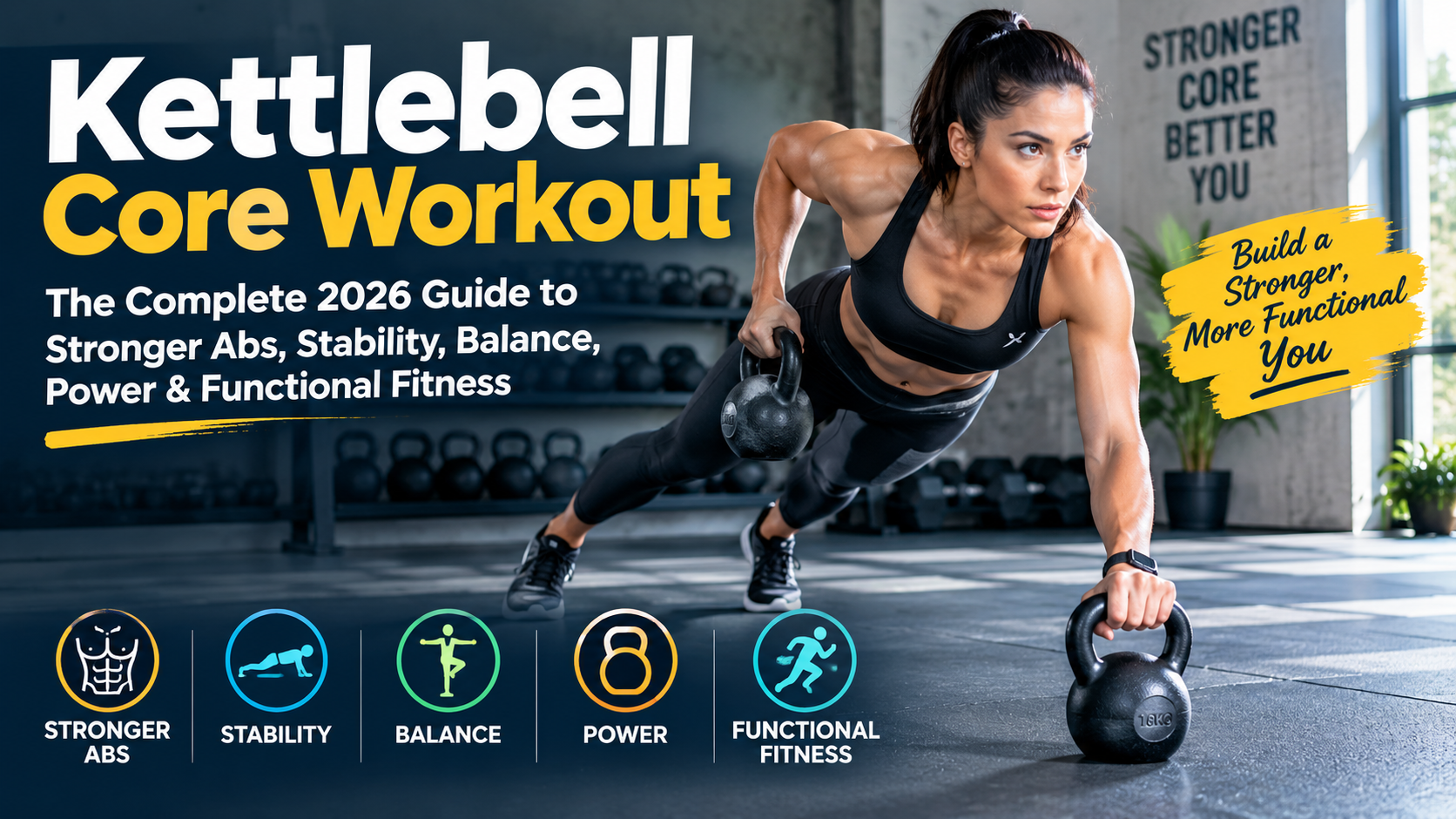
A kettlebell core workout can do much more than challenge your abdominal muscles. The shifting weight of a kettlebell forces your trunk to stabilize while your hips, shoulders, and legs produce movement. That makes kettlebell training particularly useful for developing core strength that transfers to lifting, running, sports, and everyday activities.
Unlike isolated abdominal exercises, kettlebell movements often require the core to resist motion. Your torso may need to prevent rotation during a suitcase carry, maintain alignment during a Turkish get-up, or stabilize the spine while the hips generate power during a swing. In other words, the goal is not simply to make your abs burn; it is to teach your entire midsection to control movement efficiently.
A well-designed kettlebell core workout can train the rectus abdominis, obliques, transverse abdominis, spinal stabilizers, glutes, and hip muscles together. With appropriate technique and progressive resistance, it can become a practical component of a broader strength and conditioning program.
What Is a Kettlebell Core Workout?
A kettlebell core workout is a strength-training session that uses one or more kettlebell exercises to challenge the muscles responsible for trunk stability, posture, force transfer, and controlled movement. These muscles include the abdominal wall, obliques, deep core musculature, lower-back stabilizers, diaphragm, pelvic-floor muscles, and surrounding hip musculature.
The defining feature is often core stability rather than simple spinal movement. For example, a plank asks the trunk to resist extension, while a suitcase carry asks it to resist lateral flexion. A kettlebell press can require the core to prevent unwanted rotation, while a Turkish get-up combines mobility, coordination, and full-body stability.
This distinction matters because everyday movement rarely involves performing isolated crunches. Carrying groceries, lifting an object from the floor, changing direction, or maintaining balance while moving a load all require the trunk to transfer force between the lower and upper body.
Why Kettlebells Are Effective for Core Training
Kettlebells have an offset center of mass, which creates a different stability challenge from many conventional dumbbell exercises. When the load moves away from your body’s center, your trunk must respond by creating tension and maintaining alignment.
That instability can be useful when it is controlled. Consider a suitcase carry: holding a kettlebell on one side creates an asymmetrical load, and your core must work to prevent your torso from leaning toward the weight. The exercise therefore trains the lateral stabilizers while simultaneously challenging grip, posture, and gait.
The same principle appears in dynamic movements. During a properly performed kettlebell swing, the hips generate most of the movement while the abdominal wall helps stabilize the trunk. The exercise therefore connects hip power with trunk control rather than treating the core as an isolated body part.
The Best Kettlebell Exercises for Your Core
A strong kettlebell core workout should include exercises that challenge different functions of the trunk. Important movement patterns include anti-extension, anti-rotation, anti-lateral flexion, controlled rotation, carries, and full-body stabilization.
| Exercise | Primary core demand | Main training benefit | Difficulty |
|---|---|---|---|
| Kettlebell dead bug | Anti-extension | Deep trunk control | Beginner |
| Suitcase carry | Anti-lateral flexion | Stability and posture | Beginner |
| Goblet squat | Bracing | Full-body strength | Beginner |
| Kettlebell swing | Dynamic stabilization | Hip power and coordination | Intermediate |
| Renegade row | Anti-rotation | Trunk and upper-body stability | Intermediate |
| Turkish get-up | Multi-planar stability | Coordination and control | Intermediate |
| Half-kneeling press | Anti-rotation | Shoulder and core stability | Intermediate |
The suitcase carry is especially accessible. Stand tall while holding a kettlebell in one hand, keep your ribs stacked over your pelvis, and walk slowly without allowing the weight to pull your torso sideways. The challenge comes from maintaining alignment rather than moving the kettlebell.
The Turkish get-up is more complex. It requires controlled transitions from lying to standing while keeping the kettlebell stable overhead. Because it combines mobility, balance, shoulder stability, and trunk control, it should be learned with a light weight before adding substantial resistance.

How to Perform a Kettlebell Core Workout Safely
Technique should come before load. A heavier kettlebell does not automatically produce a better training stimulus if the additional resistance causes excessive spinal movement, poor breathing, loss of balance, or compensatory motion.
Begin each exercise with a stable position and controlled breathing. During many strength movements, exhaling through the effort while maintaining abdominal tension can help create a strong brace. Avoid treating bracing as permanently sucking the stomach inward; effective trunk stability generally involves coordinated tension around the entire midsection.
A useful rule is to stop a set when technique begins to deteriorate rather than forcing additional repetitions. As one practical coaching principle puts it, “The strongest repetition is the one you can control from beginning to end.” This is particularly important with ballistic exercises such as swings, where poor mechanics can quickly become amplified by momentum.
Building a Beginner Kettlebell Core Workout
Beginners can start with movements that teach bracing and positional control before progressing toward faster or more technical exercises. A simple session might combine dead bugs, goblet squats, suitcase carries, and controlled kettlebell deadlifts.
The goal during the first few sessions is not exhaustion. Instead, focus on learning how to maintain a neutral trunk, hinge correctly at the hips, coordinate breathing with movement, and keep the kettlebell close to the body’s center when appropriate.
A beginner-friendly session could use two or three sets of each exercise with controlled repetitions or short carries. Rest long enough to maintain quality. Once technique becomes consistent, gradually increase repetitions, duration, or resistance rather than changing everything at once.
Using Kettlebell Swings for Core Stability
Kettlebell swings are frequently described as an abdominal exercise, but their primary movement comes from the hips. The glutes and hamstrings generate force during the hip hinge, while the core stabilizes the torso so that power can transfer efficiently.
The key is to avoid turning the swing into a squat or an arm raise. The kettlebell should travel because of the force produced by the hips, not because the shoulders are lifting it upward. At the top of the movement, the body should form a strong, controlled standing position rather than an exaggerated backward lean.
For people learning swings, starting with the hip hinge is essential. Practicing unloaded hinges and kettlebell deadlifts can help establish the movement pattern before introducing ballistic repetitions. Once the hinge is reliable, swings can become a powerful addition to a broader conditioning program.
Training Anti-Rotation and Lateral Stability
One of the most valuable aspects of a kettlebell core workout is its ability to train the trunk to resist unwanted movement. Anti-rotation exercises are particularly relevant because many athletic and everyday movements involve forces that attempt to twist the torso.
A half-kneeling kettlebell press is a useful example. From a stable half-kneeling position, pressing the kettlebell overhead creates a tendency for the body to compensate by rotating or arching. Maintaining a stacked ribcage and controlled pelvis forces the core to resist those changes.
Suitcase carries provide another straightforward approach. Because the load is held on one side, the trunk must resist bending. Walking slowly increases the coordination challenge because the core must stabilize the body while the legs and arms continue moving.
Using the Turkish Get-Up for Full-Body Stability
The Turkish get-up is one of the most comprehensive kettlebell movements for developing coordination and stability. The exercise involves moving from the floor to standing and back down while keeping the kettlebell controlled overhead.
Its value comes from the number of systems working together. The shoulder must stabilize the load, the trunk must maintain position, the hips must create mobility and stability, and the body must coordinate several transitions. It is therefore better viewed as a movement skill than a conventional abdominal exercise.
Beginners should practice the sequence without weight or with a very light kettlebell. Each transition should be deliberate. Rushing through the movement defeats much of its purpose and makes it harder to identify where technique is breaking down.
Creating a Balanced Training Session
A complete kettlebell core workout does not need dozens of exercises. Quality matters more than quantity. A practical session can begin with a warm-up, move into stability-focused exercises, progress toward stronger compound movements, and finish with carries or controlled conditioning.
For example, a session could combine dead bugs for trunk control, goblet squats for bracing under load, suitcase carries for lateral stability, and swings for dynamic hip power. More experienced trainees could incorporate Turkish get-ups or renegade rows.
The workout should also fit into a larger fitness program. Core training works best when combined with lower-body strength, upper-body pulling and pressing, cardiovascular conditioning, mobility work, and adequate recovery rather than performed as an isolated daily challenge.
Common Problems and How to Fix Them
A frequent problem is using too much weight. When the kettlebell is excessively heavy, people may compensate by leaning, arching the lower back, shrugging the shoulders, or losing control of the movement. The solution is simple but important: reduce the load until the intended movement pattern can be maintained.
Another issue is treating every core exercise as a race. Fast repetitions can reduce control and make it difficult to identify technical errors. Slowing down carries, get-ups, presses, and floor-based movements can increase the training challenge without increasing the weight.
Poor breathing is another common limitation. Holding the breath for extended periods can make a set feel unnecessarily difficult, while failing to create adequate trunk tension can reduce stability. Practice controlled breathing while maintaining a firm but sustainable brace.
How Often Should You Train Your Core With Kettlebells?
For most recreational trainees, direct core work can be included several times per week depending on training volume, exercise intensity, and recovery. Heavy or technically demanding movements require more recovery than light stability exercises.
A useful approach is to treat core training as part of strength programming rather than something that must be performed every day. A few well-executed exercises can provide a substantial stimulus, particularly when compound kettlebell movements already challenge the trunk.
Progress should be measured through better control, stronger resistance, longer carries, improved technique, or increased training capacity. Visible abdominal definition, meanwhile, depends heavily on overall body composition and cannot be produced by core exercises alone.
Who Can Benefit From Kettlebell Core Training?
A kettlebell core workout can benefit beginners, recreational lifters, athletes, and experienced strength trainees when exercises are selected according to ability. Beginners may benefit from learning basic bracing and carrying patterns, while experienced athletes can use more complex movements to challenge coordination and force transfer.
The training can also be useful for people who want efficient full-body workouts. A suitcase carry, swing, goblet squat, or Turkish get-up can involve multiple muscle groups simultaneously, allowing a relatively short session to train strength, stability, coordination, and conditioning.
However, people with an existing injury, persistent pain, recent surgery, or a medical condition affecting exercise tolerance should obtain appropriate professional guidance before starting a new resistance-training program. Exercise should challenge the body without deliberately provoking pain.
FAQs About Kettlebell Core Workouts
Is a kettlebell core workout good for building abs?
Yes, kettlebell training can strengthen the abdominal and trunk muscles, particularly through exercises involving bracing, anti-rotation, carries, and dynamic stabilization. However, stronger abdominal muscles and visible abs are different outcomes. Abdominal definition also depends on overall body composition, nutrition, genetics, and total physical activity.
Can kettlebell swings strengthen the core?
Kettlebell swings can train the core to stabilize the spine while the hips generate force. The exercise emphasizes the posterior chain, particularly the glutes and hamstrings, while the abdominal muscles help control the trunk. Proper hip-hinge mechanics are essential for getting the intended training effect.
How heavy should a kettlebell be for core exercises?
The appropriate weight depends on the exercise, training experience, and ability to maintain good technique. A lighter kettlebell is generally appropriate for technical exercises such as Turkish get-ups, while stronger trainees may use heavier loads for carries or squats. The correct resistance is one that challenges you without compromising control.
Can kettlebell exercises reduce belly fat?
Kettlebell training can contribute to overall energy expenditure and muscle development, but it cannot specifically target fat loss from the abdomen. Reducing body fat generally requires a sustainable combination of nutrition, physical activity, resistance training, cardiovascular exercise, sleep, and appropriate calorie balance.
How long should a kettlebell core workout last?
A focused session can be effective in roughly 15 to 30 minutes, particularly when it uses compound movements and controlled rest periods. Longer workouts are not automatically better. The ideal duration depends on the rest of your training program, exercise selection, intensity, and recovery capacity.
Can beginners do kettlebell core exercises?
Yes, beginners can use kettlebells for core training by starting with simple movements such as carries, deadlifts, goblet squats, and controlled floor exercises. Learning proper bracing and hip-hinge mechanics should come before advanced ballistic or technically demanding movements.
Conclusion
A well-designed kettlebell core workout develops much more than abdominal endurance. It teaches the trunk to resist unwanted movement, transfer force between the upper and lower body, maintain posture under load, and coordinate with the hips and shoulders.
The most effective approach is progressive rather than extreme. Begin with manageable resistance, master fundamental patterns, emphasize breathing and bracing, and gradually increase training demands as technique becomes reliable. Carries, swings, presses, squats, dead bugs, renegade rows, and Turkish get-ups can all contribute different pieces to a complete core-training strategy.
The final insight is that strong core training is less about making your abs tired and more about making your entire body capable of producing and controlling force. When kettlebell exercises are performed with precision and integrated into a balanced fitness program, they can provide a practical path toward greater stability, strength, coordination, and functional performance.