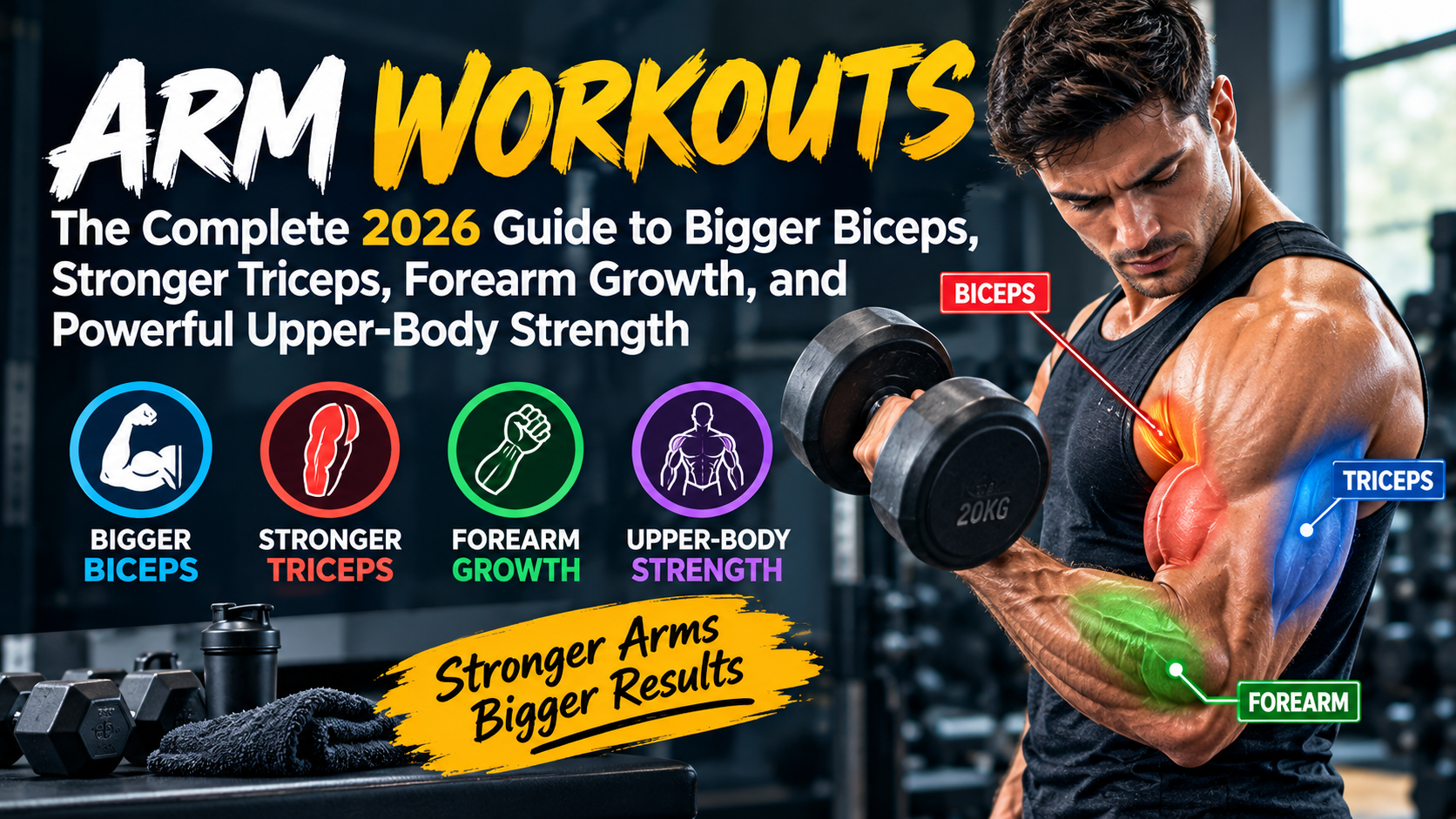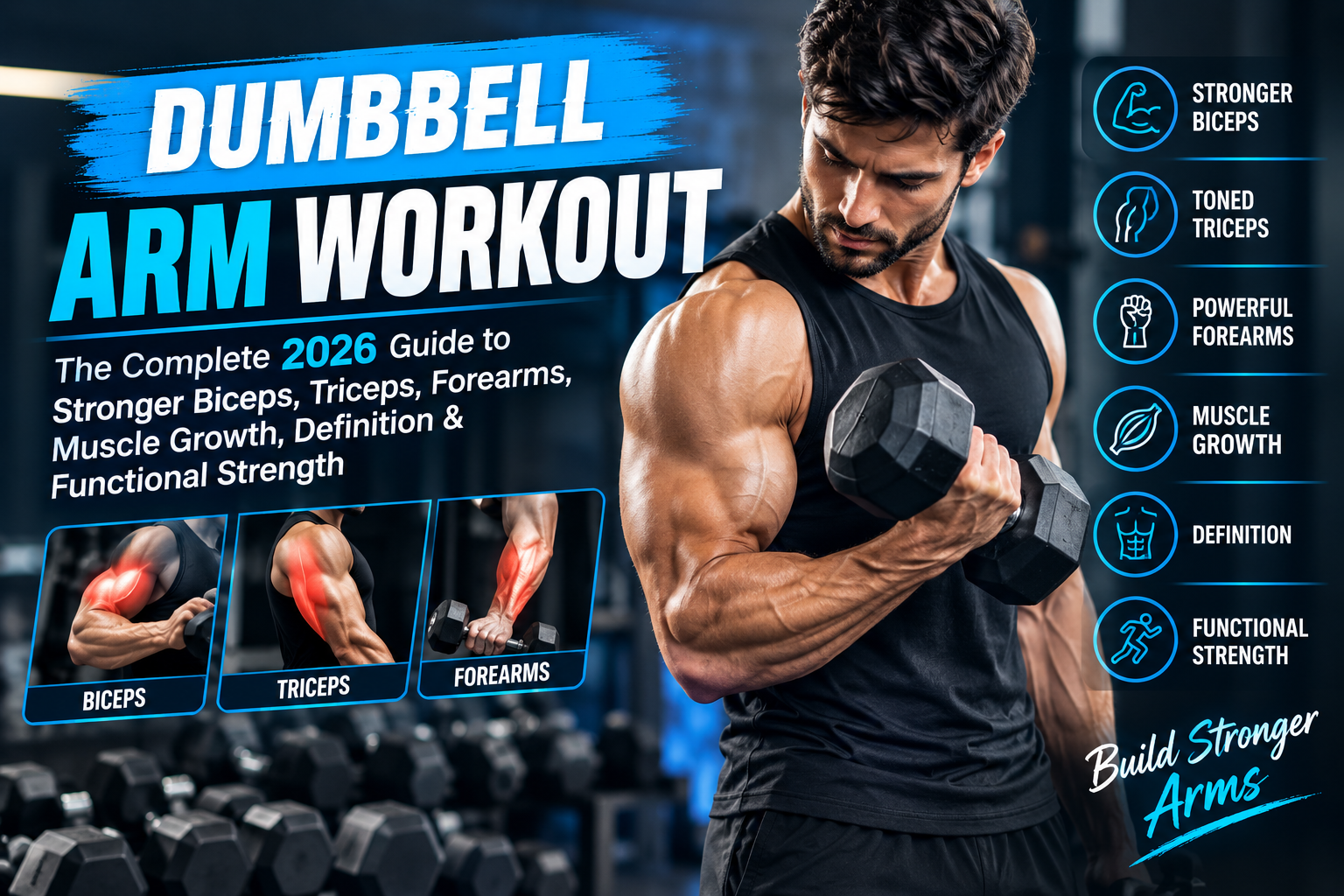
A dumbbell arm workout is one of the most practical ways to build stronger, more muscular arms without needing a large home gym or complicated equipment. With a pair of dumbbells, you can train the biceps, triceps, brachialis, forearms, and supporting muscles through a wide range of movements.
The biggest advantage is flexibility. Dumbbells allow each arm to work independently, which can expose strength imbalances that barbells sometimes hide. They also make it easier to adjust your grip, range of motion, training angle, and resistance.
For muscle growth, however, simply performing curls until your arms burn is not enough. Effective training depends on progressive overload, appropriate volume, controlled repetitions, sufficient recovery, and good nutrition. As the old strength-training principle puts it, “The exercise is the stimulus; recovery is where adaptation happens.”
What Is a Dumbbell Arm Workout?
A dumbbell arm workout is a resistance-training session designed primarily to strengthen and develop the muscles of the upper arms and forearms using dumbbells. The main targets are the biceps brachii, triceps brachii, brachialis, brachioradialis, and forearm muscles.
Although curls are usually associated with arm training, a balanced routine needs both elbow-flexion and elbow-extension exercises. Biceps curls train the muscles responsible for pulling the forearm upward, while movements such as dumbbell extensions and presses emphasize the triceps, which make up a substantial portion of upper-arm mass.
Dumbbells also provide an important unilateral-training benefit. If your right arm is stronger than your left, independent loading prevents the stronger side from doing most of the work. Over time, this can help improve muscular balance, coordination, and control.
Why Dumbbells Are Effective for Building Arm Muscle
One reason a dumbbell arm workout works so well is that dumbbells provide freedom of movement. Unlike a fixed barbell, each hand can follow a slightly different path that matches its natural anatomy. This can make certain exercises feel more comfortable while allowing you to focus on the target muscle.
Dumbbells are also useful for progressive overload. You can gradually increase resistance, repetitions, training volume, or exercise difficulty as your strength improves. Muscle hypertrophy does not require constantly using extremely heavy weights; consistent training performed sufficiently close to muscular fatigue can be highly productive.
Another benefit is accessibility. Adjustable or fixed dumbbells can fit into a home-training environment, apartment, garage gym, or commercial facility. A well-designed routine can therefore deliver meaningful arm training without requiring a complete cable or machine setup.
Best Dumbbell Exercises for Biceps and Triceps
A complete dumbbell arm workout should include exercises that challenge the arms from different positions and with different grips. For the biceps, the standard dumbbell curl is an excellent starting point because it is simple to learn and easy to progressively overload.
Hammer curls are particularly useful for developing the brachialis and brachioradialis alongside the biceps. Because the palms face inward, the neutral grip can also feel comfortable for people who find traditional supinated curls awkward. Incline dumbbell curls provide another useful variation by placing the shoulder farther behind the torso and increasing the lengthened position of the biceps.
For the triceps, overhead dumbbell extensions emphasize the long head, while lying dumbbell extensions provide a different resistance profile. Close-grip dumbbell pressing can also involve the triceps while allowing you to handle more total load than an isolation movement.


4
| Exercise | Primary muscles | Typical rep range | Key technique focus |
|---|---|---|---|
| Dumbbell Curl | Biceps | 8–15 | Keep elbows controlled |
| Hammer Curl | Brachialis, biceps, forearms | 8–15 | Maintain neutral grip |
| Incline Curl | Biceps | 10–15 | Control the stretched position |
| Overhead Extension | Triceps long head | 8–15 | Keep elbows relatively stable |
| Lying Extension | Triceps | 8–15 | Lower the weights under control |
| Close-Grip Dumbbell Press | Triceps, chest | 6–12 | Keep dumbbells close |
How to Structure an Effective Dumbbell Arm Workout
An effective dumbbell arm workout does not need to contain dozens of exercises. For most people, a focused session containing a few well-chosen movements is easier to perform consistently and recover from.
A useful structure begins with a compound movement or demanding exercise, followed by controlled isolation exercises. For example, a trainee might start with close-grip dumbbell presses, move into alternating curls, then perform overhead triceps extensions and hammer curls. This arrangement trains both sides of the upper arm without allowing exercise variety to overwhelm quality.
For general hypertrophy, moderate repetitions work well. A practical starting point is around 6–12 repetitions for heavier compound movements and roughly 8–15 repetitions for most isolation exercises. The final repetitions should feel challenging while maintaining sound technique.
Dumbbell Arm Workout for Beginners
For beginners, a dumbbell arm workout should prioritize technique rather than maximum weight. Start with a load that allows smooth repetitions and a controlled lowering phase. If your torso is swinging dramatically during curls, the dumbbell is probably too heavy for strict isolation work.
A simple beginner session can include dumbbell curls, hammer curls, overhead triceps extensions, and lying triceps extensions. Perform a manageable number of sets and leave some repetitions in reserve during the first few weeks. This gives connective tissues, joints, and muscles time to adapt.
Consistency matters more than chasing an intense pump. Someone who trains moderately three times a week for several months will generally make more useful progress than someone who performs exhausting arm sessions for two weeks and then stops.
Dumbbell Arm Workout for Muscle Growth
For hypertrophy, a dumbbell arm workout should create enough mechanical tension and training stimulus while still allowing adequate recovery. The goal is not simply to make the muscles tired; the goal is to repeatedly expose them to productive resistance.
Progressive overload can take several forms. You might increase a dumbbell from 15 to 20 pounds, move from 10 to 12 controlled repetitions, add a set, or improve technique with the same weight. A useful approach is double progression: work within a predetermined repetition range and increase resistance once you can comfortably reach the upper end with good form.
Training close to failure can be effective, particularly with isolation exercises, but every set does not need to become an all-out effort. Maintaining approximately one to three good repetitions in reserve on many working sets can provide a strong stimulus without creating unnecessary fatigue.
Common Problems and How to Fix Them
One common problem during arm training is using momentum instead of muscular control. During a curl, aggressively swinging the torso can move the dumbbell upward while reducing the challenge placed on the elbow flexors. The solution is simple: reduce the weight, stabilize the upper body, and control both directions of the movement.
Another issue is neglecting the triceps. People often associate large arms with biceps development, yet the triceps contribute substantially to upper-arm size. A routine containing plenty of curls but little direct triceps work can therefore produce an imbalanced result.
Limited progress can also come from changing exercises too frequently. Muscles do not require constant novelty. Keeping core movements in your program long enough to measure improvements in repetitions, load, and technique makes progression much easier to evaluate.
How Often Should You Train Your Arms?
A well-planned dumbbell arm workout can generally be performed one to three times per week depending on training experience, total weekly volume, and how much indirect arm work you receive from exercises such as rows, pull-ups, presses, and push-ups.
If you already perform several back and chest sessions each week, your biceps and triceps are receiving additional stimulus. Adding large amounts of direct arm work on top of that may increase fatigue without producing proportionally better results.
Recovery should guide your schedule. Persistent soreness, declining performance, joint discomfort, or an inability to complete your normal repetitions can indicate that training volume or frequency needs adjustment. Muscle growth is a long-term process, so sustainable programming generally beats aggressive short-term routines.
Nutrition and Recovery for Better Results
A dumbbell arm workout provides the training stimulus, but nutrition supplies the resources required for adaptation. Adequate protein, sufficient calories, carbohydrates for training energy, healthy fats, hydration, and micronutrients all contribute to recovery and performance.
For people trying to gain muscle, total calorie intake matters. A modest calorie surplus can support muscle growth, while someone trying to reduce body fat may prioritize adequate protein and resistance training to help preserve lean mass. There is no single diet that works identically for everyone.
Sleep is equally important. Regularly getting sufficient sleep supports physical recovery, training performance, and general well-being. Think of training as sending the body a construction request; recovery provides the time and resources needed to complete the work.
How to Make Your Dumbbell Training More Effective
The most productive dumbbell arm workout is one you can progressively improve. Record your exercises, weights, repetitions, and sets so you can identify whether your performance is actually moving forward.
Tempo can also improve training quality. Instead of dropping a dumbbell rapidly after every curl, use a controlled eccentric phase. This does not mean making every repetition excessively slow; it means staying in control rather than allowing gravity to dictate the movement.
Full, comfortable ranges of motion are another valuable consideration. Avoid forcing painful positions simply to achieve greater movement. Good technique should make the intended muscles work hard while keeping unnecessary stress away from the joints.
Safety and Proper Form
Before beginning a dumbbell arm workout, use a brief warm-up involving light movement and progressively lighter practice sets. The purpose is to prepare the relevant joints and muscles rather than exhaust yourself before the working sets begin.
Keep wrists relatively neutral, avoid uncontrolled swinging, and maintain stable elbow positions where appropriate. Sharp pain is not a normal sign of productive training. If an exercise consistently causes pain rather than ordinary muscular effort or fatigue, stop and address the technique or movement selection.
People with existing injuries or medical limitations should obtain appropriate professional guidance before substantially changing their resistance-training routine. Good training is challenging, but it should also be repeatable and sustainable.
Frequently Asked Questions
Can I build big arms with dumbbells alone?
Yes, dumbbells can provide enough resistance and exercise variety to build significant arm strength and muscle. The key factors are progressive overload, sufficient training volume, appropriate nutrition, recovery, and consistent execution rather than whether the resistance comes from a barbell, cable, or machine.
How many exercises should a dumbbell arm workout include?
A focused session can be highly effective with around four to six exercises, especially when it includes both biceps and triceps movements. More exercises are not automatically better because excessive volume can reduce performance and make recovery harder.
How heavy should dumbbells be for arm exercises?
Choose a weight that allows you to complete your planned repetitions with controlled technique while making the final repetitions challenging. If you must swing your body or lose your range of motion to finish the set, reduce the load rather than sacrificing form.
Can I do a dumbbell arm workout every day?
Daily direct arm training is generally unnecessary for most people. Muscles need recovery after demanding resistance exercise, and the biceps and triceps also receive indirect work during many upper-body exercises. A balanced weekly schedule usually produces better long-term results than repeatedly training the same muscles without adequate recovery.
Are dumbbell curls enough to build bigger arms?
Dumbbell curls are excellent for the biceps, but they are not enough for complete arm development. A balanced program should also train the triceps, brachialis, brachioradialis, and forearms through different movement patterns and grips.
How long does a dumbbell arm workout need to be?
A productive session can often be completed in approximately 30–45 minutes. Workout duration matters less than the quality of the working sets, appropriate exercise selection, progressive overload, and consistent training over time.
Conclusion
A dumbbell arm workout can provide everything needed for stronger, more muscular, and better-balanced arms when it is built around sound training principles. Focus on biceps and triceps development, use controlled repetitions, progressively increase your training demands, and give your body enough food and recovery to adapt.
The most important takeaway is simple: effective arm training is not about how many curls you can perform—it is about how well you can progressively challenge the muscles while maintaining excellent technique. With consistency and patience, a pair of dumbbells can become a remarkably powerful tool for building lasting upper-body strength and muscular development.
Meta Description: Build stronger arms with this complete dumbbell arm workout guide covering biceps, triceps, forearms, muscle growth, form, training and recovery.