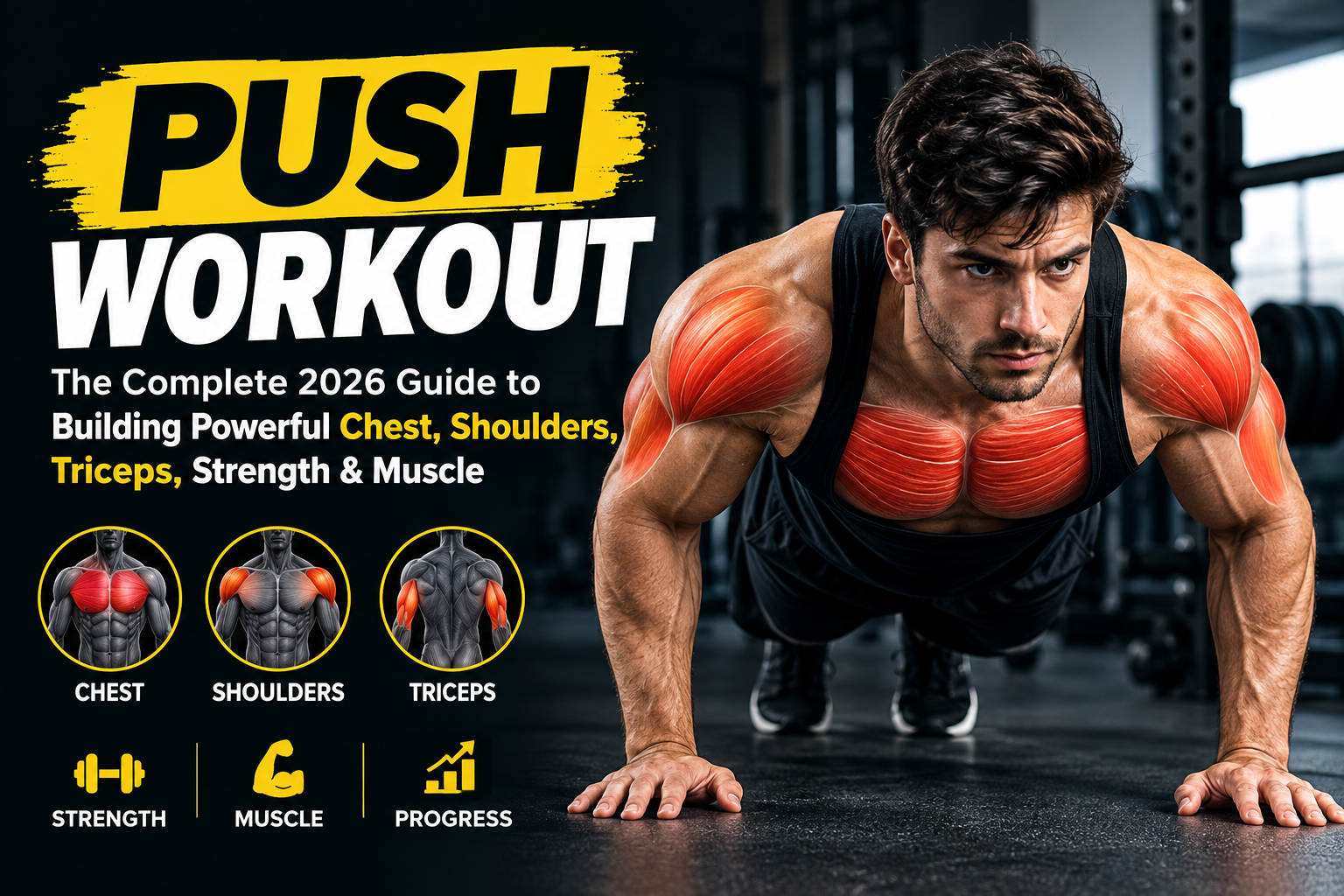
A well-designed push workout is one of the most effective ways to build upper-body strength, muscle mass, and pressing performance without spending endless hours in the gym. It focuses on the muscles responsible for pushing resistance away from your body, primarily the chest, shoulders, and triceps.
Whether your goal is hypertrophy, strength, athletic performance, or a more balanced physique, the key is not simply doing more pressing exercises. Exercise selection, training volume, intensity, recovery, progressive overload, and proper technique all determine whether your sessions produce meaningful results. A smart routine should challenge the target muscles while managing fatigue so you can continue progressing week after week.
What Is a Push Workout?
A push workout is a resistance-training session centered on exercises in which you press a weight or your body away from you. The primary muscle groups are the pectoralis major and minor, anterior and lateral deltoids, and triceps brachii. Common movements include the bench press, overhead press, incline dumbbell press, chest fly, lateral raise, and triceps extension.
The concept fits naturally into a push-pull-legs training split. Push sessions train pressing muscles together, while pull sessions emphasize the back and biceps and leg sessions target the lower body. This organization makes it easier to distribute training volume and recovery demands across the week.
A useful way to think about the session is as a hierarchy: compound presses provide the foundation, while isolation exercises fill in specific muscular needs. As strength coach Dan John has often emphasized through his training philosophy, simple movements performed consistently can outperform complicated routines that are difficult to sustain.
The Muscles Trained During a Push Session
The chest is usually the largest target muscle. Horizontal pressing movements such as the barbell bench press and dumbbell bench press primarily train the pectorals while also involving the anterior deltoids and triceps. Changing the angle can alter emphasis, although no pressing variation completely isolates one muscle.
The shoulders and triceps provide essential assistance. Overhead pressing places substantial demands on the deltoids and triceps, while lateral raises directly challenge the lateral deltoids through shoulder abduction. Triceps exercises then provide more direct elbow-extension work. This combination creates a comprehensive upper-body session rather than simply a collection of chest exercises.
| Exercise | Primary Focus | Typical Reps | Training Role |
|---|---|---|---|
| Barbell bench press | Chest, triceps | 5–8 | Strength and mass |
| Incline dumbbell press | Upper chest, shoulders | 8–12 | Hypertrophy |
| Overhead press | Shoulders, triceps | 6–10 | Strength and mass |
| Cable or dumbbell lateral raise | Lateral deltoids | 10–20 | Shoulder development |
| Cable fly | Chest | 10–15 | Chest isolation |
| Triceps pushdown | Triceps | 10–15 | Isolation |
| Overhead triceps extension | Triceps | 10–15 | Long-head emphasis |
How to Build an Effective Push Workout
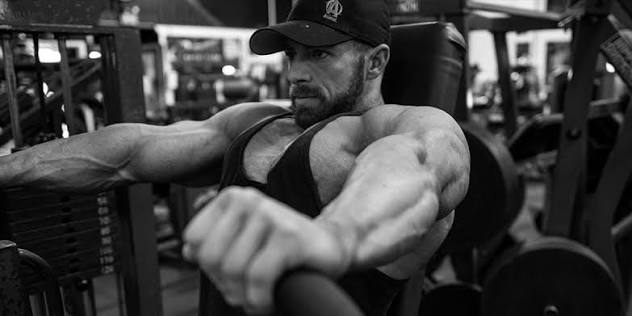
An effective push workout normally begins with a major compound movement when strength and performance are priorities. The bench press or another heavy chest press can be performed while you are relatively fresh, allowing better technique and higher-quality repetitions. A second compound movement, such as an overhead or incline press, can then add additional stimulus.
After the major lifts, isolation exercises can address muscles that need more direct work. For example, lateral raises can develop the medial deltoids, while cable flyes can provide additional chest volume with less systemic fatigue than another heavy press. Triceps extensions can finish the session by directly training elbow extension.
The exact exercise order should reflect your priorities. If chest strength is the main goal, bench pressing belongs early. If shoulder development is the priority, overhead pressing may receive greater attention. This is a practical application of specificity: the movement you want to improve most should generally receive your best energy and concentration.
A Practical Push Workout for Muscle Growth
A balanced hypertrophy-focused session could begin with the barbell bench press for three to four working sets of roughly six to eight repetitions. Follow it with an incline dumbbell press for three sets of eight to twelve repetitions, using a controlled eccentric phase and a stable pressing position.
Next, perform an overhead press for two to three sets of six to ten repetitions, followed by lateral raises for three sets of twelve to twenty repetitions. Finish with a cable fly and a triceps exercise, using approximately two to three sets each. This provides substantial chest, shoulder, and triceps volume without requiring excessive exercise variety.
The goal is not to leave the gym unable to move your arms. Effective hypertrophy training is about accumulating high-quality work that the body can recover from. A set that finishes with one or two technically sound repetitions still available can be highly productive, particularly when repeated consistently over months.
Progressive Overload Without Sacrificing Technique
Progressive overload is one of the foundations of an effective push workout. It means gradually increasing the training stimulus as your body adapts. That can involve adding weight, performing additional repetitions, improving technique, increasing range of motion, or accumulating productive volume.
Suppose you bench press 70 kilograms for three sets of eight repetitions with excellent form. Rather than immediately making a large jump in weight, you could work toward three sets of nine or ten repetitions. Once you reach the upper end of your planned repetition range comfortably, a small weight increase can reset the repetitions before building them upward again.
This approach is often called double progression and works particularly well for general hypertrophy training. The important principle is that progression should be measurable without becoming reckless. Adding weight while shortening the range of motion or turning controlled repetitions into unstable ones is not meaningful progress.
Push Workout Technique and Form Essentials
Technique determines where resistance goes and how efficiently you can produce force. During pressing movements, maintain a stable body position, control the lowering phase, and avoid allowing fatigue to dramatically change your movement pattern. For bench pressing, the shoulders should remain appropriately positioned while the feet provide a stable base.
For overhead presses, avoid turning every repetition into an uncontrolled back extension. Keep the trunk braced and move the weight through a comfortable range. During lateral raises, using extremely heavy dumbbells often shifts the exercise toward momentum rather than productive shoulder work. A lighter load with controlled movement is frequently more effective.
A useful rule is simple: “Make the target muscle work harder, not the exercise look harder.” This mindset helps distinguish productive intensity from unnecessary strain. Good technique should remain recognizable from the first repetition to the last.
Common Problems and How to Fix Them
One common problem is excessive pressing volume. Someone may perform bench press, incline press, machine press, dips, push-ups, and several additional chest movements in the same session. The result can be diminishing returns, irritated joints, and insufficient recovery rather than faster growth. The solution is to prioritize a few high-quality movements and track total weekly volume.
Another issue is neglecting the shoulders or triceps because pressing already feels demanding. Compound exercises certainly train both, but indirect stimulation does not always provide enough volume for maximum development. Adding targeted lateral raises and triceps work can address this gap without turning the session into an unnecessarily long workout.
Poor recovery creates another bottleneck. If performance repeatedly declines, muscles remain excessively sore, or motivation collapses, adding more exercises is rarely the answer. Sleep, nutrition, rest days, and sensible programming are part of the training process—not interruptions to it.
How Often Should You Train Push Muscles?
For many recreational lifters, training each major muscle group around twice per week can work well when total volume is appropriately distributed. A push-pull-legs routine can accomplish this through a higher-frequency weekly structure, while other programs may combine upper- and lower-body sessions.
Frequency should be viewed alongside volume and recovery. Two moderate sessions can be easier to manage than one enormous session because the weekly workload is distributed more evenly. For example, instead of attempting twelve or more demanding chest sets in one day, a lifter might divide productive work across two sessions.
Individual recovery capacity matters. Training age, sleep, nutrition, stress, exercise selection, and intensity all influence how much work someone can handle. The best program is therefore not the one with the most exercises but the one that produces steady performance improvements while remaining recoverable.
Nutrition and Recovery for Better Results
Resistance training provides the stimulus, but adaptation requires adequate recovery resources. Protein supports muscle protein synthesis, carbohydrates help fuel demanding training, and sufficient overall energy availability supports performance and recovery. A balanced diet built around minimally processed foods can provide the foundation for these needs.
Sleep is equally important. A hard push workout does not automatically produce more muscle simply because it was exhausting. Your body needs time to repair and adapt to the training stress. Consistent sleep, hydration, appropriate nutrition, and rest between demanding sessions can significantly improve training quality.
Recovery also means managing exercise intensity. Not every set needs to reach absolute muscular failure. Training close to failure can be highly effective for hypertrophy, but repeatedly pushing every compound lift to failure can create disproportionate fatigue. Strategic effort is often more sustainable than constant maximal effort.
Push Workout for Beginners
Beginners should focus on learning movement patterns before chasing impressive numbers. A simple routine might include a machine or dumbbell chest press, a manageable overhead press, lateral raises, and a triceps exercise. Two or three working sets per movement can be sufficient while technique and training tolerance develop.
The early objective is consistency. A beginner who trains regularly for six months with controlled technique and gradual progression will generally be better positioned than someone who changes programs every few weeks. Learning how to brace, control repetitions, select appropriate loads, and recognize muscular fatigue creates a foundation for more advanced programming.
Beginners should also avoid copying the workload of experienced bodybuilders or strength athletes. Advanced lifters have usually developed greater work capacity and technical skill. Starting with manageable volume allows the body to adapt without unnecessary soreness or joint stress.
Push Workout for Strength and Hypertrophy
A strength-oriented push workout places greater emphasis on heavier compound lifts and lower repetition ranges, while hypertrophy training typically uses a broader range of moderate repetitions. The two goals overlap considerably because stronger muscles can often handle greater loads, and sufficient mechanical tension is central to muscle growth.
For strength, a lifter might prioritize bench and overhead pressing with sets around four to eight repetitions. Additional work can then target the chest, deltoids, and triceps with moderate-to-high repetitions. For hypertrophy, more total work can be performed in moderate repetition ranges while maintaining controlled technique and sufficient proximity to muscular failure.
The best approach for many people is hybrid programming. Building strength through compound lifts while accumulating targeted hypertrophy work creates a well-rounded session. It also provides multiple ways to measure progress beyond simply watching the scale.
Frequently Asked Questions
How many exercises should a push workout include?
Most people can achieve excellent results with roughly four to seven carefully selected exercises. The ideal number depends on training experience, weekly frequency, exercise overlap, and recovery capacity. A session should cover the major movement patterns without adding exercises simply to make the workout longer.
Is a push workout good for building muscle?
Yes. A properly programmed push workout can be highly effective for building the chest, shoulders, and triceps because it combines compound pressing movements with targeted isolation work. Muscle growth depends on sufficient training stimulus, progressive overload, nutrition, and recovery rather than any single exercise.
Should I train chest before shoulders?
For most people, chest can be trained before shoulders because pressing exercises for the chest already involve the anterior deltoids and triceps. However, if shoulder strength or development is the primary goal, putting overhead pressing earlier can ensure that the shoulders receive higher-quality work while you are fresh.
How long should a push workout take?
A productive session commonly takes around 45 to 75 minutes, although the exact duration depends on warm-up requirements, rest periods, exercise selection, and training goals. Longer sessions are not automatically better. Once performance and technique begin deteriorating, additional volume may provide less benefit.
Can I do a push workout at home?
Yes. A home routine can use push-ups, resistance bands, adjustable dumbbells, resistance machines, or other available equipment. The fundamental principles remain the same: choose challenging movements, use controlled technique, progressively increase the difficulty, and provide enough recovery between sessions.
Should every set go to failure?
No. Although training close to failure can stimulate muscle growth, taking every set to absolute failure can create unnecessary fatigue, particularly on heavy compound movements. Leaving a small number of technically strong repetitions in reserve is often a practical strategy for maintaining performance and recovery.
Conclusion
A successful push workout is built around more than a list of chest and shoulder exercises. It combines intelligent exercise selection, appropriate volume, progressive overload, sound technique, and enough recovery to allow adaptation. Compound presses provide the foundation, while lateral raises, flyes, and triceps exercises help complete muscular development.
The biggest mistake is assuming that more training automatically means better results. A focused session performed consistently, progressed patiently, and supported by good nutrition and sleep can outperform a complicated routine filled with unnecessary volume.
The final takeaway is simple: train with purpose, progress with patience, and recover with the same discipline you bring to the gym. When those principles remain consistent, a well-structured push workout can become one of the most reliable tools for developing strength, muscle, and confident upper-body performance.