
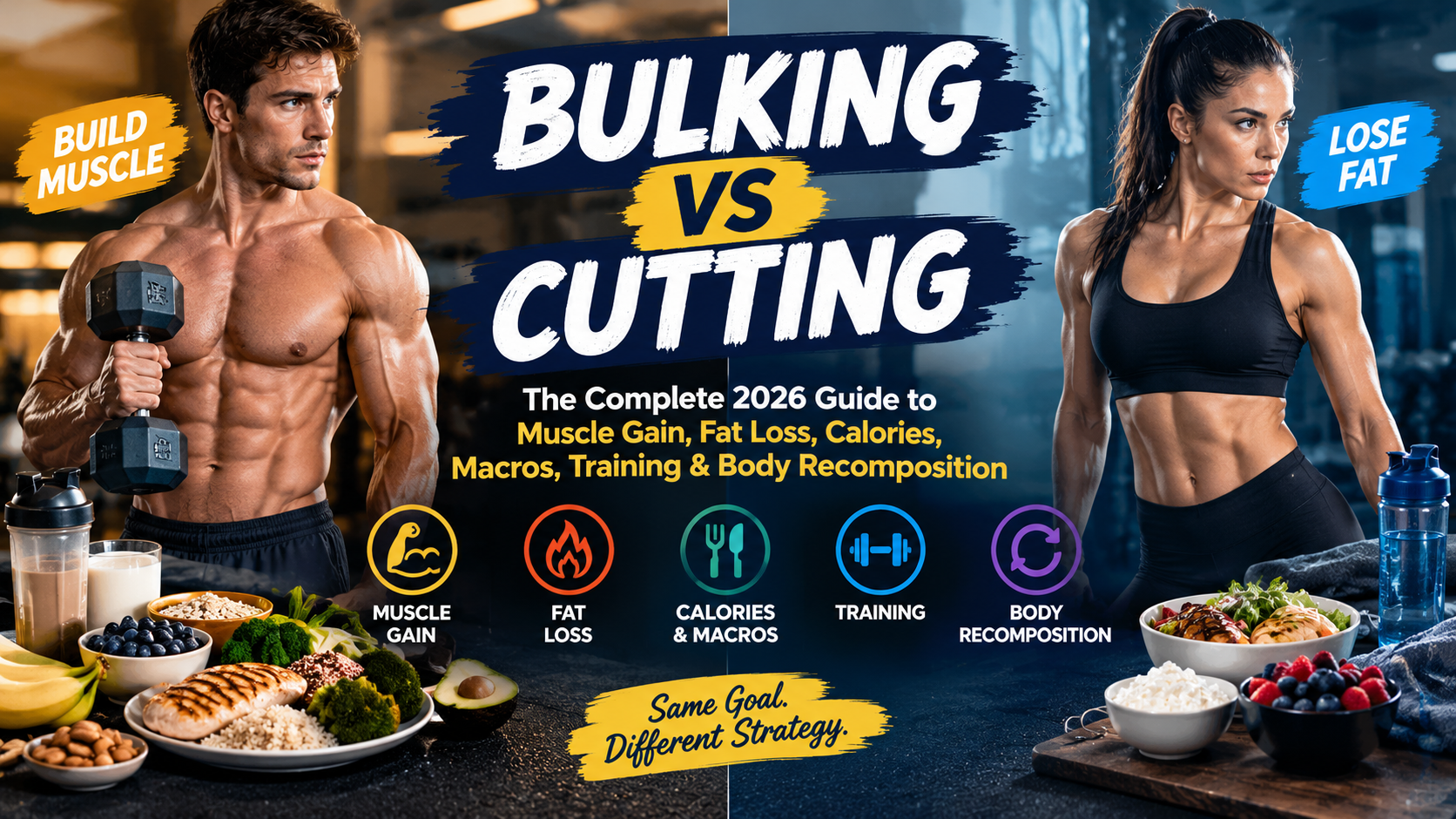
Bulking vs cutting describes two traditional phases of physique-focused training. Bulking generally means eating in a controlled calorie surplus to support muscle growth, while cutting involves a calorie deficit designed to reduce body fat while preserving as much lean muscle as possible.
The concept sounds simple, but successful body composition changes require more than increasing or reducing calories. Protein intake, resistance training, recovery, rate of weight change, food quality, training performance, and individual starting body composition all influence the outcome. The smartest approach is usually gradual rather than extreme.
For someone trying to build an athletic physique, the key question is not simply which phase is better. It is understanding when each approach makes sense, how aggressively to pursue it, and when to transition.
What Bulking and Cutting Actually Mean
Bulking is a muscle-building phase in which calorie intake is intentionally higher than energy expenditure. The surplus provides additional energy that can support resistance-training performance, recovery, and new tissue growth. A well-planned bulk is not an excuse to eat unlimited amounts of highly processed food. The goal is controlled weight gain with an emphasis on maximizing muscle while limiting unnecessary fat accumulation.
Cutting reverses the energy equation. Calories are reduced below expenditure so stored body energy can be mobilized, primarily reducing body fat over time. The challenge is preserving muscle while losing fat. Resistance training and adequate protein become especially important because a calorie deficit can make maintaining lean mass more difficult.
Bulking vs Cutting: The Main Differences
The most useful way to understand bulking vs cutting is to compare the purpose, calorie target, expected rate of weight change, and training priorities of each phase. Neither phase is inherently better; they simply pursue different body-composition outcomes.
| Factor | Bulking | Cutting |
|---|---|---|
| Primary goal | Build muscle | Reduce body fat |
| Energy balance | Calorie surplus | Calorie deficit |
| Protein | High | High |
| Resistance training | Essential | Essential |
| Body weight | Gradually increases | Gradually decreases |
| Main challenge | Limiting unnecessary fat gain | Preserving muscle |
| Cardio | Moderate and strategic | Useful for activity and fitness |
| Recovery | Important for growth | Important for performance and muscle retention |
| Typical mindset | Patience and progression | Patience and consistency |
The important point is that both phases depend on resistance training. Someone who cuts calories without lifting weights may lose weight, but that does not necessarily mean the resulting physique will have the desired muscular definition.

How a Successful Bulk Works
During a bulk, the objective is to create a modest calorie surplus rather than dramatically increasing food intake. A large surplus may accelerate scale weight gain, but the additional weight is not guaranteed to be muscle. Excess energy can also increase fat storage, potentially making the next cutting phase longer and more difficult.
A practical approach is to monitor body weight alongside gym performance, measurements, and visual changes. If strength is gradually improving and body weight is rising at a controlled pace, the plan is likely moving in the intended direction. If weight is increasing rapidly while waist measurements climb disproportionately, the calorie surplus may be unnecessarily aggressive.
A useful principle is: “A good bulk should build your physique, not simply build the number on the scale.”
How a Successful Cut Works
Cutting requires a calorie deficit, but the deficit should be appropriate to the individual’s size, activity level, training experience, and starting body composition. Extremely restrictive diets may produce rapid initial weight loss, but they can also make training harder, increase hunger, reduce recovery, and make muscle retention more difficult.
Protein becomes particularly important during a cut. Maintaining regular resistance training provides the body with a reason to retain muscle tissue, while adequate protein supplies the amino acids needed for maintenance and recovery. The combination is far more useful than simply performing large amounts of cardio.
Someone who normally eats enough to maintain their weight might begin with a moderate reduction in calories and monitor progress for several weeks. If weight and measurements are moving too slowly, adjustments can be made gradually rather than immediately adopting a severe restriction.
Calories and Energy Balance
Calories are central to bulking vs cutting because body weight is strongly influenced by the relationship between energy intake and energy expenditure. A sustained surplus tends to support weight gain, while a sustained deficit tends to support weight loss. However, the scale does not tell you exactly what type of tissue has changed.
During a bulk, calories should support productive training without creating excessive fat gain. During a cut, the deficit should be large enough to produce meaningful progress but not so aggressive that performance and recovery collapse. Daily calorie needs can also fluctuate based on activity, occupation, training volume, body size, and changes in body weight.
This is why calorie targets should be treated as starting estimates rather than permanent numbers. Body-weight trends over several weeks provide more useful information than a single weigh-in.
Protein and Macronutrients
Protein is one of the most important nutritional variables in bulking vs cutting. A consistently high protein intake supports muscle protein synthesis and helps provide the raw materials required for recovery. During a calorie deficit, adequate protein becomes particularly valuable because preserving lean tissue is a major objective.
Carbohydrates and dietary fats also have important roles. Carbohydrates can support high-quality resistance training by supplying readily available energy, while dietary fats contribute essential fatty acids and help support normal physiological functions. A balanced diet does not require eliminating either macronutrient.
The International Society of Sports Nutrition has emphasized the importance of sufficient protein and resistance training for individuals seeking to increase or maintain muscle mass. In practice, consistency across weeks and months matters far more than obsessing over a single meal.
Training During a Bulk
Strength training during a bulk should focus on progressive overload. This means gradually challenging the muscles through increased resistance, repetitions, improved technique, additional training volume, or more demanding variations.
Compound exercises such as squats, deadlifts, presses, rows, pull-ups, and lunges can form the foundation of a program, while isolation exercises can provide additional volume for specific muscle groups. The goal is not to make every workout exhausting. Productive training creates enough stimulus for adaptation while leaving enough recovery capacity for future sessions.
Keeping a training log can make progress easier to evaluate. If a lifter begins with a certain dumbbell weight and eventually performs more repetitions with excellent technique, that improvement provides evidence that training capacity is increasing.
Training During a Cut
Resistance training remains essential during bulking vs cutting, but training during a cut often requires greater attention to fatigue management. A calorie deficit can reduce recovery capacity, so trying to maintain unnecessarily high training volume may become counterproductive.
A useful strategy is to preserve training intensity while managing total volume according to recovery. Someone might continue lifting challenging weights but perform fewer accessory sets. The objective is to maintain a strong muscular stimulus rather than chase exhaustion.
Cardio can complement the plan by increasing energy expenditure and improving cardiovascular fitness. However, excessive cardio combined with an aggressive calorie deficit can create unnecessary fatigue. A balanced program uses cardio as a tool rather than treating it as punishment for eating.
When to Bulk, Cut or Maintain
Choosing between bulking vs cutting should depend on current body composition, training experience, goals, and personal preference. Someone who is relatively lean and wants additional muscle may benefit from a controlled surplus. Someone carrying more body fat may prefer to reduce fat before entering a muscle-building phase.
There is also a third option: maintenance or body recomposition. Beginners, people returning after a long training break, and individuals with higher body-fat levels may sometimes gain muscle while losing fat when resistance training, protein intake, sleep, and calorie intake are appropriately managed.
Maintenance phases can also provide psychological and physical relief after a long cut. Instead of continuously moving toward another extreme, maintaining body weight for a period can make it easier to establish sustainable eating and training habits.
Common Mistakes in Bulking and Cutting
One of the biggest mistakes in bulking vs cutting is treating either phase as an all-or-nothing process. A bulk does not require eating enormous meals, and a cut does not require starving yourself. Extreme approaches often create unnecessary fluctuations in body weight and make adherence more difficult.
Another common mistake is changing the plan too quickly. Body weight naturally fluctuates because of hydration, glycogen, sodium, food volume, and digestion. Looking at a multi-week trend is much more informative than reacting emotionally to a single morning weigh-in.
A further problem occurs when people stop resistance training during a cut or neglect nutrition quality during a bulk. The solution is to keep the fundamentals consistent: progressive resistance training, adequate protein, appropriate calories, sufficient sleep, and regular monitoring.
Bulking vs Cutting for Beginners
Beginners should usually avoid rushing into an aggressive bulking vs cutting cycle. New lifters can make significant progress from simply learning proper exercise technique, establishing consistent resistance training, eating enough protein, and improving overall diet quality.
A beginner who immediately starts a large surplus may gain unnecessary body fat, while someone who aggressively cuts before building a training foundation may sacrifice opportunities for early strength and muscle development. Establishing good habits first creates a stronger foundation for future specialized phases.
For many beginners, the initial goal should be becoming stronger, more active, and more consistent. Once those habits are established, a more deliberate nutritional phase can be introduced based on measurable goals.
How Long Should Each Phase Last?
There is no universal duration for bulking vs cutting. The appropriate length depends on how much muscle someone wants to build, how much fat they want to lose, their starting point, and how well they tolerate the nutritional phase.
A productive bulk can last several months or longer because meaningful muscle growth is a slow process. Cutting may also take several months when the goal is substantial fat loss while preserving lean mass. Shorter phases can be useful for smaller adjustments, while longer phases allow gradual progress without unnecessary extremes.
The transition point should be based on objective progress rather than impatience. Waist measurements, body-weight trends, strength performance, photographs, and how clothing fits can collectively provide a clearer picture than the scale alone.
Recovery and Lifestyle Factors
Sleep is frequently overlooked when discussing bulking vs cutting, yet recovery affects training performance, appetite regulation, and the body’s ability to adapt to exercise. Consistently poor sleep can make a calorie deficit feel harder and may reduce training quality.
Stress management matters as well. A demanding job, inadequate sleep, intense training, and restrictive dieting can create a recovery burden that is difficult to sustain. Successful physique development is therefore not just a nutrition equation. It is a lifestyle system in which training, food, sleep, and stress management need to work together.
Frequently Asked Questions
Is bulking or cutting better for building muscle?
Bulking is generally designed specifically to support muscle growth because a controlled calorie surplus provides additional energy for training and recovery. However, beginners and some people with higher body-fat levels may experience muscle gain without a traditional bulk. The most important factors remain progressive resistance training, adequate protein, appropriate nutrition, and recovery.
Should I bulk if I have a high body-fat percentage?
A traditional bulk may not be the most appropriate starting point for someone who already carries substantial body fat. A maintenance intake or controlled calorie deficit may be more practical initially. The decision should consider training experience, body composition, health status, and the individual’s long-term goals rather than body weight alone.
How much protein should I eat during a cut?
Protein needs vary by body size, training status, calorie intake, and other factors. Research in sports nutrition commonly supports relatively high protein intake for active individuals, particularly during calorie restriction. A qualified nutrition professional can help establish an appropriate target when individual circumstances require more precise planning.
Can I gain muscle and lose fat at the same time?
Yes, body recomposition is possible, particularly for beginners, people returning to resistance training, and some individuals with higher levels of body fat. It generally requires consistent resistance training, adequate protein, appropriate calorie intake, and patience. The rate of change may be slower than pursuing a dedicated bulk or cut.
How quickly should I gain weight during a bulk?
A controlled rate is generally preferable to rapid weight gain because muscle growth occurs relatively slowly. If body weight rises dramatically from week to week, a meaningful portion of the increase may come from fat, water, glycogen, and food volume rather than new muscle tissue. Monitoring several weeks of trends helps determine whether calorie intake is appropriate.
Does cardio hurt muscle growth during a bulk?
Cardio does not automatically prevent muscle growth. Moderate cardiovascular exercise can support heart health, work capacity, and general fitness. Problems are more likely when cardio volume becomes excessive, recovery is inadequate, or calorie expenditure makes it difficult to maintain the intended energy surplus.
What should I eat during bulking and cutting?
Both phases should emphasize nutrient-dense foods such as lean proteins, eggs, dairy or suitable alternatives, whole grains, fruits, vegetables, legumes, nuts, seeds, and healthy fats. During a bulk, calorie-dense foods can make a modest surplus easier to achieve. During a cut, high-volume foods rich in protein and fiber can help manage hunger while keeping calories controlled.
Conclusion
Understanding bulking vs cutting is ultimately about understanding the relationship between nutrition, training, recovery, and body composition. A successful bulk uses a controlled calorie surplus to support muscle development, while a successful cut uses a manageable calorie deficit to reduce body fat while protecting lean tissue.
Neither phase should be treated as a race. The strongest long-term results usually come from gradual adjustments, progressive resistance training, sufficient protein, sensible calorie targets, and consistent recovery. Monitoring trends rather than reacting to daily fluctuations makes the process far more predictable.
The final takeaway is simple: build when your priority is adding muscle, cut when reducing body fat is the priority, and maintain when your body and lifestyle need stability. The best physique strategy is not the most extreme one; it is the one you can execute consistently while continuing to improve.