Building a stronger, wider back takes more than lifting heavy weights. It requires choosing effective exercises, understanding how your muscles work, and using proper technique consistently. One of the most useful exercises for developing upper-body pulling strength is the lat pulldown, a gym staple that allows beginners and experienced lifters to train their back with adjustable resistance.
This cable-based movement primarily targets the latissimus dorsi, the broad muscles that contribute to the V-shaped appearance of the upper body. It also involves the biceps, forearms, and muscles that control the shoulder blades. Unlike pull-ups, which require you to lift your body weight, this exercise lets you select a manageable load and gradually build strength.
Whether your goal is muscle growth, improved pulling performance, or a more balanced workout routine, understanding the movement’s mechanics can help you train more effectively. This guide covers proper form, muscles worked, exercise variations, programming, common mistakes, and practical ways to improve your results.
What Is a Lat Pulldown?
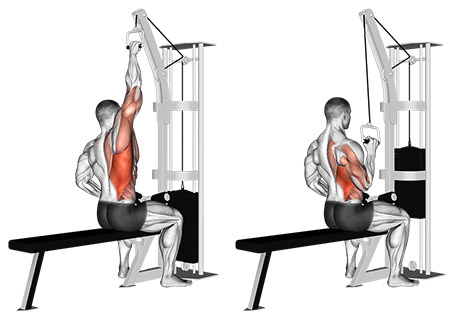
A lat pulldown is a resistance-training exercise performed on a cable machine, usually with a seated position and an overhead bar. You pull the bar toward your upper chest while keeping your torso stable, then control its return to the starting position. The movement emphasizes shoulder adduction and extension, actions that bring the upper arms down toward the torso or backward.
The exercise is especially useful for people who cannot yet perform full pull-ups or want to train their back with precise resistance adjustments. For example, a beginner can start with a light load and learn to coordinate the shoulders, elbows, and trunk before progressing to heavier weights.
It also suits experienced lifters who want to accumulate controlled pulling volume without relying exclusively on body-weight exercises. However, the quality of each repetition matters more than the number displayed on the weight stack.
Muscles Worked During the Lat Pulldown
The primary target is the latissimus dorsi, a large muscle extending across much of the middle and lower back. The lats help pull the upper arms down and backward, making them important for climbing, swimming, and many gym movements.
Several supporting muscles contribute to the exercise. The biceps brachii and brachialis assist with elbow flexion, while the forearm muscles help maintain grip. The trapezius, rhomboids, and other scapular muscles help coordinate shoulder-blade movement and stability.
Your trunk muscles also work to maintain a controlled seated position. Although the exercise primarily develops the upper-body pulling muscles, maintaining good posture requires coordination throughout the torso.
| Muscle | Main role | Training benefit |
|---|---|---|
| Latissimus dorsi | Pulls the upper arm down and backward | Back width and pulling strength |
| Biceps brachii | Bends the elbow | Assists pulling movements |
| Brachialis | Assists elbow flexion | Supports arm strength |
| Rhomboids | Help retract and stabilize shoulder blades | Upper-back control |
| Trapezius | Supports shoulder-blade movement | Shoulder stability |
| Forearm muscles | Maintain grip | Grip endurance |
Understanding these contributions helps explain why you may feel the exercise in your arms as well as your back. The goal is not to eliminate arm involvement, which is impossible, but to coordinate the movement so the back muscles contribute effectively.
How to Perform a Lat Pulldown With Proper Form
Correct technique starts before you pull the bar. Adjust the thigh pad so your legs remain comfortably secured without excessive pressure, select an appropriate weight, and sit with your feet flat on the floor. Reach overhead and grip the bar slightly wider than shoulder width if that position feels comfortable for your shoulders.
Begin with your arms extended overhead and your shoulders in a controlled, natural position. Pull your elbows down toward your sides while bringing the bar toward your upper chest. Keep your torso upright or slightly leaned back, avoiding excessive rocking or swinging. Briefly control the bottom position without forcing the bar against your chest.
Return the bar upward slowly, allowing your arms to extend as your shoulder blades move naturally with the motion. Avoid abruptly dropping the weight stack or shrugging excessively to finish the repetition.
A useful coaching cue is: “Drive your elbows down, keep your ribs controlled, and let the weight rise without losing your position.” This encourages a coordinated pull instead of turning every repetition into an arm-dominant movement.
Start with a manageable resistance and perform smooth repetitions through a comfortable range. If you must lean far backward or jerk your torso to move the load, reduce the weight.
Best Grip Variations and Their Benefits
Grip selection changes the movement’s feel, available range of motion, and demands on the wrists and shoulders. A moderately wide overhand grip is a common starting point, but it is not automatically superior to every alternative. The best choice is one that allows controlled movement without discomfort.
A shoulder-width overhand grip offers a balanced position for many lifters. A neutral grip, where the palms face each other, may feel more comfortable for people whose shoulders or wrists dislike a pronated position. An underhand grip often increases the contribution of the elbow flexors and may allow a slightly different pulling path.
| Variation | Grip or attachment | Main consideration |
|---|---|---|
| Standard pulldown | Overhand bar grip | General back development |
| Neutral-grip pulldown | Palms facing each other | May feel comfortable for some shoulders |
| Close-grip pulldown | Narrow handle | Allows a different elbow path |
| Underhand pulldown | Palms facing you | Greater emphasis on elbow flexors for many lifters |
| Single-arm pulldown | Individual handle | Allows side-to-side control and focused technique |
No grip magically isolates a specific portion of the lats. Muscle recruitment overlaps across variations, and overall results depend on training effort, range of motion, progression, and consistency.
Common Lat Pulldown Mistakes and How to Fix Them
One of the most frequent mistakes is using excessive weight. When the load is too heavy, lifters often swing backward, jerk the bar down, or shorten the movement. These strategies make the exercise harder to control and can shift attention away from the intended pulling action.
The solution is simple: lower the resistance until you can perform smooth repetitions without momentum. Keep your torso stable, guide your elbows downward, and control the return. A slightly lighter load that allows consistent technique is often more productive than a heavier weight that forces compensations.
Another mistake is pulling the bar behind the neck. This position can require substantial shoulder mobility and may aggravate discomfort for some people. Pulling toward the upper chest is generally a more practical choice for standard training.
Other common problems include gripping the bar excessively tightly, leaning too far back, rushing the eccentric phase, and failing to use a comfortable range of motion. If a grip or movement causes sharp pain, stop and adjust the exercise rather than pushing through it.
Lat Pulldown vs. Pull-Ups: Which Is Better?
Both exercises train vertical pulling and can strengthen the lats, biceps, and supporting upper-back muscles. The main difference is how resistance is applied. During a pulldown, you pull a selected weight toward your body. During a pull-up, you raise your body toward a fixed bar.
The cable machine makes resistance easier to adjust, which is useful for beginners, rehabilitation under professional guidance, and lifters who want to increase training volume gradually. Pull-ups demand greater body-weight control and can be more challenging when a person’s current strength is limited.
Neither exercise is universally better. A beginner might build foundational strength with pulldowns before progressing to assisted pull-ups. An experienced athlete might use both to develop different aspects of pulling performance.
For balanced training, select exercises according to your goals, available equipment, physical ability, and comfort. Progress is more likely when your routine is sustainable than when you repeatedly force yourself into a movement you cannot yet control.
Sets, Repetitions, and Progressive Overload for Muscle Growth
For general muscle development, a practical starting point is two to four sets of approximately eight to twelve repetitions. Some lifters respond well to higher or lower repetition ranges, provided resistance and effort are appropriate. Beginners should prioritize learning the technique before pursuing high training volumes.
Train your back consistently, often twice weekly, while considering the workload from rows, pull-ups, deadlifts, and other compound exercises. The right volume depends on your experience, recovery, schedule, and total training program.
Progressive overload means gradually increasing the challenge as your performance improves. You might complete an additional repetition with the same weight, improve control, or add a small amount of resistance while preserving your technique. You do not need to increase the load every workout.
Rest sufficiently between sets to maintain good form, and allow recovery between demanding sessions. Adequate sleep, nutrition, and sufficient protein support muscle repair and growth. Consistency over several months is more important than occasional maximal-effort sessions.

How to Build a Balanced Back Workout
A well-rounded back workout includes both vertical and horizontal pulling. Vertical pulls emphasize bringing the arms down toward the body, while horizontal rows train pulling the elbows backward. Additional exercises can address trunk stability, rear-shoulder development, and hip-hinge strength.
For example, a beginner could combine pulldowns, seated cable rows, and bird dogs. An experienced lifter might add pull-ups, chest-supported rows, and Romanian deadlifts, adjusting the workload to fit their overall program.
Avoid assuming that one machine can develop every aspect of the back equally. Different exercises challenge the muscles from different directions and place different demands on the trunk and shoulder blades.
If you experience persistent shoulder, neck, or back pain, consult a qualified healthcare professional before changing your training substantially. Exercise selection and loading should reflect your symptoms, medical history, and individual capabilities.
Frequently Asked Questions About the Lat Pulldown
Does the lat pulldown make your back wider?
It can contribute to a wider-looking back by developing the latissimus dorsi. Visible changes depend on consistent resistance training, nutrition, genetics, and overall body composition. The exercise supports muscle growth but cannot guarantee a particular physique or spot-reduce fat.
Should I lean back during a lat pulldown?
A small, comfortable backward lean is acceptable for many lifters, but excessive leaning changes the movement and encourages momentum. Keep your torso relatively stable and use a pulling path that allows controlled repetitions without discomfort.
Is a wide grip better for lat growth?
Not necessarily. A moderately wide grip is effective, but a shoulder-width or neutral grip can also develop the lats. Choose a grip that allows comfortable shoulder movement, a useful range of motion, and consistent technique rather than assuming wider is always better.
How many times a week should I perform lat pulldowns?
Many people can include the exercise once or twice weekly, depending on their overall back-training volume and recovery. If your program already contains several demanding pulling movements, additional sets may not be necessary. Adjust frequency according to progress and fatigue.
Can beginners perform lat pulldowns?
Yes. The adjustable weight stack makes the movement accessible to beginners who are learning vertical pulling mechanics. Start with light resistance, secure your position, and practice controlled repetitions before increasing the load.
Should I pull the bar to my chest or behind my neck?
Pulling the bar toward the upper chest is generally the more practical standard variation. Behind-the-neck pulldowns require greater shoulder positioning and may be uncomfortable for some individuals. There is usually no need to use the behind-the-neck position to develop a strong back.
Conclusion: Build a Stronger Back With Better Technique
The lat pulldown is a versatile exercise for developing vertical pulling strength, training the latissimus dorsi, and supporting a balanced upper-body routine. Its adjustable resistance makes it useful for beginners and experienced lifters alike, provided they use appropriate loads and controlled technique.
Focus on a comfortable grip, stable posture, a smooth pulling motion, and a controlled return. Combine vertical pulls with rowing movements and suitable trunk exercises to train your back more comprehensively. Progress gradually, recover adequately, and avoid treating heavier weights as the only measure of success.
The key takeaway is simple: consistent, technically sound training builds a stronger back more reliably than chasing weight at the expense of control. Master the movement first, and let steady progress do the work.