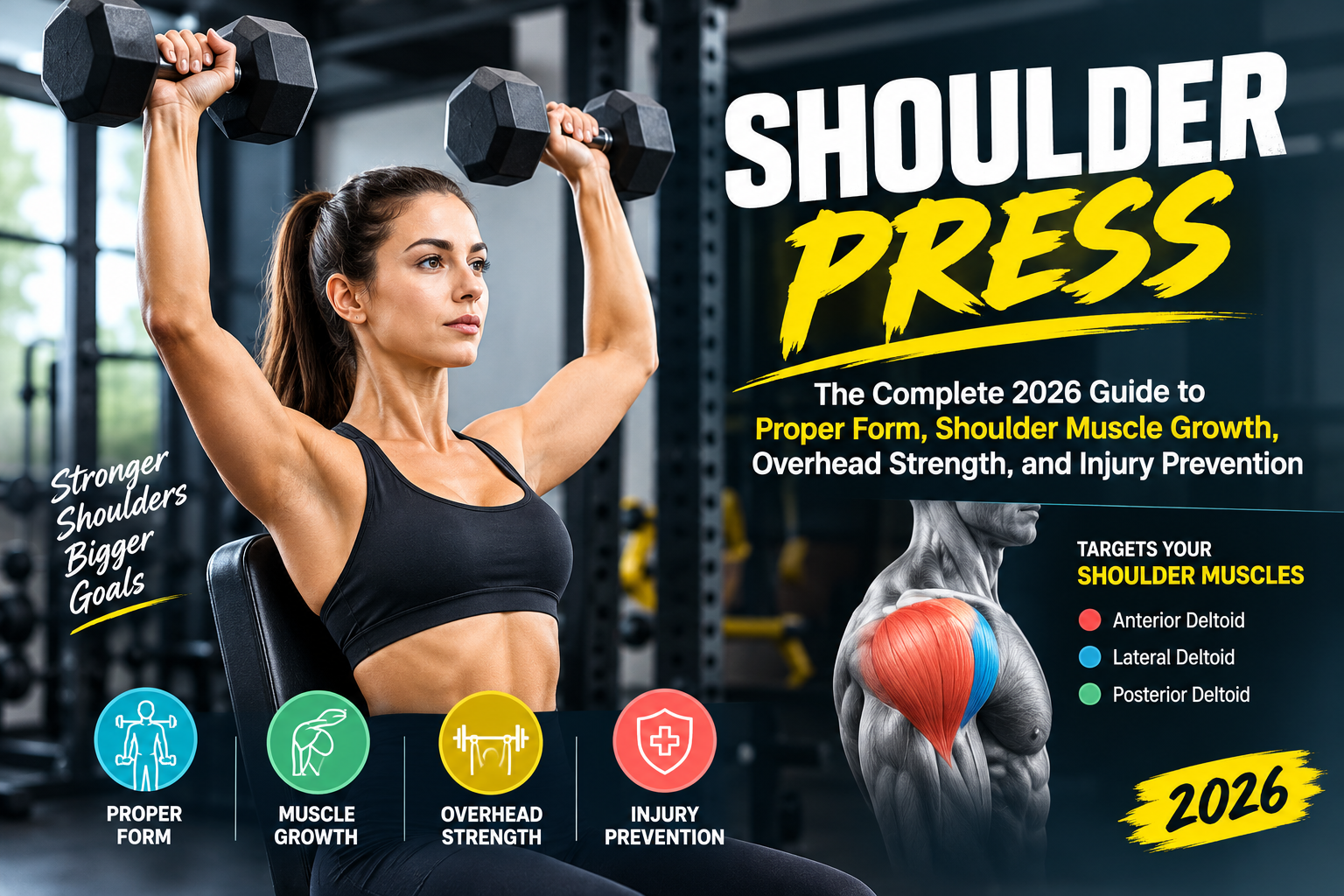
The shoulder press is one of the most effective upper-body exercises for developing stronger shoulders, improving overhead strength, and building balanced upper-body muscle. Performed with dumbbells, a barbell, or a machine, this compound movement trains the deltoids while engaging the triceps and several muscles that stabilize the shoulder blades and trunk.
Whether you train at home or in a commercial gym, learning proper technique helps you get more from every repetition. The right variation, manageable resistance, and controlled range of motion can make this exercise useful for beginners, experienced lifters, athletes, and anyone looking to improve everyday pushing strength.
What Is the Shoulder Press?
The shoulder press is a compound exercise in which you push resistance upward from approximately shoulder level until your arms reach a controlled overhead position. Depending on the equipment, you can perform it while seated or standing, using dumbbells, a barbell, kettlebells, or a resistance machine.
Its primary purpose is to strengthen the deltoid muscles, particularly the front and middle portions, while also training the triceps and supporting muscles around the shoulder girdle. Standing variations require additional trunk stabilization, while seated versions with back support can reduce balance demands and help you concentrate on the pressing movement.
Overhead pressing also has practical applications outside the gym. Placing luggage on a shelf, lifting an object overhead, or putting away equipment all require some combination of shoulder strength and control. However, gym performance does not automatically guarantee safe performance in every real-world situation; mobility, coordination, and load management remain important.
Muscles Worked During an Overhead Press


The main muscles involved are the deltoids, which cover the shoulder joint and help raise the upper arm. The anterior deltoid contributes strongly to pressing forward and upward, while the middle deltoid helps elevate the arm. The exact contribution of each portion varies with arm position, grip, equipment, and individual anatomy.
The triceps brachii extend the elbows to finish the press. The upper trapezius and serratus anterior contribute to upward rotation of the shoulder blades, a normal part of raising the arms overhead. The rotator cuff muscles help control the position of the upper arm within the shoulder joint, while the abdominal muscles and spinal stabilizers help maintain trunk control, especially when standing.
It is important to understand that the exercise does not train every shoulder muscle equally. The rear deltoids, for example, are usually better targeted with movements such as reverse flyes and face pulls. A balanced shoulder routine combines pressing with pulling exercises and movements that address different functions of the shoulder.
How to Perform the Shoulder Press With Proper Form
Good technique starts with a weight you can control from the first repetition to the last. Before lifting, establish a stable position and make sure you can move your arms overhead without forcing a painful range of motion.

- Set your position: Sit on a bench with back support or stand with your feet approximately hip- to shoulder-width apart.
- Position the weights: Hold dumbbells near shoulder height, or position a barbell at the upper chest or front shoulders using a comfortable grip.
- Brace your trunk: Tighten your abdominal muscles and keep your ribs controlled rather than excessively flaring them upward.
- Press upward: Drive the weights overhead smoothly, allowing your shoulder blades to rotate naturally as your arms rise.
- Finish with control: Reach a comfortable overhead position without aggressively locking your elbows or shrugging excessively.
- Lower slowly: Return the weights to the starting position without dropping them or bouncing into the next repetition.
Your head may move slightly backward as the weight passes your face, particularly during a barbell press. Move it back into a neutral position as the bar clears, rather than forcing an exaggerated backward lean. The goal is a smooth path that keeps the load controlled over your body.
A useful coaching cue is: “Press up while keeping your ribs stacked over your pelvis.” This helps reduce excessive lower-back arching, a common compensation when the load is too heavy or overhead mobility is limited.
Best Shoulder Press Variations for Different Goals
Different equipment changes the stability demands, range of motion, and comfort of the movement. The best version is one you can perform consistently with good technique and without aggravating existing symptoms.
Dumbbell press: Dumbbells allow each arm to move independently, which can help accommodate individual shoulder mechanics. They are versatile for home or gym workouts, although controlling two separate weights requires coordination.
Barbell overhead press: A barbell is useful for progressive strength training and allows both arms to lift a shared load. It requires adequate overhead mobility and careful control of the bar path. Lifters with shoulder discomfort may find the fixed hand position less comfortable.
Seated dumbbell press: A bench with back support reduces the balance demands compared with standing. This can be useful for beginners or lifters who want to focus on shoulder strength without as much full-body stabilization.
Machine shoulder press: A machine provides a guided path and can make it easier to adjust resistance. However, the fixed movement path will not suit every body, so adjust the seat and handles to a comfortable starting position.
Landmine press: Pressing a barbell angled upward from a landmine attachment creates a diagonal path rather than a strictly vertical one. Some people find this more comfortable when a traditional overhead position feels restricted, although individual responses vary.
Choose the variation that matches your experience, equipment, and comfort. You do not need to perform every version in one workout.
Common Shoulder Press Mistakes and How to Fix Them
A common mistake is selecting a weight that forces the body to compensate. Excessive lower-back arching, leg drive during a strict press, and uncontrolled lowering can shift the movement away from the intended pattern. Reduce the load until you can complete each repetition without losing position.
Another issue is forcing the arms into a position that feels uncomfortable. Shoulder anatomy and mobility differ, so not everyone will use exactly the same grip width or elbow angle. Keep the wrists reasonably aligned with the forearms, and allow the shoulder blades to move naturally as the arms travel overhead.
| Common mistake | Why it can be a problem | Practical correction |
|---|---|---|
| Arching the lower back excessively | May reflect poor trunk control or excessive load | Reduce weight and brace the abdomen |
| Using momentum | Makes the movement less controlled | Slow down and use a manageable load |
| Lowering too quickly | Reduces control during the eccentric phase | Lower over approximately two seconds |
| Flaring the elbows excessively | May create an uncomfortable pressing position | Adjust grip and elbow angle naturally |
| Shrugging forcefully throughout | Can indicate poor control or an unsuitable load | Press smoothly and allow natural shoulder-blade movement |
| Ignoring pain | May aggravate an underlying issue | Stop and reassess technique, load, or exercise choice |
Some shoulder-blade elevation and upward rotation are normal during overhead movement. The goal is not to keep the shoulders pinned down at all costs, but to achieve a coordinated, comfortable press.
How Many Sets and Repetitions Should You Do?
Your ideal training volume depends on your experience, goals, and how the exercise fits into your broader program. Beginners should focus on consistent technique before increasing resistance, while experienced lifters can adjust sets, repetitions, and load to support strength or muscle growth.
| Training goal | Sets | Repetitions | Rest |
|---|---|---|---|
| Beginner technique | 2–3 | 8–10 | 60–90 seconds |
| Muscle growth | 3–4 | 8–12 | 90–120 seconds |
| Strength development | 3–5 | 4–6 | 2–3 minutes |
| Muscular endurance | 2–3 | 12–15 | 45–90 seconds |
These ranges are general starting points, not strict rules. For muscle growth, select a weight that makes the final repetitions challenging while allowing you to maintain good form. For strength, heavier loads and longer rest periods may be appropriate once you have developed sufficient technique and experience.
Progressive overload is essential for continued improvement. You can gradually increase weight, add repetitions, or improve control over time. Increase resistance in small increments rather than making large jumps that compromise technique. If your form deteriorates before you reach the target repetitions, the load is probably too heavy for that set.
How to Include Shoulder Presses in Your Workout
For a balanced upper-body session, combine an overhead pressing movement with a horizontal push, a pulling exercise, and work for the rear deltoids or upper back. For example, you might perform dumbbell presses, chest presses or push-ups, seated rows, and reverse flyes. This approach develops complementary movement patterns rather than overemphasizing the front of the shoulders.
If shoulder growth is your priority, you can place the main pressing exercise near the beginning of your workout, when you are relatively fresh. Follow it with lateral raises for the middle deltoids and rear-delt exercises to address areas that overhead pressing does not fully emphasize. Avoid adding so much volume that your performance or recovery suffers.
Warm up with several minutes of light activity and a few easy sets using lighter resistance. These sets help you rehearse the movement and assess comfort before working at a challenging intensity. You do not need to exhaust the shoulders during your warm-up.
Shoulder Mobility, Safety, and Injury Prevention
Comfortable overhead movement requires coordination between the shoulder joint, shoulder blades, upper back, and trunk. If you cannot raise your arms overhead without pain or significant compensation, start with a lighter variation, reduce the range of motion temporarily, or choose an alternative such as a landmine press while you assess the limitation.
Avoid treating mobility as something that must be forced. Gentle shoulder and upper-back movements may help you prepare for training, but stretching alone will not resolve every source of restricted movement. Persistent pain, noticeable weakness, recent injury, or a sudden loss of range of motion should be evaluated by a qualified healthcare professional.
Recovery matters as much as exercise selection. Allow time between challenging shoulder sessions, maintain consistent sleep, and avoid increasing training volume too quickly. If your shoulders are already fatigued from heavy bench pressing or other upper-body work, adjust the load or total number of sets accordingly.
A sound training principle is simple: build strength through a comfortable, controlled range before chasing heavier weights. Pain is not a requirement for progress, and forcing a repetition through sharp discomfort is not a useful measure of effort.
Frequently Asked Questions
Is the shoulder press good for building muscle?
Yes. It can stimulate the deltoids and triceps when performed with sufficient resistance, consistent technique, and progressive training. For balanced shoulder development, combine pressing with lateral raises, rear-delt exercises, and appropriate upper-back training.
Is a dumbbell or barbell shoulder press better?
Both can build strength and muscle. Dumbbells allow independent arm movement and flexible positioning, while a barbell makes it easier for many lifters to increase total load systematically. Choose the option that feels comfortable and suits your goals, experience, and equipment.
Should you do shoulder presses sitting or standing?
Seated presses with back support reduce balance demands and may help you focus on the shoulders. Standing presses require more trunk stabilization and coordination. Neither is automatically superior; your choice should reflect your training goal and ability to maintain controlled technique.
Can you perform shoulder presses every day?
Most people do not need challenging overhead pressing every day to make progress. Repeated hard sessions may interfere with recovery, particularly when combined with bench presses and other shoulder exercises. Begin with one or two sessions per week and adjust according to your training experience and recovery.
Why does my shoulder hurt during an overhead press?
Pain may be related to excessive load, uncomfortable positioning, limited movement tolerance, or an underlying shoulder problem. Stop the painful movement, reduce the load, and assess whether a different variation is comfortable. Persistent or worsening symptoms warrant evaluation by a qualified healthcare professional.
Does the shoulder press train all three deltoid heads?
It primarily emphasizes the anterior deltoid and also recruits the middle deltoid, depending on technique and equipment. The posterior deltoid receives less direct stimulation, so reverse flyes, face pulls, and suitable rowing exercises can help round out a shoulder-training program.
Conclusion: Build Stronger Shoulders With Consistent Technique
The shoulder press is a valuable compound exercise for developing overhead strength, training the deltoids and triceps, and improving control during upper-body pushing movements. With dumbbells, barbells, machines, or landmine equipment, you can adapt the movement to your training environment and experience level.
Start with a variation that feels comfortable, use a manageable load, and maintain a controlled trunk position while allowing natural shoulder-blade movement. Build your training gradually, balance pressing with pulling and rear-delt work, and give your muscles enough time to recover.
The final takeaway: Strong shoulders come from consistent training, thoughtful progression, and good movement quality—not simply lifting the heaviest weight. Master the fundamentals first, then build toward greater strength and muscle development one controlled repetition at a time.