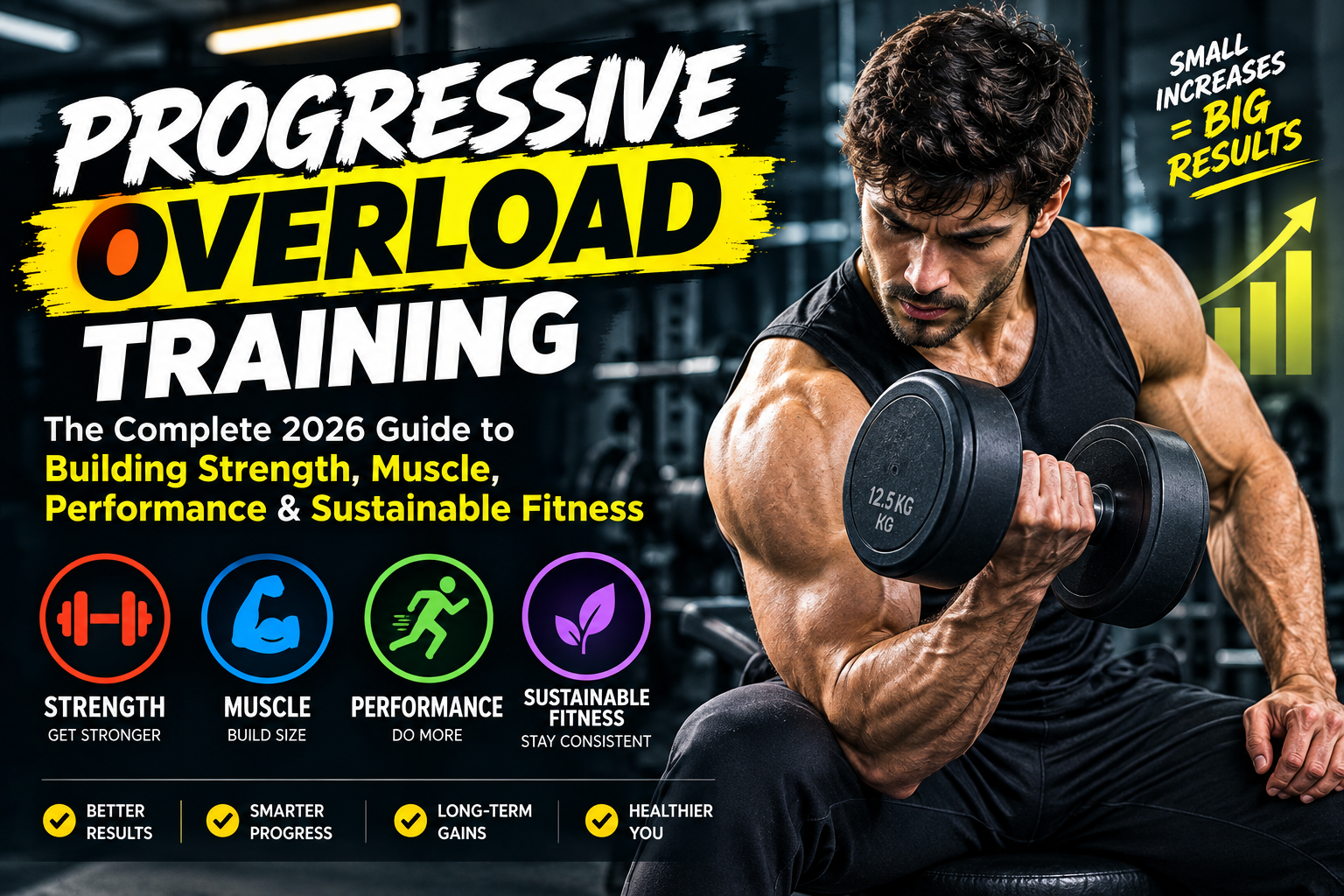
Progressive overload training is one of the fundamental principles behind getting stronger, building muscle, and improving physical performance. The concept is straightforward: your body needs a gradually increasing training stimulus to continue adapting.
That does not always mean adding more weight every workout. Progress can come from performing more repetitions with the same load, improving technique, increasing range of motion, adding productive training volume, reducing unnecessary rest, or making an exercise more challenging while maintaining quality.
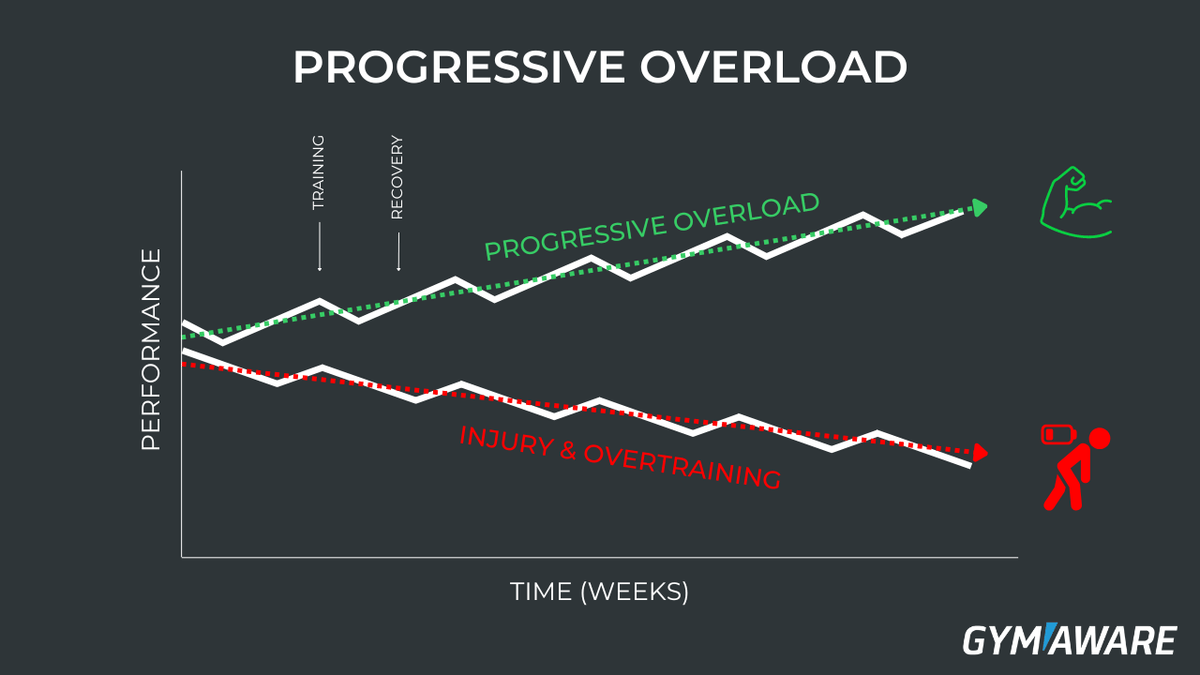
The real skill is knowing when and how to progress. A smart approach creates enough stimulus to encourage adaptation without adding so much fatigue that recovery and performance suffer.
What Is Progressive Overload Training?
Progressive overload training is the deliberate process of gradually increasing the demands placed on your muscles and cardiovascular or neuromuscular systems as your fitness improves. The objective is to prevent your body from becoming fully accustomed to the same training stimulus.
For example, imagine performing a dumbbell bench press with 25-kilogram weights for three sets of eight repetitions. After several weeks, you can complete three sets of twelve with excellent form. Increasing the dumbbells slightly and returning to a lower repetition range creates a new challenge. That is progressive overload in practice.
The principle applies to beginners and experienced lifters, although the rate of progression changes dramatically. A beginner may add weight frequently, while an advanced athlete may spend weeks improving a small performance variable. As strength increases, meaningful progress becomes slower and requires greater precision.
Why Progressive Overload Builds Strength and Muscle
Muscle and strength adaptations occur because the body responds to training stress. Resistance exercise creates mechanical tension and other physiological demands that encourage the body to adapt. With appropriate nutrition and recovery, muscles can become larger and the nervous system can become more efficient at producing force.
A useful analogy is learning a language. If you practice the same basic words forever, improvement eventually slows. Introducing increasingly difficult vocabulary challenges your ability and encourages further development. Resistance training works similarly: once a workload becomes comfortably manageable, the body has less reason to make substantial additional adaptations.
However, overload must be progressive rather than reckless. Adding 20 kilograms to a lift simply because you want faster results can compromise technique and increase injury risk. Effective progression is controlled, measurable, and appropriate for the person’s training experience.
The Main Ways to Apply Progressive Overload
Increasing resistance is the most recognizable form of overload. If you can perform an exercise comfortably at the top of your planned repetition range, adding a small amount of weight can increase the training stimulus. This approach works particularly well for compound movements such as squats, bench presses, rows, deadlifts, and overhead presses.
Repetitions provide another practical progression method. Suppose your program calls for eight to twelve repetitions. You might begin with 10 repetitions using a particular load and gradually reach 12 while maintaining technique. Once the upper target becomes manageable, you can increase the load and work back toward eight repetitions.
| Progression Method | Example | Best Used For |
|---|---|---|
| Increase weight | 60 kg → 62.5 kg | Strength and hypertrophy |
| Increase repetitions | 8 reps → 12 reps | General muscle growth |
| Increase sets | 3 sets → 4 sets | Additional training volume |
| Improve technique | Better control and stability | All training levels |
| Increase range of motion | Deeper controlled movement | Mobility and muscle stimulus |
| Increase exercise difficulty | Standard push-up → weighted push-up | Bodyweight training |
| Reduce excessive rest | 120 sec → 90 sec | Conditioning-focused work |
The important distinction is between genuine progression and simply doing more. Four poorly performed sets are not necessarily better than three excellent sets. Training quality should remain the foundation.
Progressive Overload for Muscle Growth
For hypertrophy, progressive overload training should be combined with sufficient weekly volume, appropriate exercise selection, and sets performed with meaningful effort. Muscle growth does not depend on one magical repetition range. Multiple repetition ranges can work when the resistance is challenging and technique remains controlled.
Consider a lifter performing an incline dumbbell press. During the first week, three sets of ten may be challenging. Several weeks later, the same three sets of ten may feel significantly easier. The lifter could add a small amount of resistance or increase repetitions before progressing the load. This keeps the exercise productive instead of allowing the stimulus to become stagnant.
Training close to muscular failure can also increase the effectiveness of lighter loads, but every set does not need to reach absolute failure. Especially on demanding compound exercises, leaving a small amount of capacity available can help manage fatigue while still providing a strong stimulus.
Progressive Overload for Strength
Strength development requires more than muscle size. Technique, motor learning, coordination, leverage, and nervous-system adaptations all influence how much force a person can produce. Consequently, strength-oriented progression often emphasizes compound lifts and carefully managed intensity.
A practical example is the barbell squat. An athlete might begin with 100 kilograms for three sets of five. If all repetitions are technically sound and recovery remains good, the load can gradually increase. But if adding weight causes the athlete to lose bracing, shorten the range of motion, or change the movement pattern dramatically, the progression has moved too quickly.
Strength coach Mark Rippetoe has famously emphasized the importance of effective basic movements and consistent progression in strength development. The broader lesson is useful even outside his specific programming philosophy: strong fundamentals create a better platform for long-term performance than constantly chasing novelty.
How to Use Reps, Sets, and Load
Repetitions, sets, and resistance work together to determine training stress. A heavier load generally allows fewer repetitions, while a lighter load can support more repetitions. Neither approach is automatically superior; the appropriate choice depends on the exercise and training objective.
For major compound lifts, moderate repetition ranges can provide an effective balance between strength development, muscle stimulus, and fatigue management. Isolation movements often work well with higher repetitions because lighter loads can be easier to control and less demanding on the joints.
A useful system is double progression. Choose a repetition range, maintain the same weight until you reach the upper end across your working sets, then increase the resistance slightly. This creates an objective progression system without forcing weight increases every session.
Tracking Progress Without Guessing
A training log is one of the simplest tools for applying progressive overload training correctly. Record the exercise, resistance, repetitions, sets, and relevant notes about technique or difficulty. Over time, these records reveal patterns that are impossible to remember accurately from workout to workout.
For example, a training log might show that your dumbbell shoulder press increased from 20 kilograms for three sets of eight to 24 kilograms for three sets of ten over several months. That is meaningful progress even if your body weight has barely changed.
Performance should also be evaluated beyond the number on the bar. Better range of motion, improved control, more stable technique, reduced perceived effort, and greater work capacity can all indicate adaptation. This broader view prevents unnecessary frustration when increases in absolute weight become slower.
Common Progressive Overload Mistakes
One of the biggest mistakes is increasing weight too quickly. Lifters sometimes confuse heavier resistance with better training, but excessive loading can turn a controlled exercise into a collection of compensations. The solution is to prioritize technically sound repetitions and use small, sustainable increases.
Another problem is changing exercises too frequently. If your bench press, squat, or row changes every few weeks, it becomes difficult to determine whether you are actually getting stronger. Exercise variety has a place in a complete program, but keeping key movements consistent for a meaningful period makes progress easier to measure.
A third mistake is ignoring recovery. If sleep, nutrition, stress, and rest are poorly managed, performance may decline even when the program is well designed. In that situation, adding more weight may worsen the problem. Sometimes the correct solution is temporary volume reduction or a lighter training week rather than additional overload.
How Beginners Should Approach Progression
Beginners generally have a major advantage: early adaptations can occur relatively quickly. During the first months of resistance training, improvements in coordination and movement efficiency can accompany increases in muscle strength. This means beginners often can progress more frequently than experienced lifters.
The best strategy is to learn technically sound movement patterns before aggressively increasing resistance. A beginner performing controlled squats, presses, rows, and hinges can establish a strong foundation for future development. Once technique becomes consistent, gradual load increases become easier to manage.
Beginners should also resist comparing their progression rate with someone who has trained for years. Advanced lifters often work extremely hard for small improvements. Sustainable development is not about matching someone else’s numbers; it is about consistently improving your own performance.

When to Increase the Weight
A practical rule is to increase resistance when you can complete the upper end of your prescribed repetition range with good technique and still maintain appropriate effort. The increase should be small enough that the next session remains technically productive.
For example, if your target is eight to twelve repetitions and you can perform twelve controlled repetitions across all working sets, a modest load increase may be appropriate. You might then complete eight or nine repetitions with the new weight and gradually build upward again.
This approach creates a repeating cycle of adaptation and progression. The process may feel slow compared with dramatic transformations advertised online, but sustainable training is measured in months and years rather than individual workouts.
Progressive Overload and Recovery
Training creates the stimulus, while recovery allows the body to adapt. This makes recovery a fundamental component of progressive overload training rather than something separate from it. Adequate sleep, protein intake, hydration, calories, and rest between demanding sessions all influence your ability to perform.
If performance improves consistently, recovery is probably supporting the training demand. If multiple workouts show declining strength, persistent soreness, poor motivation, and deteriorating technique, the problem may be excessive fatigue rather than insufficient effort.
A strategically planned deload can sometimes help. Reducing training volume or intensity for a short period can allow accumulated fatigue to dissipate. Afterward, many athletes return with better performance and renewed training capacity.
Progressive Overload at Home
Progressive overload training does not require a commercial gym. Bodyweight exercises can become progressively harder through additional repetitions, slower tempos, increased range of motion, pauses, unilateral variations, or external resistance such as a weighted backpack or resistance band.
For example, someone might progress from standard push-ups to feet-elevated push-ups and eventually weighted push-ups. A similar approach can be used for split squats, lunges, rows, and core exercises. The equipment may be different, but the underlying principle remains the same: increase the challenge as adaptation occurs.
Home training can actually encourage creativity in progression. A limited equipment setup forces you to pay closer attention to leverage, movement quality, tempo, and exercise difficulty rather than relying exclusively on heavier weights.
How Progressive Overload Fits Into a Complete Program
Progression works best when it is integrated into a structured training program. Your weekly schedule should balance movement patterns, muscle groups, volume, intensity, and recovery. Push-pull-legs, upper-lower, and full-body programs can all incorporate systematic progression.
The important factor is consistency. A sophisticated progression model cannot compensate for frequently missed workouts or constantly changing routines. Establish a manageable training schedule, select exercises you can perform safely, and give the program enough time to demonstrate whether it works.
As the saying goes, “What gets measured gets managed.” In strength training, that means keeping useful records and using them to make rational decisions rather than relying entirely on how a workout felt.
Frequently Asked Questions
What is progressive overload training?
Progressive overload training is the practice of gradually increasing the demands placed on the body so it continues adapting. This can involve increasing resistance, repetitions, sets, range of motion, exercise difficulty, or improving execution while maintaining appropriate recovery.
How often should I increase weight?
There is no universal schedule for increasing weight. Resistance should generally increase when you can consistently perform the upper end of your planned repetition range with strong technique and appropriate effort. Beginners may progress more frequently, while advanced lifters may need longer periods between meaningful increases.
Is progressive overload necessary for muscle growth?
Some form of progression is highly important for long-term muscle growth because the body adapts to repeated training stress. However, progression does not always mean adding weight. Additional repetitions, better technique, increased range of motion, or carefully managed volume can also increase the training stimulus.
Can progressive overload be used for bodyweight exercises?
Yes. Bodyweight exercises can become progressively more challenging through increased repetitions, slower tempos, pauses, greater range of motion, harder variations, unilateral movements, or added external resistance. Push-ups, pull-ups, squats, lunges, and dips can all be progressed without traditional gym equipment.
What happens if I cannot increase my weight?
A plateau does not necessarily mean your program has failed. You can temporarily focus on improving repetitions, technique, range of motion, or consistency before increasing resistance again. Reviewing sleep, nutrition, exercise volume, and recovery can also reveal why performance has stalled.
Should I use progressive overload on every exercise?
Progression should be applied broadly, but not every exercise needs to progress in exactly the same way. Heavy compound movements may prioritize load and repetitions, while isolation exercises may benefit more from controlled repetitions, range of motion, and consistent technique.
Conclusion
Progressive overload training is not about lifting heavier at every opportunity. It is a systematic method for making training gradually more demanding while preserving technique, recovery, and long-term consistency.
The strongest approach combines measurable progression with intelligent programming. Increase resistance when appropriate, add repetitions when useful, improve technique, monitor training volume, and recognize that recovery determines how effectively your body can adapt to the stimulus.
The final insight is simple: progress does not need to be dramatic to be meaningful. A small improvement repeated consistently across weeks, months, and years can transform strength, muscle development, physical performance, and overall fitness.