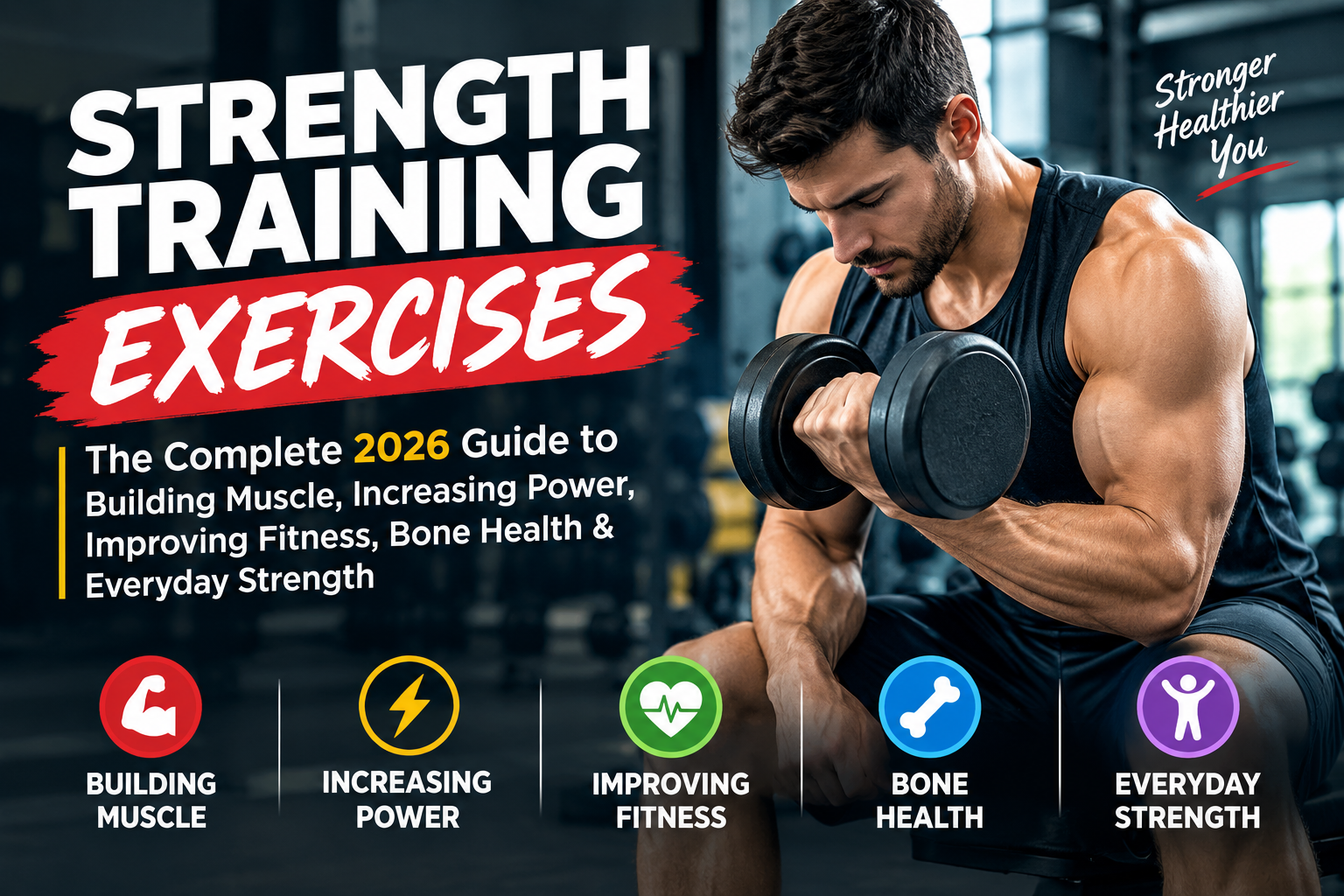
Strength training is one of the most effective ways to improve physical performance, build lean muscle, support bone health, and make everyday movement easier. You do not need to become a competitive bodybuilder or powerlifter to benefit. A thoughtfully designed routine can work for beginners, experienced gym-goers, older adults, athletes, and people training at home.
The best strength training exercises are not necessarily the most complicated. Squats, deadlifts, presses, rows, lunges, carries, and pull-based movements can create an impressive training stimulus when performed with appropriate resistance and progressive overload.
The real secret is consistency. Strength develops when you repeatedly challenge your muscles and nervous system, recover adequately, and gradually increase the demands placed on your body. In other words, effective resistance training is less about finding a magical exercise and more about mastering the fundamentals.
What Are Strength Training Exercises?
Strength training exercises are movements performed against resistance to improve muscular strength, endurance, power, or size. The resistance may come from free weights, machines, resistance bands, body weight, cables, or other training equipment.
During resistance training, muscles produce force against an external load. With consistent training, the body adapts by improving neuromuscular coordination and, depending on the program and nutrition, increasing muscle cross-sectional area. These adaptations can make tasks such as lifting objects, climbing stairs, carrying groceries, and maintaining posture easier.
A useful way to understand strength training is to think of it as progressive communication with your body. You provide a challenging stimulus, and your body responds by becoming better prepared for a similar demand in the future.
Why Strength Training Matters for Overall Health
One of the biggest advantages of strength training exercises is that their benefits extend far beyond appearance. Resistance training can help develop muscular strength and physical function while supporting bone health and maintaining lean body mass. Stronger muscles also contribute to joint stability and better movement capacity.
Strength training can become particularly valuable as people age. Muscle mass and strength naturally tend to decline over time, but regular resistance exercise provides a practical way to challenge the muscles and maintain functional capacity. A stronger body can make everyday activities feel less demanding.
There is also a psychological component. Completing a difficult set with controlled technique creates measurable progress. Moving from a light dumbbell to a heavier one or performing more repetitions with the same resistance provides tangible evidence that training is working.
The Best Strength Training Exercises for Full-Body Development
The most useful strength training exercises generally fall into several movement patterns: squat, hinge, push, pull, lunge, carry, and core stabilization. Training across these patterns helps create a balanced program rather than repeatedly emphasizing one area of the body.
| Movement pattern | Example exercise | Primary areas trained | Main benefit |
|---|---|---|---|
| Squat | Back squat | Quadriceps, glutes, core | Lower-body strength |
| Hinge | Romanian deadlift | Hamstrings, glutes, back | Posterior-chain strength |
| Horizontal push | Bench press | Chest, triceps, shoulders | Pressing strength |
| Horizontal pull | Dumbbell row | Back, biceps | Pulling strength |
| Vertical push | Overhead press | Shoulders, triceps | Upper-body strength |
| Vertical pull | Pull-up | Lats, biceps, upper back | Back and grip strength |
| Lunge | Split squat | Legs, glutes | Unilateral strength |
| Carry | Farmer’s carry | Grip, core, shoulders | Functional strength |
Compound movements are particularly efficient because they train multiple joints and muscle groups simultaneously. A squat, for example, requires coordinated action from the hips, knees, ankles, and trunk. This makes compound exercises valuable when training time is limited.
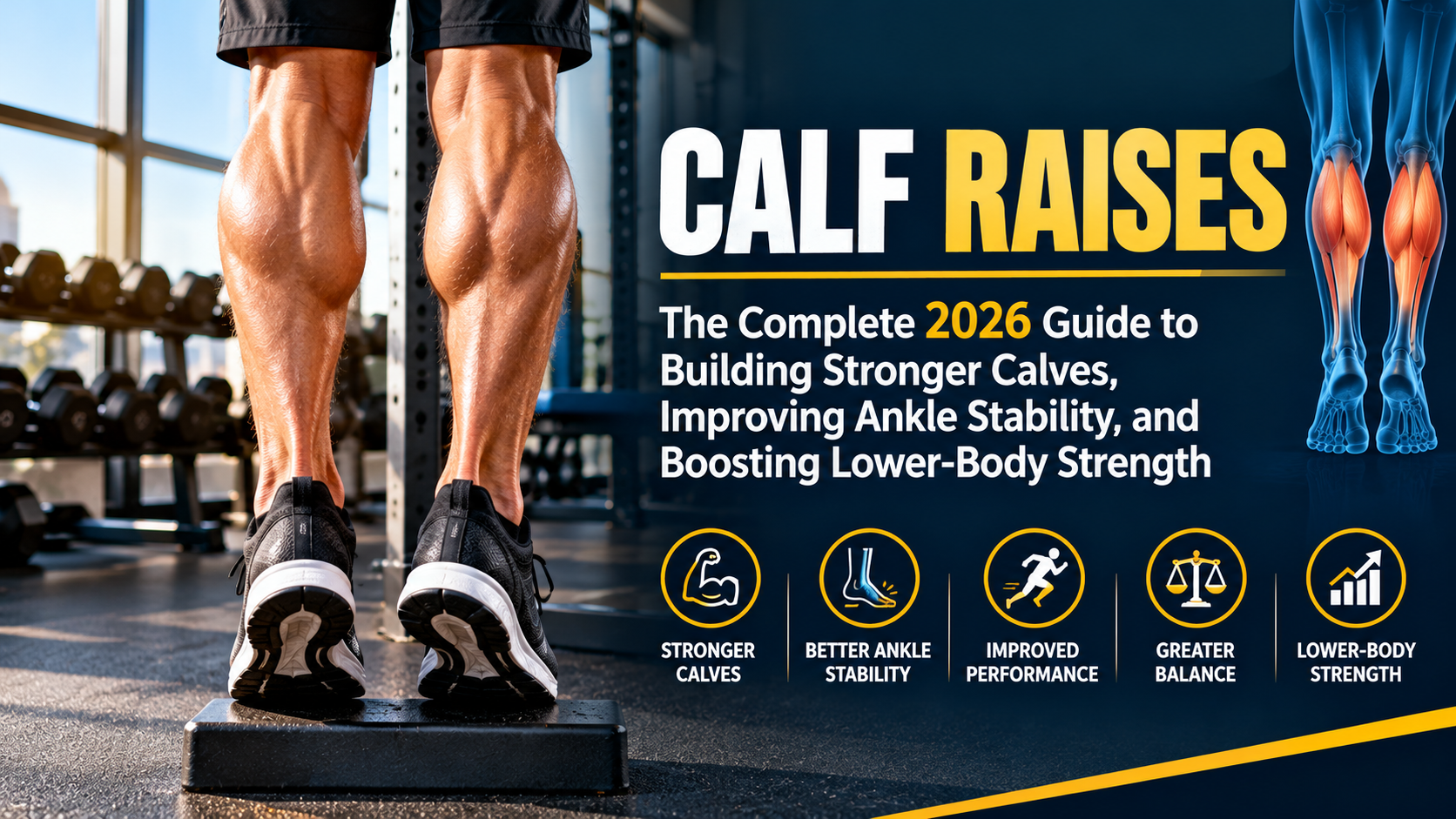
Isolation exercises still have an important role. Curls, triceps extensions, lateral raises, and calf raises allow you to place additional emphasis on specific muscles. The strongest programs usually combine broad movement patterns with targeted exercises according to individual goals.

Strength Training Exercises for Beginners
Beginners should treat technique as a skill rather than something to rush through. Start with manageable resistance and learn how to control the movement through a comfortable range of motion. The objective during the early stages is not to discover your maximum strength but to establish reliable movement patterns.
Bodyweight squats, goblet squats, dumbbell rows, incline push-ups, hip hinges, split squats, and loaded carries can provide excellent starting points. Once technique becomes consistent, resistance can gradually increase.
A common beginner mistake is confusing soreness with effectiveness. Extreme soreness is not a requirement for progress. A productive session should challenge the muscles without leaving you unable to perform normal activities for several days.
Strength Training Exercises for Muscle Growth
People pursuing hypertrophy need strength training exercises that provide sufficient mechanical tension and can be progressed over time. Muscle growth is influenced by training volume, intensity, exercise selection, nutrition, recovery, and individual factors.
Moderate repetition ranges are practical for many exercises, although muscle growth can occur across a relatively broad range when sets are sufficiently challenging. A set of controlled repetitions should become progressively harder toward the end without requiring reckless technique.
Progressive overload is fundamental. You can increase resistance, repetitions, sets, range of motion, or improve execution. For example, if you can perform three sets of 10 goblet squats comfortably with a particular weight, eventually progressing to three sets of 12 or increasing the load can create a new challenge.
Strength Training Exercises for Building Power
Strength and power are related but not identical. Strength describes the ability to produce force, while power involves producing force rapidly. Athletes often need both qualities because sprinting, jumping, throwing, and changing direction require force to be expressed quickly.
Power-focused movements can include medicine-ball throws, kettlebell swings, jump variations, and appropriately programmed Olympic-lifting derivatives. These movements require greater attention to technique and should generally be introduced after a person has established a solid foundation of movement competency.
A useful principle is simple: build control before chasing speed. Explosive training performed while fatigued or with poor technique can reduce movement quality. Adequate recovery between demanding sets helps maintain the speed and coordination that power development requires.
How to Build a Balanced Strength Training Routine
An effective strength training exercises program should cover the major movement patterns while allowing sufficient recovery. A full-body routine performed several times per week can work exceptionally well for beginners, while experienced lifters may prefer upper-body and lower-body splits.
Training volume should match experience and recovery capacity. Someone who works a physically demanding job may need less gym volume than someone who spends most of the day sitting. The best program is therefore not necessarily the one with the most sets; it is the one that produces progress without overwhelming recovery.
Exercise order also matters. Technically demanding compound movements are usually performed earlier in the session when concentration and energy are higher. Smaller isolation exercises can follow once the primary strength work is complete.
Progressive Overload and Measuring Progress
Progressive overload is the engine behind long-term improvement from strength training exercises. Without gradually increasing the challenge, the body eventually becomes accustomed to the same workload.
Progress does not always mean adding weight every session. You might perform an extra repetition, improve your range of motion, use better technique, reduce unnecessary rest, or complete the same workload with greater control. Keeping a training log makes these improvements much easier to identify.
For example, imagine performing dumbbell rows with 25 kilograms for eight repetitions. Several weeks later, you may perform 10 repetitions with the same weight before moving to a heavier pair. That is meaningful progress even though the dumbbell itself did not immediately become heavier.
Common Training Problems and Practical Solutions
A frequent problem with strength training exercises is doing too much too soon. Beginners sometimes copy advanced routines and immediately attempt high volumes or heavy loads. The solution is to begin with a sustainable workload and increase demands gradually.
Another problem is inconsistent technique. If a person changes their range of motion or body position every session, comparing performance becomes difficult. Recording exercises and maintaining consistent execution provides a much clearer picture of genuine strength development.
Poor recovery is another hidden obstacle. Training harder while sleeping poorly, eating inadequately, or ignoring persistent fatigue does not automatically produce better results. Sometimes the solution to stalled progress is not another workout but better recovery between workouts.
Strength Training at Home
You can perform many strength training exercises at home with surprisingly little equipment. Adjustable dumbbells, resistance bands, a sturdy bench, and bodyweight movements can create a versatile training environment.
Squats, push-ups, lunges, rows, Romanian deadlifts, overhead presses, carries, and floor presses can all be adapted to home training. Even without heavy weights, progression can come from increasing repetitions, slowing the eccentric phase, using unilateral variations, or expanding the range of motion where appropriate.
The key limitation of home training is often not exercise selection but resistance availability. If a person becomes significantly stronger, eventually the available load may no longer provide enough challenge for certain movements. At that point, additional equipment can make continued progression easier.
Safety, Form and Recovery
Good technique should remain a priority throughout strength training exercises. Maintain controlled movement, avoid unnecessary momentum, and use a resistance level that allows you to complete repetitions without sacrificing positioning.
Warm-up sets can help prepare the body for heavier work. They should gradually expose you to the movement and resistance rather than becoming a separate exhausting workout. For demanding compound lifts, several progressive warm-up sets can be particularly useful.
Recovery includes sleep, nutrition, hydration, rest days, and appropriate workload management. Persistent sharp pain is different from normal muscular fatigue and should not simply be ignored. If pain continues or affects normal movement, professional assessment is appropriate.
Nutrition for Strength and Muscle Development
Nutrition supports the adaptations created by strength training exercises. Protein provides amino acids required for muscle repair and remodeling, while carbohydrates can help support demanding training sessions and replenish glycogen.
Total energy intake also matters. Someone attempting to gain substantial muscle may require more calories than someone focused primarily on maintaining body composition. Conversely, during fat loss, adequate protein and resistance training can help preserve lean tissue.
There is no requirement for an elaborate diet. Meals built around protein-rich foods, vegetables, fruits, whole grains or other carbohydrate sources, healthy fats, and adequate fluids can provide a strong nutritional foundation.
Frequently Asked Questions
What are the most effective strength training exercises?
The most effective movements depend on your goals, experience, available equipment, and individual biomechanics. Squats, deadlifts or hip hinges, presses, rows, pull-ups, lunges, and loaded carries are highly versatile because they train major muscle groups and fundamental movement patterns.
How many days per week should I strength train?
Many beginners can make excellent progress with two or three resistance-training sessions per week. More experienced trainees may use additional sessions depending on their program and recovery. The important consideration is allowing muscles and connective tissues enough time to recover while providing consistent training stimulus.
Can strength training help with weight loss?
Yes. Resistance training can support a weight-management program by helping maintain or develop lean muscle while overall calorie balance determines whether body weight decreases. Combining resistance training with appropriate nutrition and regular physical activity is generally more effective than relying on exercise alone.
Can I build muscle with strength training exercises at home?
Yes. Home training can build muscle when the available resistance is sufficiently challenging and the program uses progressive overload. Dumbbells, resistance bands, adjustable weights, and bodyweight movements can provide substantial training stimulus, although equipment limitations may eventually affect progression.
How long should a strength training workout last?
A productive workout may take approximately 30–60 minutes, depending on the number of exercises, sets, warm-up requirements, and rest periods. Workout quality matters more than reaching a specific duration. Efficient programming can produce excellent results without spending hours in the gym.
Should I train to failure on every set?
No. Training to absolute muscular failure on every set is not necessary for strength or hypertrophy. Many sets can be highly productive when they finish with a small number of technically sound repetitions still available, particularly for demanding compound movements.
Conclusion
The most effective strength training exercises are built around fundamental movement patterns, progressive overload, proper technique, and consistent recovery. You do not need an enormous exercise library or an extremely complicated routine to become stronger.
Start with movements that train the major muscle groups, master their technique, track your performance, and gradually increase the training challenge. Combine resistance training with adequate protein, balanced nutrition, quality sleep, and realistic expectations.
The final insight is worth remembering: strength is not created by one heroic workout. It is built through hundreds of well-executed sessions that gradually teach your body to do more than it could before.