The traps muscle plays a major role in upper-body strength, shoulder stability, neck movement, and the overall appearance of your back. Whether you want a thicker upper back, stronger shoulders, improved posture, or better performance in the gym, understanding how the trapezius works can help you build a more effective training routine.
Often called the traps, the trapezius is a large, diamond-shaped muscle that extends from the base of the skull down the upper and middle spine and across the shoulders. It helps control the shoulder blades, supports movements of the neck, and contributes to lifting, pulling, carrying, and overhead activities.
Despite its importance, the trapezius is frequently misunderstood. Many people rely exclusively on heavy shrugs, overlooking the middle and lower portions that perform different functions. A balanced approach includes exercises that elevate, retract, depress, and upwardly rotate the shoulder blades while allowing adequate recovery.
This guide explains trapezius anatomy, its functions, the best exercises for growth, training recommendations, common mistakes, and practical ways to develop a stronger, more balanced upper body.
What Is the Traps Muscle?

The traps muscle is a broad, superficial muscle covering much of the upper back and the back of the neck. It connects the skull and spine to the shoulder girdle, including the clavicle and scapula. Its size and multiple attachment points allow it to perform several important functions rather than a single movement.
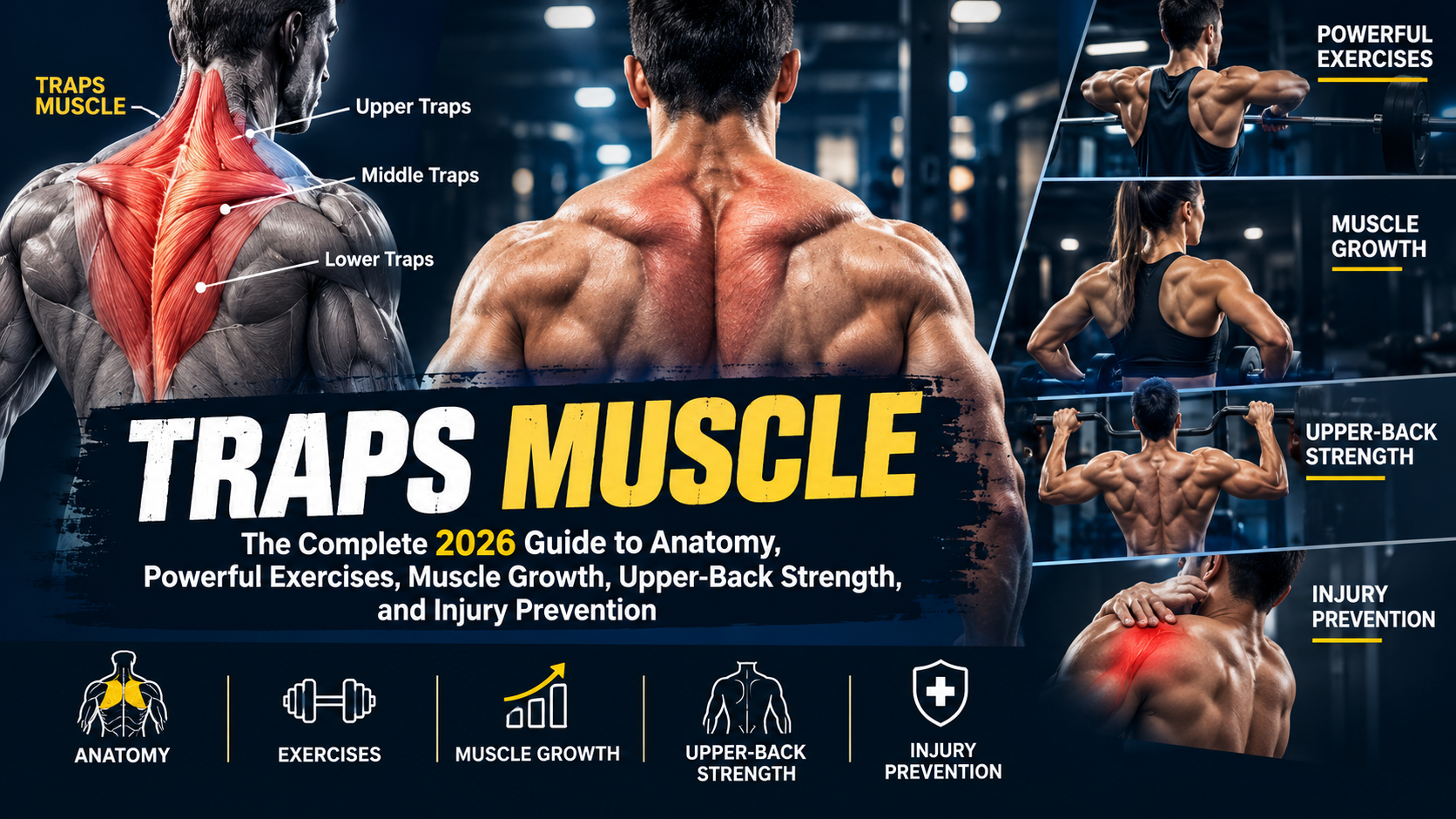
The trapezius is commonly divided into three functional regions: upper, middle, and lower fibers. The upper fibers help elevate the shoulder blades, the middle fibers primarily retract them, and the lower fibers contribute to depression and upward rotation of the scapula. Together, these regions coordinate shoulder movement and help maintain control during pulling and overhead exercises.
For example, when you carry heavy grocery bags, your trapezius helps stabilize your shoulders under the load. When you perform a pull-up, it contributes to controlling the shoulder blades. During an overhead press, its coordinated activity helps the scapula rotate upward so the arm can move overhead.
Trapezius Anatomy and Muscle Functions


Understanding the three regions makes it easier to choose exercises that train the entire muscle. Although their functions overlap, each region contributes differently depending on your arm position, movement direction, and resistance.
- Upper trapezius: Extends from the neck region toward the clavicle and shoulder. It helps elevate the scapula and contributes to upward rotation and neck movement.
- Middle trapezius: Runs mainly horizontally across the upper back. Its primary role is scapular retraction, drawing the shoulder blades toward the spine.
- Lower trapezius: Extends upward from the lower thoracic spine toward the scapula. It helps control scapular depression and contributes to upward rotation during overhead movement.
These regions work with other muscles, including the serratus anterior, rhomboids, levator scapulae, and rotator cuff. Effective shoulder movement depends on coordination between these structures rather than one muscle acting alone.
| Trapezius region | Main function | Useful exercises |
|---|---|---|
| Upper traps | Shoulder elevation and scapular control | Dumbbell shrugs, farmer’s carries |
| Middle traps | Scapular retraction | Chest-supported rows, reverse flyes |
| Lower traps | Scapular control and upward rotation | Prone Y raises, cable Y raises |
| Entire trapezius | Coordinated shoulder-girdle stability | Rows, carries, selected pulling movements |
Best Traps Muscle Exercises for Strength and Growth


A well-designed program combines direct trapezius exercises with compound movements that challenge the upper back and shoulder girdle. Heavy shrugs are useful for upper-trapezius development, but rows and selected scapular exercises help address other regions.
Dumbbell or barbell shrugs are among the most straightforward options. Stand tall with weights at your sides, raise your shoulders upward in a controlled movement, pause briefly, and lower them without bouncing. Avoid rolling your shoulders in circles; the goal is controlled elevation, not exaggerated joint movement.
Chest-supported rows target the middle back while reducing the need to stabilize your torso compared with unsupported rowing. Pull your elbows backward and allow your shoulder blades to move naturally. Farmer’s carries challenge grip strength and shoulder-girdle stability as you walk while holding heavy weights. For lower-trapezius development, prone Y raises can help train controlled scapular movement using relatively light resistance.
Other useful movements include cable rows, face pulls, reverse flyes, and appropriately performed overhead exercises. Each has a different emphasis, so select exercises based on your goals rather than expecting one movement to train every region equally.
How to Build Bigger Traps
Muscle growth depends on progressive resistance training, sufficient training volume, nutrition, and recovery. If your goal is a thicker upper back, start with a manageable workload and increase it gradually as your technique and strength improve.
For upper-trapezius growth, shrugs and loaded carries are useful choices. For the middle and lower regions, combine rowing variations with movements that emphasize scapular control. Compound pulling exercises can provide additional stimulus, but they should not replace direct work if the trapezius is a priority.
A common problem is increasing the weight before establishing a controlled range of motion. Heavy shrugs performed with bouncing or repeated knee drive can shift the emphasis away from deliberate muscular work. Reduce the load if necessary and focus on consistent repetitions, a controlled lowering phase, and stable body positioning.
Another consideration is recovery. The trapezius already works during deadlifts, rows, carries, and many shoulder exercises. Adding high volumes of direct work on top of demanding compound sessions may create unnecessary fatigue. Track your performance and adjust your training volume when strength stalls or soreness persists.
Traps Muscle Workout Plan for Different Fitness Levels
Beginners should focus on learning basic movement patterns and building consistency before adding substantial direct volume. Two or three sets of shrugs and rows may be enough to introduce targeted trapezius training alongside a balanced full-body program.
Intermediate lifters can benefit from combining heavier upper-trapezius work with controlled middle- and lower-trapezius exercises. The exact number of sets depends on how much pulling, carrying, and shoulder training already exists in the weekly routine.
| Experience level | Exercise selection | Sets and reps |
|---|---|---|
| Beginner | Dumbbell shrugs, chest-supported rows | 2–3 sets of 8–12 reps each |
| Intermediate | Barbell shrugs, cable rows, prone Y raises | 3 sets of 8–15 reps each |
| Advanced | Shrugs, rows, farmer’s carries, Y raises | 3–4 sets per exercise, adjusted to recovery |
These are starting guidelines rather than fixed requirements. Farmer’s carries are usually programmed by distance or time rather than repetitions, and lower-trapezius exercises often work best with lighter loads and controlled movement.
Train the trapezius once or twice weekly initially, accounting for the demands of your other workouts. Increase resistance when you can complete the prescribed work with stable technique. You can also progress by adding repetitions, improving control, or increasing carry distance without sacrificing posture.
Common Trapezius Training Mistakes
One frequent mistake is training only the upper trapezius. Shrugs can build the prominent muscles around the neck and shoulders, but they do not fully address the middle and lower regions. Include rows and targeted scapular exercises to create a more balanced program.
Another issue is using momentum to lift excessive weight. If your shoulders jerk upward or your torso repeatedly bounces, the load may be too heavy for controlled repetitions. Select a weight that lets you move smoothly and lower it deliberately.
Poor posture during loaded carries is also worth addressing. Leaning backward, allowing the shoulders to collapse, or taking unstable steps can reduce movement quality. Keep your torso steady, walk naturally, and choose a load you can control.
Finally, avoid assuming that constant tightness means your traps are weak or need more training. Neck discomfort can have several causes, including prolonged positioning, stress, and other musculoskeletal factors. If discomfort persists, worsens, or includes numbness or weakness, seek an appropriate clinical assessment rather than attempting to solve it through increasingly heavy exercises.
Traps Muscle, Posture, and Shoulder Health
The trapezius helps coordinate scapular movement, which is essential for raising your arms, reaching overhead, and performing pulling movements. The upper and lower fibers work with the serratus anterior to contribute to upward rotation of the shoulder blade. The middle fibers help control retraction during rowing and related movements.
Balanced training can improve strength and movement control, but the relationship between posture and pain is more complicated than simply strengthening one muscle. Neck or shoulder discomfort may involve several muscles, joints, movement habits, workload, and individual health factors.
For people who spend long periods at a desk, changing positions regularly, taking movement breaks, and performing comfortable shoulder and upper-back exercises may help reduce stiffness associated with prolonged sitting. Strength training is one part of the solution, not a guaranteed treatment for every type of neck or shoulder pain.
A useful coaching principle is: “Train the shoulder blades to move with control, not simply to stay squeezed together.” This matters because healthy shoulder mechanics require both stability and movement, particularly during overhead reaching.
Nutrition and Recovery for Trapezius Growth
Muscle development requires more than exercise selection. Adequate protein supports muscle repair and adaptation, while sufficient total energy helps fuel training and recovery. Protein-rich foods such as eggs, fish, dairy products, lean meat, beans, lentils, and soy can contribute to daily requirements.
For many healthy adults who strength train, approximately 1.4–2.0 grams of protein per kilogram of body weight per day is a practical evidence-based range. Individual needs vary with total energy intake, training demands, body composition goals, and health circumstances. Protein supplements can be convenient, but they are not essential when dietary intake is adequate.
Sleep also matters. Consistent, sufficient sleep supports recovery, performance, and training adaptation. Allow enough time between demanding sessions for fatigue to subside, especially when your routine includes heavy deadlifts, rows, or loaded carries.
If progress slows, review the entire picture rather than adding exercises automatically. Check whether your training is progressive, your nutrition supports your goal, and your weekly workload allows recovery. Sustainable improvements usually come from consistent habits rather than dramatic changes.
Frequently Asked Questions
How often should you train the trapezius?
Many lifters can train the trapezius directly once or twice per week, depending on their experience and total upper-body workload. Rows, deadlifts, carries, and shoulder exercises also involve the muscle, so count these when planning recovery. Increase frequency only when you can maintain performance and recover adequately.
What is the best exercise for bigger traps?
Shrugs are an effective option for upper-trapezius development because they directly train shoulder elevation against resistance. However, a complete routine should also include rows and selected scapular exercises to train the middle and lower regions. The best exercise depends on which area you want to emphasize and which movements you can perform comfortably.
Do deadlifts work the trapezius?
Yes. Deadlifts require the trapezius and other upper-back muscles to help stabilize the shoulder girdle while the body handles a heavy load. However, the amount of direct growth stimulus varies with technique, loading, and training volume. Dedicated shrugs and other targeted exercises may be useful when additional trapezius development is a priority.
Can you build traps without weights?
Yes. Bodyweight movements such as prone Y raises and selected scapular-control exercises can train parts of the trapezius, especially when performed with good technique. However, progressively loading the muscle becomes more difficult without external resistance. Resistance bands or household items designed for safe loading can provide additional options.
Do strong traps improve posture?
Stronger trapezius muscles can support shoulder-blade control and contribute to upper-back function. However, posture depends on more than muscle strength, and no single exercise guarantees an ideal position or eliminates pain. A balanced program, regular movement, and comfortable work habits can all contribute to better movement tolerance.
Why do my traps hurt after training?
Mild muscular soreness after an unfamiliar or demanding workout can occur as your body adapts. Excessive loading, poor exercise control, and sudden increases in training volume may increase discomfort. Sharp pain, persistent symptoms, numbness, or weakness should not be dismissed as normal soreness and warrant professional evaluation.
Conclusion
The traps muscle is essential for upper-back strength, shoulder-blade control, neck movement, and a balanced upper-body physique. Its three regions perform complementary functions, making it important to train more than just the prominent muscles at the top of the shoulders.
Combine shrugs and loaded carries with rows and lower-trapezius exercises, then build gradually through appropriate resistance, sound technique, adequate protein, and consistent recovery. Avoid chasing heavy weights at the expense of control, and adjust your routine to match your experience and goals.
The key takeaway is simple: develop the trapezius as a coordinated muscle group, not just a pair of raised shoulders. A balanced approach can support stronger lifts, better shoulder control, and long-term upper-body development.