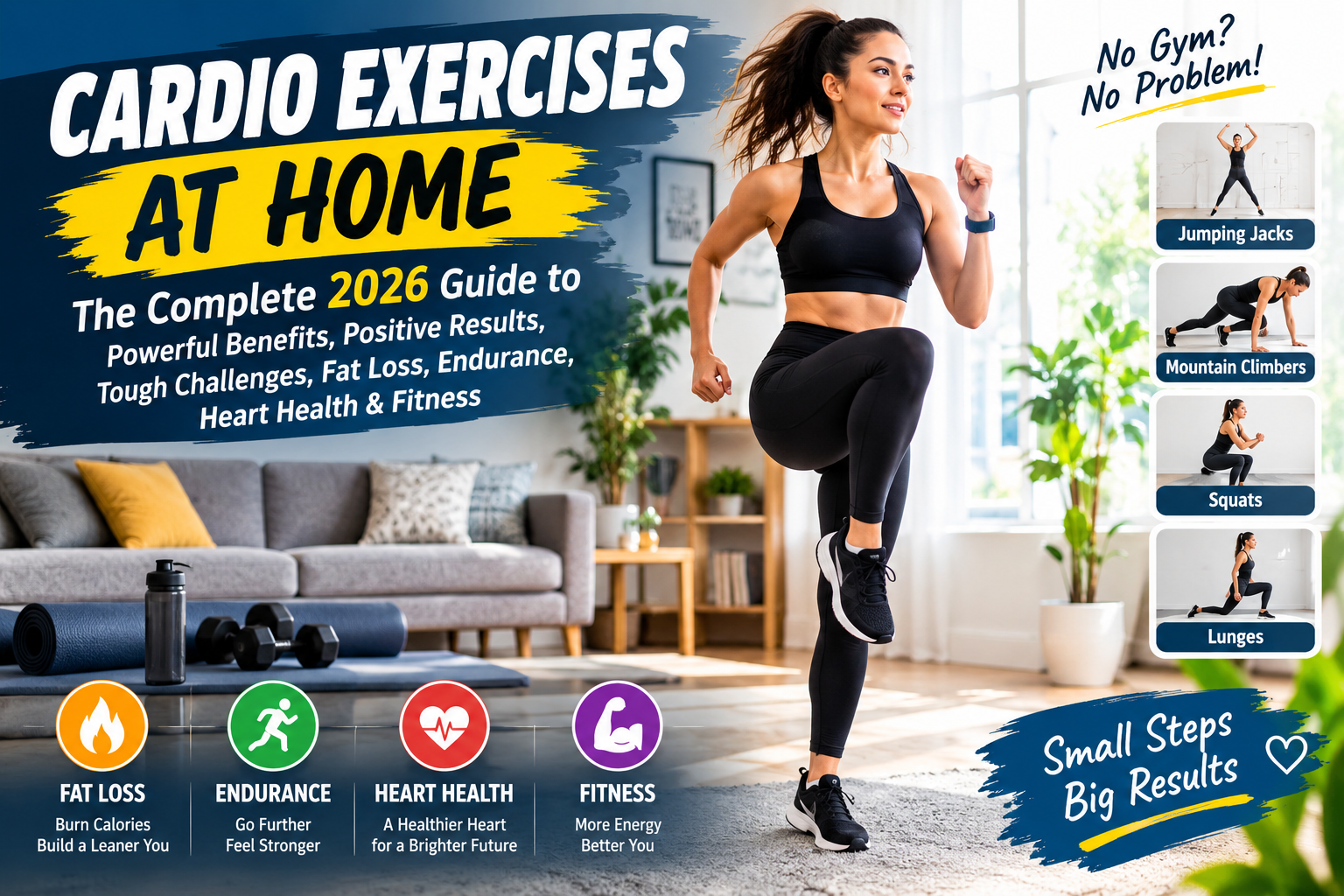
Cardio does not require a treadmill, elliptical, or expensive gym membership. With the right movements and a sensible progression strategy, cardio exercises at home can raise your heart rate, improve cardiovascular fitness, increase endurance, and support healthy weight management. From brisk marching and step-ups to jumping jacks, high knees, mountain climbers, and dance-based workouts, there are plenty of ways to create an effective routine using little or no equipment.
The biggest advantage of home cardio is accessibility. You can train in a living room, bedroom, garage, or small outdoor space and adjust the intensity to your fitness level. The key is understanding how intensity, duration, exercise selection, recovery, and consistency work together. A short, well-structured workout can be more useful than a long session performed without purpose.
What Are Cardio Exercises at Home?
Cardio exercises at home are movements performed in a residential setting that increase breathing and heart rate for a sustained period. They can include low-impact activities such as marching in place and step-touch movements, moderate exercises such as brisk stair climbing, or vigorous movements such as burpees and fast high knees.
The American Heart Association recommends regular aerobic activity as part of a healthy lifestyle, with adults generally aiming for at least 150 minutes of moderate-intensity aerobic activity or 75 minutes of vigorous activity each week, alongside muscle-strengthening activity. The important point is that activity can be accumulated throughout the week rather than completed in a single session.
“Effective home cardio is less about having perfect equipment and more about creating enough movement and intensity to challenge your cardiovascular system.”
This makes home training particularly useful for people with busy schedules. Ten- or fifteen-minute sessions can be incorporated before work, during a lunch break, or in the evening, provided they contribute to an overall consistent activity pattern.
Why Home Cardio Matters for Heart Health and Fitness
Cardiovascular exercise trains the systems responsible for delivering oxygen and nutrients to working muscles. As fitness improves, everyday activities such as climbing stairs, walking uphill, carrying groceries, or playing with children can feel less demanding. Regular aerobic activity is also associated with important cardiovascular and metabolic health benefits.
Another major advantage is improved exercise tolerance. Someone who becomes winded after several minutes of movement may gradually develop better endurance by repeatedly exposing the body to manageable challenges. Think of cardiovascular fitness like a battery: consistent training helps improve how efficiently your body produces and uses energy during physical activity.
The best cardio exercises at home are therefore not necessarily the most exhausting ones. A workout that leaves someone unable to recover for several days may be less practical than a moderate routine that can be repeated consistently throughout the week.
Best Cardio Exercises at Home Without Equipment
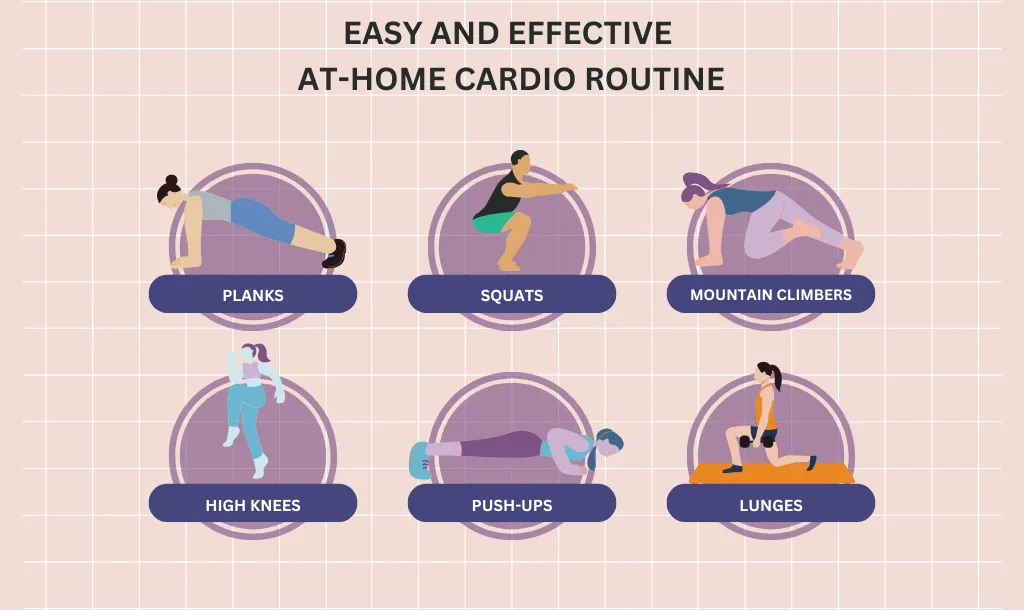
Bodyweight movements make it possible to create challenging workouts without purchasing specialized equipment. Marching in place, jumping jacks, high knees, butt kicks, mountain climbers, squat-to-reaches, skaters, and burpees can all be adapted to different fitness levels.
For beginners, marching with purposeful arm movement is an excellent starting point because it allows intensity to increase gradually. A more experienced exerciser can transition from marching to high knees or jumping variations. Similarly, a standard jumping jack can be modified into a step-out jack by removing the jumping component, making it more accessible for people who prefer lower-impact training.
| Exercise | Impact level | Primary benefit | Beginner modification |
|---|---|---|---|
| Marching in place | Low | Basic aerobic conditioning | Slow marching |
| Step-ups | Low–moderate | Endurance and leg conditioning | Lower step |
| Jumping jacks | Moderate | Full-body cardiovascular work | Step jacks |
| High knees | Moderate–high | Heart rate and coordination | Slow knee drives |
| Mountain climbers | Moderate–high | Cardio and core endurance | Hands elevated |
| Skaters | Moderate–high | Lateral movement and balance | Side steps |
| Burpees | High | Full-body conditioning | Remove jump |
| Dance cardio | Low–high | Endurance and coordination | Lower tempo |
One useful strategy is to combine movements with different demands. For example, alternating jumping jacks with marching gives you a natural intensity change. Combining a lower-impact movement with a more demanding exercise can also make a workout feel sustainable without sacrificing cardiovascular stimulus.
How to Structure a Home Cardio Workout
A well-designed session generally includes a warm-up, a main cardiovascular section, and a gradual cool-down. The warm-up prepares the body for movement by gradually increasing temperature, circulation, and joint mobility. Simple movements such as walking around the room, shoulder rolls, gentle knee lifts, and controlled bodyweight squats can work well.
The main section can use intervals, steady-state movement, or a combination of both. For example, a beginner might perform 30 seconds of brisk marching followed by 30 seconds of easier movement and repeat the pattern several times. A fitter individual could use longer work intervals and shorter recovery periods.
A useful home session might look like this:
- Warm-up: 5 minutes of gentle movement
- Main workout: 15–20 minutes of alternating moderate and vigorous intervals
- Cool-down: 5 minutes of gradually decreasing movement
- Total time: approximately 25–30 minutes
This structure is flexible enough to accommodate different schedules while still providing a clear training stimulus.
Cardio Intensity and the Talk Test
Intensity is one of the most important concepts in cardiovascular training. A simple way to estimate moderate intensity is the talk test. If you can speak in complete sentences but would find singing difficult, you are generally working at a moderate level. During vigorous activity, speaking several words may become challenging because breathing is substantially elevated.
Using perceived exertion can also help. On a scale from 1 to 10, moderate activity might feel around 5–6, while vigorous work may feel closer to 7–8 for many people. These numbers are subjective, so they should be used as practical guides rather than rigid measurements.
The value of understanding intensity is that it prevents a common mistake: assuming that every workout needs to be maximal. Cardio exercises at home can be effective at several intensity levels. Easy sessions support active recovery, moderate workouts build aerobic capacity, and occasional higher-intensity intervals can provide a stronger conditioning challenge.
Cardio for Weight Loss and Calorie Burning
Cardio can contribute to weight management by increasing energy expenditure, but fat loss depends on the broader relationship between calorie intake and expenditure over time. A person can perform intense workouts while still maintaining or gaining weight if overall calorie intake consistently exceeds energy needs.
This is why sustainable routines are usually more useful than extreme workouts. Someone who completes a manageable 25-minute session four or five times per week may accumulate more useful activity than someone who attempts an exhausting workout once and then stops exercising because of excessive soreness or fatigue.
For people pursuing fat loss, combining aerobic activity with resistance training and adequate protein can help support lean mass while improving overall fitness. Sleep, nutrition, stress management, and daily movement such as walking also contribute to the bigger picture.
Low-Impact Cardio for Beginners and Joint-Friendly Training
Not every effective cardiovascular workout needs jumping. Low-impact cardio exercises at home can provide a meaningful aerobic challenge while reducing repetitive impact. Marching, step-ups, side steps, shadow boxing, dance movements, and controlled knee drives are useful examples.
Low-impact training can be especially practical for beginners, older adults, people returning to exercise, or anyone who finds repeated jumping uncomfortable. The key is not to confuse low impact with low intensity. Moving the arms more actively, increasing movement speed, using larger ranges of motion, or shortening rest periods can make a low-impact routine considerably more challenging.
For example, fast marching with powerful arm swings can elevate breathing significantly without requiring the repeated landing forces associated with jumping. This demonstrates an important training principle: intensity can come from speed, duration, range of motion, resistance, or reduced recovery—not just impact.
High-Intensity Cardio at Home
High-intensity interval training, commonly called HIIT, alternates short periods of harder exercise with recovery intervals. It can be performed with bodyweight movements and does not require a gym. Examples include fast mountain climbers, burpees, squat jumps, high knees, and rapid step-ups.
However, HIIT is demanding. Beginners should establish a basic fitness foundation before repeatedly performing maximal-effort intervals. Technique can deteriorate when fatigue becomes extreme, increasing the likelihood of poor movement patterns.
A smarter progression is to begin with moderate intervals and gradually increase work duration or reduce recovery time. Cardio exercises at home become more challenging through progression, not by making every workout brutally difficult.
How to Progress Without Gym Equipment
Progressive overload applies to cardiovascular training just as it does to resistance exercise. If the same workout becomes easy, you can increase duration, raise movement speed, add resistance, increase the number of intervals, reduce recovery periods, or select a more demanding variation.
For example, a beginner might start with 20 seconds of high knees followed by 40 seconds of marching. After several weeks, the same person could progress to 30 seconds of high knees and 30 seconds of marching. Later, they might increase the work interval to 40 seconds while maintaining good technique.
The goal is gradual adaptation. Increasing everything simultaneously can create unnecessary fatigue. Changing one variable at a time makes it easier to understand how your body responds and helps maintain consistency.
Common Home Cardio Mistakes and Practical Solutions
One common mistake is starting too aggressively. People often perform dozens of burpees, jump squats, or high knees during their first workout because these exercises look simple. The cardiovascular system may tolerate the challenge temporarily, but muscles, joints, and connective tissues also need time to adapt.
The solution is controlled progression. Begin at an intensity you can manage with good technique, leave some energy in reserve, and increase difficulty gradually. Another mistake is ignoring recovery. Rest days, lighter sessions, hydration, adequate nutrition, and sleep all contribute to adaptation.
Another problem is doing only one type of movement. Repeating the same exercise can become monotonous and may place repetitive demands on the same tissues. Rotating between marching, step-ups, dance movements, lateral exercises, and bodyweight intervals creates greater variety while allowing different movement patterns to share the workload.
How Often Should You Do Cardio at Home?
The appropriate frequency depends on intensity, fitness level, age, recovery capacity, and other training. Public-health guidelines commonly recommend at least 150 minutes of moderate aerobic activity or 75 minutes of vigorous aerobic activity per week for adults, with additional activity providing further benefits for many people.
A beginner does not need to reach the weekly target immediately. Starting with shorter sessions and gradually increasing frequency can make the habit easier to maintain. Someone who currently performs little structured exercise might begin with several short sessions and supplement them with ordinary walking and other daily movement.
For more experienced exercisers, cardio exercises at home can be combined with resistance training. A practical weekly routine might include moderate cardio on several days, strength training on separate or overlapping days, and at least some lighter periods for recovery.
Safety, Warm-Ups and Exercise Modifications
Safety begins with the training environment. Clear enough floor space to move freely, secure loose rugs, wear appropriate footwear when needed, and choose movements suitable for the available surface. Jumping exercises should generally be performed on a stable surface with sufficient room for safe landing.
A gradual warm-up is especially important before vigorous sessions. Begin with easy movements and progressively increase intensity rather than immediately performing maximal efforts. During exercise, technique should remain controlled even as breathing becomes harder.
People with known cardiovascular disease, significant medical conditions, recent injuries, or symptoms such as chest pain, fainting, or unusual shortness of breath should obtain appropriate medical guidance before beginning vigorous exercise. Exercise should challenge the body without ignoring warning signs.
Frequently Asked Questions
What are the best cardio exercises at home for beginners?
Beginners can start with marching in place, step-touch movements, low-impact jumping jacks, controlled step-ups, gentle dance movements, and walking around the home. These exercises make it easier to regulate intensity and learn how the body responds to cardiovascular activity before progressing toward more demanding movements.
Can cardio exercises at home help reduce belly fat?
Home cardio can contribute to overall fat loss by increasing energy expenditure, but it cannot selectively remove fat from the abdomen. Where the body loses fat first is influenced by genetics, hormones, sex, age, and overall body composition. A combination of sustainable calorie control, aerobic activity, resistance training, adequate protein, and recovery is more appropriate for reducing overall body fat.
How long should a home cardio workout last?
A useful session can range from approximately 10 minutes to 45 minutes depending on intensity, fitness level, and purpose. Short workouts can still contribute to overall physical activity, while longer sessions may be appropriate for developing aerobic endurance. Consistency across the week matters more than forcing every workout to be long.
Can cardio at home build endurance?
Yes. Regular aerobic training can improve the body’s ability to sustain physical activity. As conditioning improves, people can gradually increase exercise duration, movement speed, or training intensity while experiencing less fatigue at the same workload.
Are cardio exercises at home effective without equipment?
Absolutely. Bodyweight movements can raise heart rate and provide an effective cardiovascular stimulus. Marching, high knees, jumping jacks, mountain climbers, skaters, dance movements, and burpees can all be adapted according to fitness level. Equipment can add variety, but it is not a requirement for meaningful cardiovascular training.
Is home cardio better before or after strength training?
The answer depends on the training goal and weekly schedule. If strength development is the main priority, performing demanding cardio before strength training can create fatigue that affects lifting performance. Moderate cardio after strength training or in a separate session can often work well, while easier cardio can be used for warm-ups or recovery.
Conclusion
Cardio exercises at home provide a practical way to improve cardiovascular fitness, endurance, calorie expenditure, movement capacity, and overall physical activity without relying on a gym. The most effective routine is not necessarily the hardest one. It is the routine that matches your fitness level, can be progressed safely, and can be performed consistently.
Start with movements you can control, build duration gradually, and use intensity strategically. Combine low-impact aerobic work with occasional higher-intensity intervals when appropriate, and support your training with resistance exercise, nutritious food, adequate hydration, and sufficient recovery.
The final insight is simple: an effective cardio workout is created by the quality and consistency of the training stimulus, not by expensive equipment. With smart progression and regular practice, cardio exercises at home can become a sustainable foundation for better endurance, stronger cardiovascular fitness, and a healthier active lifestyle.