
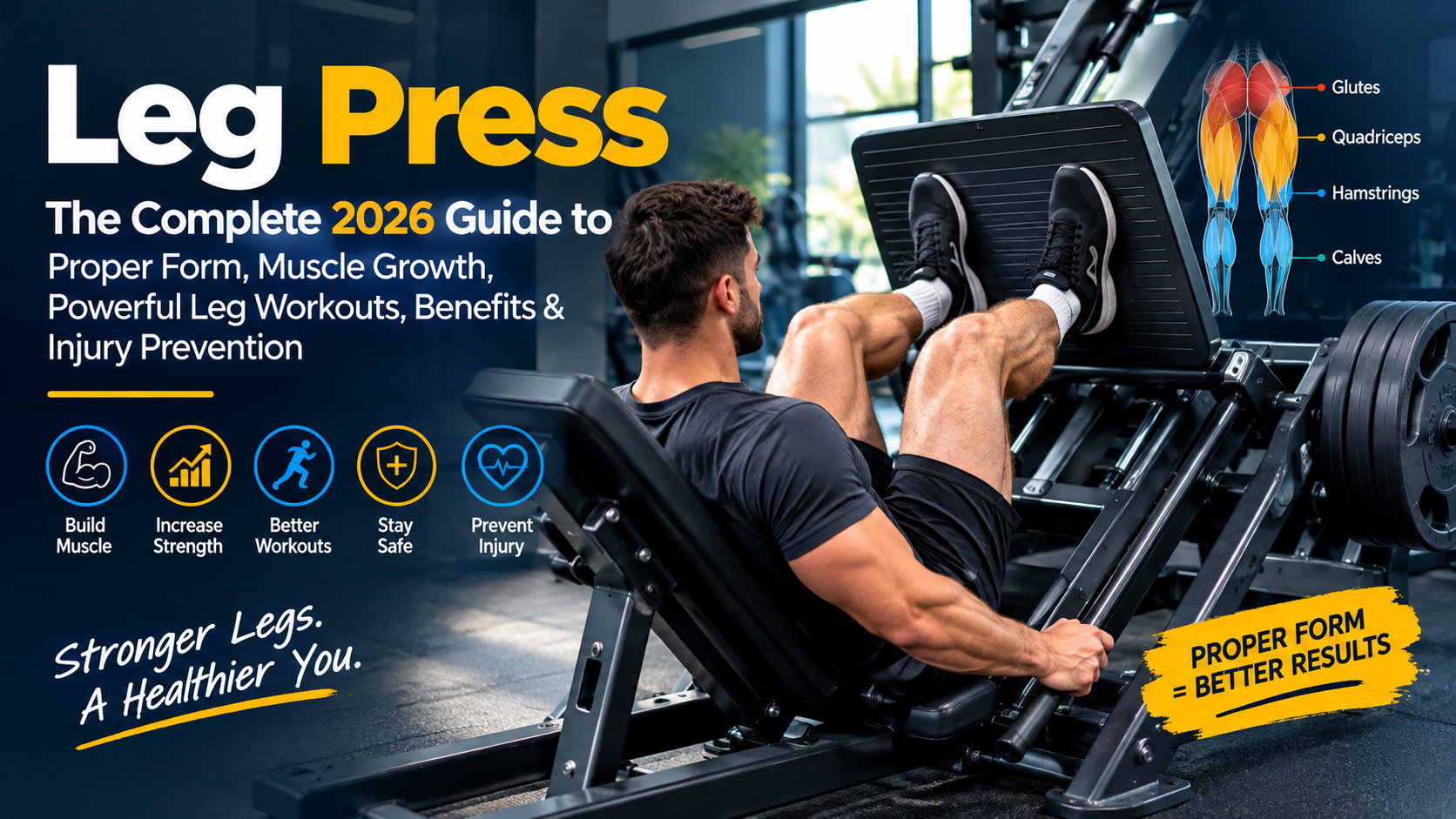
The leg press is one of the most popular lower-body strength exercises because it allows you to train your quadriceps, glutes, and other leg muscles using a guided resistance machine. Whether you’re a beginner building foundational strength or an experienced lifter looking to increase muscle size, this exercise can help you develop powerful legs without requiring the balance and coordination of a barbell squat.
However, effective results depend on more than adding weight to the machine. Foot placement, range of motion, controlled repetitions, and appropriate resistance all influence which muscles work hardest and how safely you perform each repetition. Poor technique can place unnecessary stress on your knees, hips, and lower back, particularly when you use excessive weight.
This comprehensive guide explains how to perform the movement correctly, which muscles it targets, how to adjust your technique for different goals, and how to incorporate it into a balanced lower-body training program.
What Is the Leg Press?
The leg press is a compound resistance exercise performed on a specialized machine that allows you to push a weighted platform away from your body using your legs. Depending on the equipment, you perform the movement while sitting at an incline or reclining in a horizontal position.
Unlike free-weight exercises, the machine provides a guided movement path, reducing the need to stabilize a barbell. This makes it useful for beginners, bodybuilders, and people who want to train their lower body with predictable resistance. Nevertheless, guided movement does not automatically make an exercise injury-proof.
The two most common designs are the 45-degree sled machine and the horizontal seated machine. Both train the lower body, but their resistance systems, seat positions, and movement paths differ. Because machine designs vary, the displayed weight does not always translate directly into the same resistance across different gyms.
Which Muscles Does the Leg Press Work?
This exercise primarily targets the quadriceps, the large muscles at the front of your thighs responsible for extending your knees. Your gluteus maximus also contributes significantly by extending your hips, particularly when you use a comfortable, deeper range of motion.
Your hamstrings and adductor magnus assist with hip movement, while your calves contribute to ankle stabilization and control. The exact contribution of each muscle depends on your anatomy, foot position, machine design, and depth of movement.
| Muscle group | Primary role | Training benefit |
|---|---|---|
| Quadriceps | Straighten the knees | Thigh strength and size |
| Gluteus maximus | Extend the hips | Hip strength and glute development |
| Hamstrings | Assist hip extension and stabilize movement | Lower-body coordination |
| Adductors | Assist hip movement and stabilize the thighs | Hip control and strength |
| Calves | Help stabilize the ankles | Lower-leg support |
Although several muscles participate, the quadriceps generally receive substantial loading. The exercise complements movements such as squats, lunges, Romanian deadlifts, and hamstring curls rather than replacing every lower-body exercise.
How to Perform the Leg Press With Proper Form
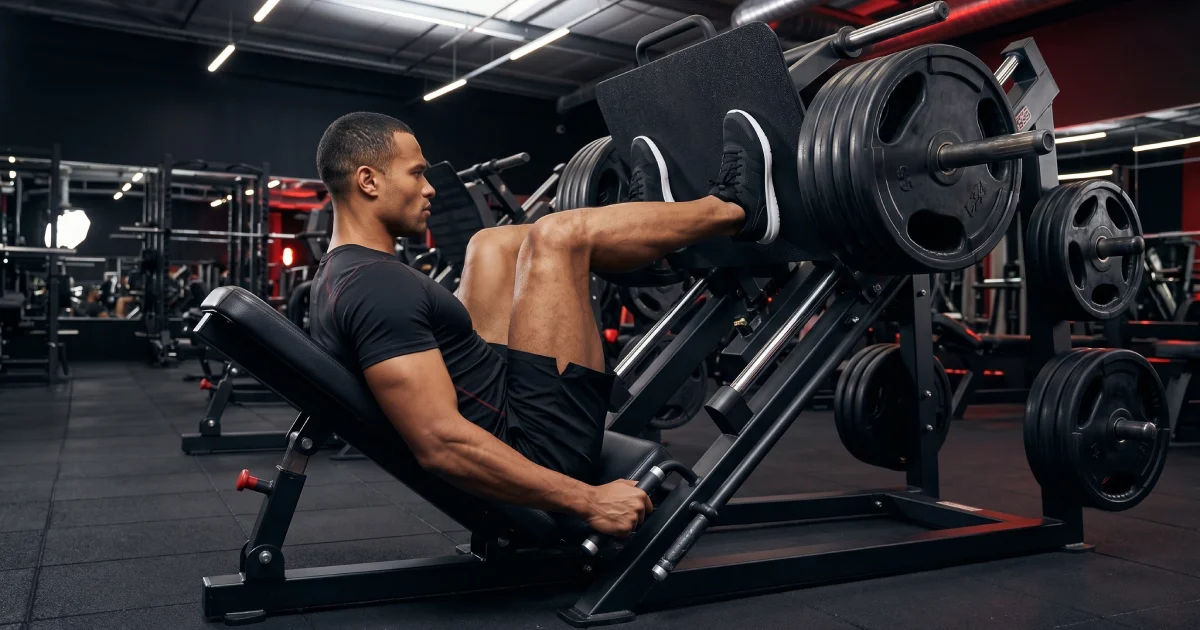
Start by adjusting the seat so your back and pelvis remain supported against the pad. Place your feet approximately shoulder-width apart on the platform, with your heels fully supported and toes angled slightly outward if that feels natural. Your knees should track in the same general direction as your toes.
Before releasing the safety mechanism, select a manageable weight. Lower the platform slowly by bending your knees and hips until you reach a comfortable depth without your lower back rounding or your pelvis lifting away from the seat. Then push through your feet to return the platform toward the starting position.
Keep your movements controlled throughout the repetition. Exhale as you push and inhale as you lower, avoiding prolonged breath-holding, especially if you have a medical condition that makes straining risky. At the top, extend your knees without forcefully locking them or resting all your weight on the joints.
A useful coaching principle is: “Move through the deepest range you can control while keeping your hips and back supported.” This emphasizes quality over the amount of weight displayed on the machine.
Best Foot Placement for Different Training Goals
Foot placement can change joint angles and influence how much work different muscles perform. However, it does not completely isolate one muscle group, and small adjustments often matter less than controlled technique, suitable resistance, and consistent training.
A shoulder-width stance with feet near the middle of the platform is a practical starting point for most people. From there, you can experiment with comfortable variations while keeping your heels supported and knees aligned.
| Foot position | Potential emphasis | Important consideration |
|---|---|---|
| Shoulder-width, mid-platform | Balanced quadriceps and glute training | Best general starting position |
| Slightly lower placement | Greater knee flexion and quadriceps demand | Avoid excessive knee discomfort |
| Slightly higher placement | More hip flexion and potential glute contribution | Maintain pelvic and back support |
| Wider stance | May increase adductor contribution | Keep knees tracking with toes |
| Narrow stance | May feel more quadriceps-focused for some lifters | Avoid forcing your knees into an unnatural path |
There is no universally perfect stance. Your hip structure, ankle mobility, limb proportions, and machine design all affect what feels natural. A position that works well for another lifter may be uncomfortable for you.
Benefits of the Leg Press for Strength and Muscle Growth
One major benefit is the ability to train the quadriceps and glutes with substantial resistance while relying less on balance than you would during a squat. This can be particularly useful when your training goal is muscle hypertrophy, or an increase in muscle size.
The machine also makes progressive overload straightforward. You can gradually increase resistance, perform additional repetitions, or improve control and range of motion as your strength develops. These gradual improvements provide measurable ways to track progress over time.
Another advantage is exercise accessibility. Beginners can learn basic lower-body resistance training without managing a barbell, while experienced lifters can use the machine for additional training volume after squats or other compound movements.
However, it does not fully replicate the balance, trunk stabilization, and movement coordination required by free-weight exercises. For well-rounded fitness, combine machine training with other movements suited to your goals and abilities.
Common Leg Press Mistakes and How to Fix Them
Loading too much weight is one of the most frequent mistakes. Excessive resistance often shortens the range of motion, causes uncontrolled repetitions, or encourages the hips to lift from the seat. Reduce the load until you can perform every repetition smoothly without compromising your position.
Another common error is lowering the platform too far. Greater depth can increase hip and knee flexion, but forcing extra depth when your pelvis begins to roll backward can place unnecessary stress on your lower back. Stop at the deepest point you can control while maintaining stable contact with the backrest.
Avoid bouncing the platform at the bottom, pushing primarily through your toes, or allowing your knees to collapse inward. Instead, maintain whole-foot contact, lower the weight under control, and keep your knees aligned with your toes.
Finally, do not treat the safety stops as optional. Learn how to engage and disengage them before starting, and never assume you can safely escape a failed repetition under heavy resistance without knowing how your particular machine operates.
How Much Weight, How Many Reps, and How Often?
The right training load depends on your experience, recovery, and objective. Beginners should prioritize technique with a light resistance that allows them to complete every repetition comfortably. More experienced lifters can use heavier loads when their form and range of motion remain consistent.
For general strength and muscle development, the following ranges provide a useful starting point.
| Training goal | Sets | Repetitions | Rest between sets |
|---|---|---|---|
| General fitness | 2–3 | 10–15 | 60–120 seconds |
| Muscle hypertrophy | 3–4 | 8–15 | 90–180 seconds |
| Strength emphasis | 3–5 | 5–8 | 2–3 minutes |
| Muscular endurance | 2–3 | 15–20 | 45–90 seconds |
These are guidelines, not mandatory prescriptions. Rest longer if you need to recover enough to maintain good technique. For most muscle-building programs, finish sets with approximately one to three repetitions left in reserve rather than repeatedly training to complete failure.
Most people can begin with one or two weekly sessions, depending on their overall training volume and recovery. Allow sufficient recovery between demanding lower-body workouts, and increase the load gradually only when your current weight feels manageable across all prescribed repetitions.
How to Add the Exercise to Your Leg Workout
The machine works well after a primary compound movement when your goal is to add targeted quadriceps and glute training. For example, a lower-body workout could include squats, a machine press, Romanian deadlifts, hamstring curls, and calf raises. This combination trains knee extension, hip extension, the hamstrings, and the lower legs more comprehensively than relying on one movement alone.
If you are a beginner, a simpler session might include the machine exercise, a hip-hinge movement, a supported split squat, and calf raises. Start with modest volume and focus on learning the movements before adding more sets.
Experienced lifters may place the exercise later in a workout to accumulate additional muscle-building volume without needing to balance heavy free weights. Alternatively, someone returning to structured training after a break might begin with the machine at a comfortable load and rebuild gradually.
Your overall program should also consider training frequency, sleep, nutrition, and recovery. More sets do not automatically produce better results if fatigue prevents you from performing quality repetitions or recovering between sessions.
Is the Leg Press Safe for Your Knees and Lower Back?
For many healthy adults, this exercise can be a useful part of a strength program when performed with appropriate resistance and controlled movement. Nevertheless, safety depends on your technique, individual anatomy, existing symptoms, and any relevant medical conditions.
Knee discomfort may occur when the load is too heavy, the movement is poorly controlled, or your foot position forces an uncomfortable joint angle. Try reducing the resistance and using a comfortable range of motion. Persistent pain, swelling, instability, or worsening symptoms warrant assessment by a qualified healthcare professional rather than repeated attempts to train through the problem.
Lower-back discomfort can develop when your hips tuck underneath you at the bottom of the repetition, causing your pelvis to lose its stable position against the backrest. Adjust the seat, reduce the depth, and choose a load that lets you maintain pelvic control.
People recovering from knee, hip, or spinal injuries should follow individualized advice from their healthcare provider or physical therapist. Stop the exercise if you experience sharp pain, numbness, dizziness, or other concerning symptoms. A machine can support controlled training, but it cannot guarantee injury prevention.
Leg Press vs. Squats: Which Is Better?
Neither exercise is automatically superior for every training goal. Squats require more coordination and stabilization, while the machine offers a guided movement path that can make it easier to focus on lower-body effort.
Squats may be especially useful for developing whole-body strength and practicing movements relevant to daily activities and sports. The machine can be valuable for adding quadriceps-focused training volume, learning resistance training, or training the legs when balance is a limiting factor.
For many lifters, the most effective approach is to use both when appropriate. For example, perform squats earlier in the workout while fresh, then use the machine for additional controlled repetitions. If squatting is uncomfortable or unsuitable for your circumstances, a qualified trainer or healthcare professional can help identify alternatives.
Frequently Asked Questions
Is the leg press good for building muscle?
Yes, it can be effective for developing the quadriceps and glutes when you use sufficient resistance, controlled repetitions, and progressive overload. Combine consistent training with adequate protein, overall nutrition, and recovery to support muscle growth.
Should I lock my knees at the top?
Avoid forcefully snapping or hyperextending your knees. You can approach a straight-leg position while maintaining muscular control, but do not aggressively lock the joints or use them to support the entire load between repetitions.
How deep should I lower the platform?
Lower it until your knees and hips reach a comfortable range of motion while your pelvis and lower back remain supported. The correct depth varies with your mobility, body proportions, and machine design. Never force additional depth at the expense of control.
Is the exercise suitable for beginners?
Yes. Its guided movement can make it easier to learn basic lower-body resistance training. Beginners should start with a light load, learn the safety mechanism, and focus on smooth repetitions before attempting heavier weights.
Does foot placement change which muscles work?
Yes, foot position can change joint angles and the relative demands placed on your quadriceps, glutes, and adductors. However, no position completely isolates one muscle, and individual comfort and controlled technique are more important than copying a particular stance.
Can I use the machine if I have knee pain?
It depends on the cause and severity of the pain. Reducing the resistance or modifying the range of motion may help some people, but persistent or unexplained symptoms should be evaluated by a healthcare professional before you continue training.
How many times per week should I train my legs?
Many people benefit from two lower-body sessions per week, although one or three sessions may also work depending on training experience, weekly volume, and recovery. Schedule sessions so you can maintain good performance and recover adequately.
Conclusion
The leg press is a versatile lower-body exercise that can support muscle growth, strength development, and structured resistance training. Its greatest advantages come from controlled movement, consistent technique, and the ability to progressively increase training demands without making balance the primary challenge.
Start with a comfortable stance, keep your back and pelvis supported, use a manageable load, and lower the platform only as far as you can control. Combine the movement with exercises that train your hamstrings, hips, calves, and overall stability for a more balanced program.
The most important takeaway is simple: consistent, well-controlled repetitions build a stronger foundation than lifting the heaviest weight on the machine. Focus on sustainable progress, respect your body’s limits, and let technique guide every increase in resistance.