

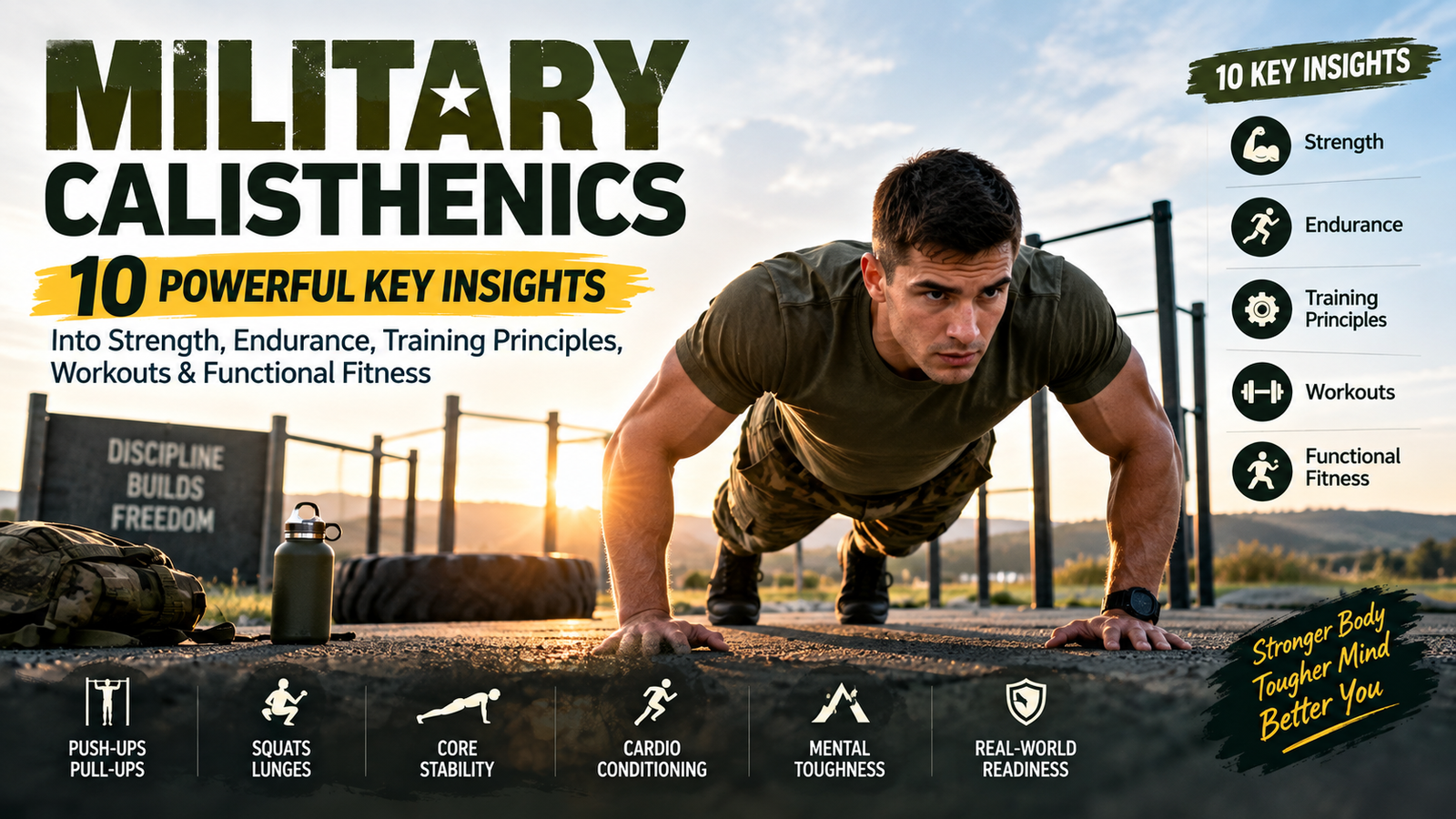
Military calisthenics is a bodyweight-focused training approach built around movements such as push-ups, pull-ups, squats, lunges, planks, dips, running, and core exercises. Its appeal comes from simplicity: you can develop substantial strength and conditioning with minimal equipment while training qualities that transfer well to everyday physical tasks.
Unlike bodybuilding programs that often emphasize individual muscles and machines, this style of training focuses heavily on movement patterns, muscular endurance, relative strength, coordination, and work capacity. Traditional military physical training has also emphasized consistency and readiness, although modern military fitness programs vary considerably by country, service branch, occupation, and training objective.
The most effective approach is not simply doing hundreds of repetitions. Good programming combines technique, progressive overload, recovery, aerobic conditioning, and appropriate intensity. That makes bodyweight training useful for beginners as well as experienced athletes.
What Is Military Calisthenics?
Military calisthenics refers broadly to structured bodyweight conditioning associated with military physical training. Common movements include push-ups, pull-ups, sit-ups or other trunk exercises, squats, lunges, burpees, mountain climbers, running, and loaded or unloaded carries depending on the program.
The underlying philosophy is straightforward: develop a body that can repeatedly perform fundamental movements under fatigue. A soldier, firefighter, outdoor athlete, or recreational trainee may all benefit from this concept, although their specific physical requirements are different. The emphasis is usually on practical conditioning rather than achieving a particular bodybuilding aesthetic.
A useful way to understand the method is to think of the body as an integrated system. A strong push-up requires more than the chest and triceps; the shoulders, trunk, hips, and legs help create a stable platform. Similarly, a pull-up combines grip strength, upper-back strength, elbow flexion, and trunk control. This whole-body involvement is one reason calisthenics remains popular.
Core Training Principles Behind Military-Style Conditioning
The foundation of military calisthenics is progressive overload. Because bodyweight is the primary resistance, progression can come from increasing repetitions, improving technique, adding sets, reducing rest periods, increasing range of motion, changing exercise difficulty, or eventually adding external resistance.
Consistency is equally important. A demanding workout performed once a week is less useful than a sustainable program repeated consistently. Military-style conditioning traditionally values regular physical preparation because endurance and strength decline when training becomes sporadic. For civilian trainees, the same principle applies without requiring extreme daily sessions.
Another important principle is movement quality. Performing 50 poorly controlled push-ups does not necessarily produce better results than performing fewer repetitions with a stable torso, controlled descent, and full range of motion. As the saying goes, “fatigue should challenge technique, not replace it.” Once form deteriorates significantly, reducing repetitions or adjusting the exercise is usually more productive.
The Most Important Exercises
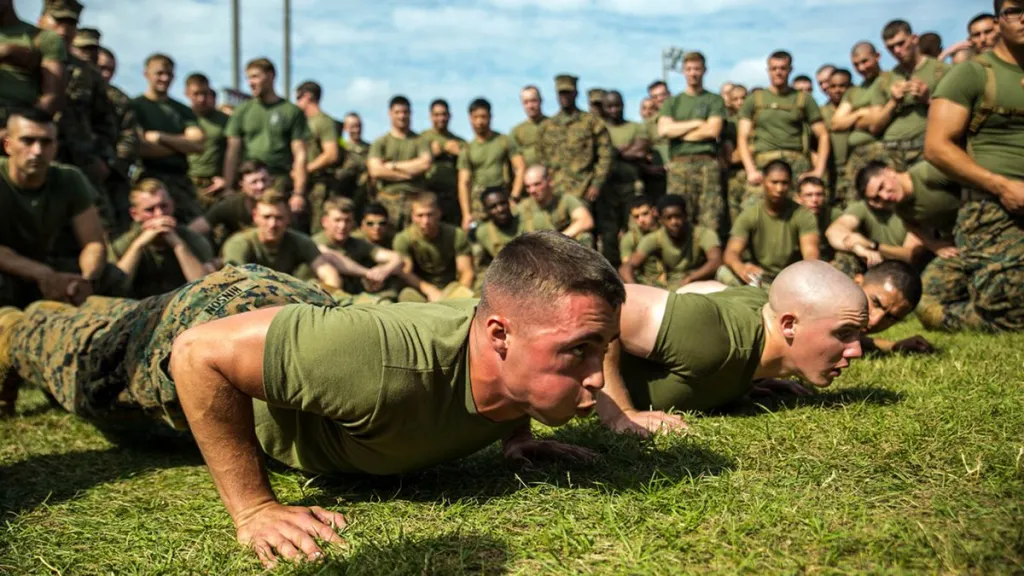
Push-ups are one of the defining movements of military calisthenics because they train horizontal pushing strength while requiring trunk stability. Standard push-ups can be progressed through tempo changes, pauses, elevated feet, close-grip positioning, or more demanding variations. Beginners can build capacity with an elevated surface before progressing toward floor repetitions.
Pull-ups provide the vertical pulling component that push-ups cannot supply. They develop the upper back, arms, grip, and trunk while requiring control of the entire body. People who cannot yet perform a full pull-up can begin with assisted repetitions, controlled negatives, or appropriate resistance-band variations.
Lower-body training is equally important. Bodyweight squats, reverse lunges, split squats, step-ups, and single-leg variations develop the hips, thighs, and lower legs. Running, jumping, and other conditioning movements can then add an endurance component. A balanced program therefore avoids becoming an upper-body repetition challenge and instead trains the entire kinetic chain.
| Exercise | Primary training quality | Useful progression |
|---|---|---|
| Push-up | Upper-body pushing endurance | Incline → standard → harder variations |
| Pull-up | Back and grip strength | Assisted → negative → full pull-up |
| Squat | Lower-body strength endurance | Squat → tempo → single-leg variations |
| Lunge | Unilateral leg strength | Reverse lunge → split squat |
| Plank | Trunk stability | Longer holds → harder variations |
| Burpee | Full-body conditioning | Controlled repetitions → increased pace |
| Running | Aerobic capacity | Easy running → intervals |
| Carry | Grip and whole-body stability | Light load → progressive load |
Building Strength Without Traditional Gym Equipment
One misconception about military calisthenics is that bodyweight training cannot produce meaningful strength gains. The reality is more nuanced. Beginners can become considerably stronger through basic movements because even simple exercises provide a significant training stimulus when they are new.
As adaptation occurs, however, endlessly increasing repetitions is not always the most efficient solution. Someone capable of performing very high numbers of standard push-ups may gain more from a harder variation than from adding another large set. Mechanical difficulty becomes an important form of progressive overload.
This is where advanced calisthenics techniques become useful. Feet-elevated push-ups, archer push-ups, pistol-squat progressions, harder pull-up variations, and controlled tempo work can increase difficulty without requiring sophisticated gym equipment. A weighted vest can also provide additional resistance when appropriate.
Endurance and Cardiovascular Conditioning
Strength alone does not define military-style fitness. Cardiovascular endurance allows the body to sustain physical work and recover between efforts. Running has traditionally been a major component of many military fitness assessments, but cycling, rowing, swimming, brisk walking, and other aerobic activities can also contribute to cardiovascular development.
A well-designed program separates different training intensities instead of turning every session into an all-out effort. Easy aerobic sessions build an endurance foundation, while shorter intervals can improve the ability to work at higher intensities. Combining these methods can produce better overall conditioning than repeatedly performing maximal workouts.
For example, a recreational trainee might use steady conversational-pace running on one day and a short interval session later in the week. Calisthenics circuits can provide another conditioning stimulus, particularly when exercises are performed continuously with controlled transitions.
Programming a Military Calisthenics Workout
An effective military calisthenics workout should have a clear purpose. A strength-focused session might emphasize pull-ups, push-ups, squats, lunges, and core work with adequate recovery between sets. A conditioning session could combine moderate repetitions of bodyweight movements with running or another cardiovascular activity.
Beginners should resist the temptation to copy advanced military fitness sessions immediately. Training volume must match current capacity. Someone who has not exercised regularly can develop excessive soreness or overuse symptoms by suddenly performing hundreds of repetitions. Progress should be gradual enough that the person can train again without being excessively fatigued.
A practical session structure is a warm-up, movement preparation, main strength work, conditioning, and a short cooldown. The exact duration depends on experience and goals. The important point is that every component has a purpose rather than simply accumulating exhaustion.
Military Calisthenics for Beginners
For beginners, the best starting point is mastering fundamental movement patterns. Incline push-ups, bodyweight squats, supported lunges, dead-bug variations, planks, assisted pull-ups, and easy aerobic work can establish the necessary foundation.
A beginner might perform several manageable sets rather than attempting one enormous circuit. For example, leaving a few technically sound repetitions in reserve can help maintain form and make recovery easier. Over time, repetitions can increase and easier variations can gradually be replaced with standard movements.
The problem many newcomers face is confusing discomfort with progress. Muscular effort is normal, but sharp pain, persistent joint pain, dizziness, or unusual symptoms should not be treated as proof of an effective workout. The solution is sensible progression, appropriate rest, and professional evaluation when symptoms are concerning.
Recovery, Mobility, and Injury Prevention
Training creates a stimulus; recovery is where the body adapts. Sleep, nutrition, hydration, rest days, and sensible training volume all influence performance. A person who continually increases workload without recovering may see declining performance despite working harder.
Mobility also deserves attention. Full-range movements require adequate joint control and flexibility, particularly around the shoulders, hips, ankles, and thoracic spine. Dynamic movement during warm-ups can prepare the body for exercise, while gentle mobility work can support comfortable movement outside training.
Injury prevention is not about eliminating all risk. It is about managing training stress intelligently. Sudden increases in running mileage, excessive repetition of one movement, poor technique, and inadequate recovery can all contribute to problems. Variety and gradual progression are valuable tools for keeping training sustainable.
Nutrition and Bodyweight Performance
Nutrition supports the physical demands of bodyweight conditioning. Adequate protein contributes to muscle repair and maintenance, while carbohydrates can provide useful fuel for demanding training sessions. Fats, micronutrients, and adequate hydration also contribute to normal physiological function.
Bodyweight athletes should be particularly aware of energy availability. If body mass changes dramatically, exercises such as pull-ups can become easier or harder because the athlete is effectively moving a different load. This makes bodyweight performance closely connected to strength-to-weight ratio.
A simple meal built around protein, whole-food carbohydrate sources, vegetables or fruit, and healthy fats can support general training needs. There is no requirement for an extreme diet to benefit from calisthenics.
Military Calisthenics Compared With Gym Training
Military calisthenics and resistance training in a gym are not mutually exclusive. Each can address different physical qualities. Calisthenics emphasizes relative strength, coordination, body control, muscular endurance, and movement efficiency, while barbells, dumbbells, and machines make it easier to apply precise external resistance.
For someone trying to improve a pull-up, for example, repeated pull-up practice is highly specific. For someone seeking maximum lower-body strength, progressively loaded squats or other resistance exercises may provide a more measurable progression. Combining approaches can therefore be practical when equipment and training goals allow it.
The important distinction is between the training method and the goal. A military-inspired workout can be excellent for conditioning without being the optimal standalone system for every athletic objective. Training should ultimately reflect the physical qualities a person actually wants to develop.
How to Progress Safely Over Time
Progression should be measurable. Track repetitions, sets, exercise variations, running distance, approximate pace, rest periods, or perceived effort. These simple records make it easier to determine whether fitness is actually improving rather than relying on how difficult a workout felt.
A useful progression might begin with improving technique, followed by increasing repetitions, then adding sets or moving to a more challenging variation. Once the new movement becomes comfortable, the process can repeat. This creates a gradual staircase rather than an abrupt jump in workload.
The goal of military calisthenics is not to make every workout brutal. Training that leaves you unable to perform normal activities for days is difficult to sustain. The more useful benchmark is whether you can train consistently, recover appropriately, and gradually perform more demanding work with good technique.
Common Mistakes and Better Solutions
One common mistake is chasing repetition records before establishing movement quality. High-volume push-ups, squats, or sit-ups performed with poor mechanics can reinforce inefficient movement patterns. Reducing the number of repetitions and improving control can make the exercise more productive.
Another mistake is treating every workout like a fitness test. Tests measure performance; training develops it. Constantly attempting maximum repetitions or maximum running speed can create unnecessary fatigue. A better approach alternates challenging sessions with easier work and recovery.
Skipping lower-body and pulling exercises is another frequent imbalance. A program dominated by push-ups and abdominal exercises may develop certain qualities while neglecting others. A complete routine should include pushing, pulling, squatting, hinging or hip-dominant work, locomotion, trunk stability, and cardiovascular conditioning.
Frequently Asked Questions
What is military calisthenics?
Military calisthenics is a bodyweight-centered approach to physical conditioning that commonly uses push-ups, pull-ups, squats, lunges, core exercises, running, and other functional movements. Its primary goals can include muscular endurance, relative strength, cardiovascular fitness, coordination, and physical work capacity.
Can military calisthenics build muscle?
Yes, particularly for beginners and intermediate trainees. Muscle growth occurs when muscles receive sufficient training stimulus, recovery, and nutrition. As a person becomes stronger, more difficult exercise variations or external resistance may be needed to continue providing an effective stimulus.
Is military calisthenics good for beginners?
Military calisthenics can be adapted for beginners by reducing exercise difficulty, repetitions, range of motion, or training volume. Incline push-ups, assisted pull-ups, supported lunges, bodyweight squats, and manageable aerobic conditioning can establish a foundation before progressing to more demanding exercises.
How often should I do military calisthenics?
Training frequency depends on experience, exercise selection, intensity, recovery, and other physical activities. Many people can benefit from several structured training sessions per week when workload is appropriate, while beginners may need additional recovery between demanding sessions.
Can military calisthenics replace weightlifting?
It can provide substantial strength and conditioning benefits, but it does not perfectly replicate every form of resistance training. Advanced strength goals may benefit from external loading, while calisthenics offers advantages in relative strength, body control, accessibility, and movement practice.
Does military calisthenics improve endurance?
Yes. Repeated bodyweight movements can improve muscular endurance, while running and other aerobic activities can develop cardiovascular endurance. Combining strength-endurance exercises with appropriately paced aerobic training creates a more complete conditioning program.
Conclusion
Military calisthenics is best understood as a practical training philosophy rather than a single workout. Its foundation is simple: master fundamental movements, develop relative strength, improve endurance, progress gradually, and build enough work capacity to perform consistently.
The biggest advantage is accessibility. Push-ups, squats, lunges, planks, pull-up progressions, running, and other bodyweight movements can create challenging training sessions without requiring a fully equipped gym. At the same time, experienced trainees can continue progressing through harder variations, external resistance, and more sophisticated programming.
The final insight is that effective military calisthenics does not depend on making every session exhausting. The real measure of successful training is sustainable improvement: stronger movements, better endurance, improved body control, sound technique, and the ability to recover and return for the next session.